What is young adult addiction treatment?
Young adult addiction treatment is care for substance use built around people in their late teens and twenties: detox when needed, residential or outpatient therapy, and family work. Once a person turns 18, they consent to their own treatment, and parents take part through the young adult’s written permission rather than by right.
What does the newest CDC survey show about senior year?
It shows the climb. The Centers for Disease Control and Prevention released results from its 2025 Youth Risk Behavior Survey on October 15, drawn from 10,710 usable questionnaires from high school students across the country. Current use, meaning at least once in the past 30 days, rises steeply with each grade: alcohol from 11.5% in ninth grade to 30.9% in twelfth, and marijuana from 7.4% to 18.1%. By senior year, 36.3% of students said they had used marijuana at least once, and 19.5% were currently using electronic vapor products.
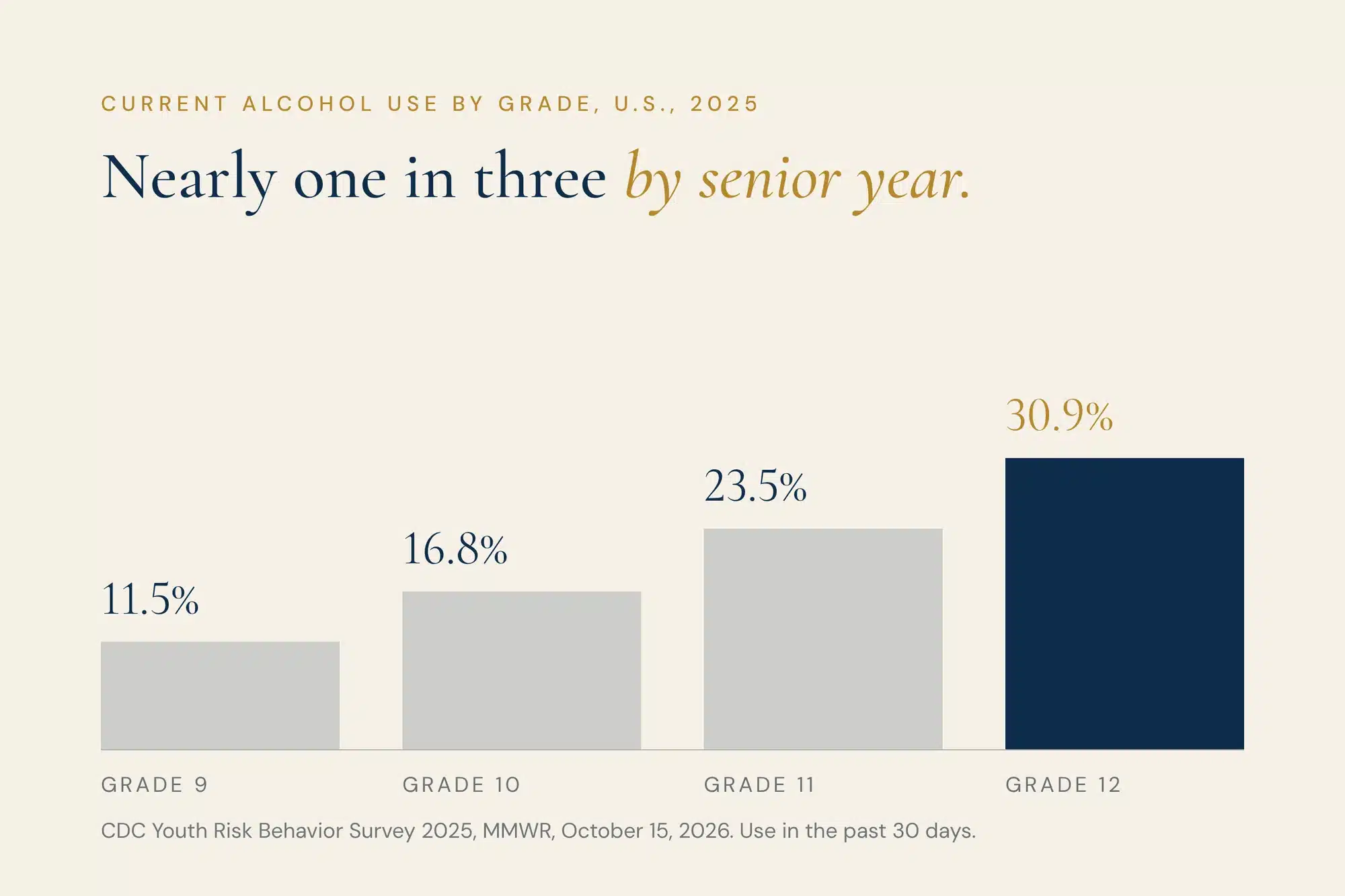
Two cautions keep these numbers honest. They are national figures, not Las Virgenes Unified figures, and the CDC notes that the overall response rate was 30.6%, the lowest in the survey’s history. A survey of teenagers is not a diagnosis of anyone. What the trend line explains is timing: for some families, the drinking or the cannabis use that started in eleventh grade is still there at nineteen, now in a person who signs their own consent forms.
What changes legally when a child turns 18?
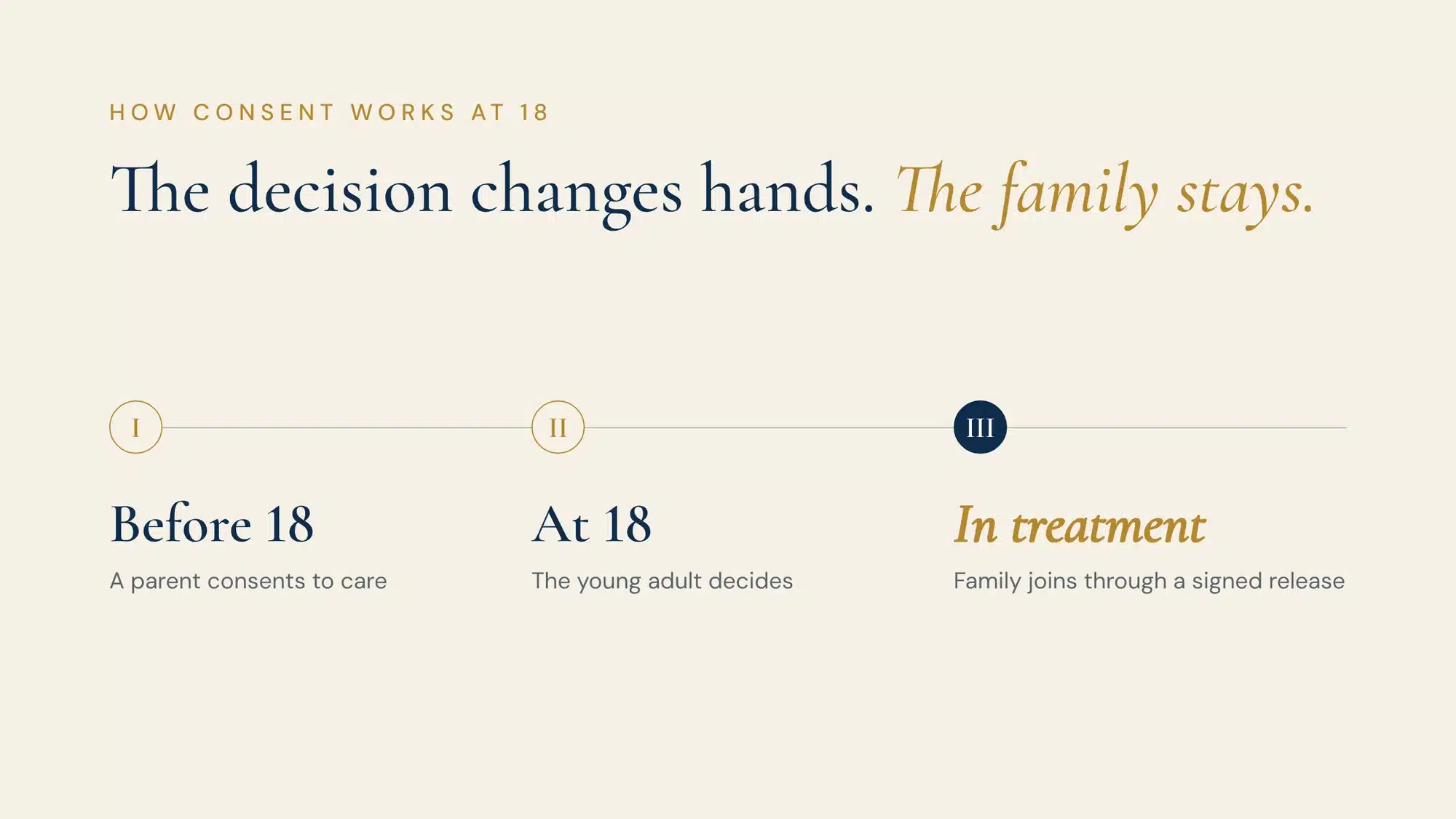
Mostly, who decides. The U.S. Department of Health and Human Services explains in its guidance on personal representatives that for adults, the person who can act on someone’s behalf for health information is whoever holds legal authority to make their health care decisions, such as an agent under a health care power of attorney or a court-appointed guardian. Being a parent is not, by itself, that authority once a child is an adult. The same guidance notes that family members involved in a person’s care can sometimes receive relevant information, but it is the exception, not a standing right.
Substance use treatment adds another layer. Federal confidentiality rules for addiction treatment records are stricter than ordinary medical privacy, which we explain in our guide to 42 CFR Part 2. In practice, a program will ask the young adult to sign a written consent naming who can be told what. Some families are surprised by that. It is better understood as protection: the same rule that keeps a parent out without permission keeps a school, an employer or a stranger out too.
Insurance, by contrast, often does not change at 18. Under federal rules summarized on HealthCare.gov, young adults can generally stay on a parent’s plan until they turn 26, whether or not they live at home. That matters because coverage tends to stay in the parent’s hands while the decision does not.
How do you get a young adult to agree to treatment?
By offering, not ordering. An eighteen-year-old who feels cornered has every reason to prove that nobody can make them do anything, and legally they are right. What tends to work is a calm, specific conversation at a quiet time: what you have seen, what you are worried about, and one or two concrete options already looked into. Our guide on how to talk to a loved one about getting help has the language, and when a loved one refuses treatment covers what to do if the first answer is no.
“Parents usually arrive ready to manage the problem. What helps more is learning to be in the room as a parent of an adult: asking, listening, and letting your son or daughter own the decision. That shift is often where the family work begins.”
Karen Lakritz, AMFT, Associate Marriage and Family Therapist, My Limitless Journeys
It helps to separate the conversation about treatment from the conversation about money and rules at home. Both may be needed. Mixed together, the second usually swallows the first.
What does young adult addiction treatment look like?
It looks like the full continuum, with more attention to structure. Many young adults arrive without a daily shape to their lives: school has ended or stalled, work is uncertain, and the substance has been filling the gap. Good care rebuilds that shape while treating whatever sits underneath the use, which at this age is often anxiety, depression, ADHD or trauma that has never been named. Our page on failure to launch describes the stalled version of this pattern directly.
For families in Calabasas, Hidden Hills and the Las Virgenes area, addiction treatment for Calabasas families runs from detox through six-bed residential care, partial hospitalization, intensive outpatient and alumni support, all with one clinical team at our licensed residence in Encino, about fifteen to twenty minutes east on the 101. There is no MLJ facility in Calabasas itself. The short drive is clinical, not just convenient: it lets parents attend family therapy in person each week instead of dialing in.
“At eighteen, the person in treatment decides who hears what. Most young adults do want their parents involved once they feel the choice is genuinely theirs, so we ask about family consent early and revisit it, rather than treating it as a box ticked at intake.”
Maria Dahlman, MA, LCSW, Regional Clinical Director, Emend Healthcare
What should parents ask a program before admission?
Ask how the program handles consent with young adults, and listen for a real answer. Questions worth putting to any program, including ours:
- 1Who signs the consent forms, and what can we be told without them?
- 2How are parents included in family sessions, and how often?
- 3How are school or work, and the return to them, planned from the start?
- 4How is a co-occurring condition such as anxiety, depression or ADHD assessed and treated?
- 5What happens if our son or daughter wants to leave early?
For the wider picture of how the levels of care fit together, the Calabasas overview sets out both local services side by side, and the Calabasas addiction treatment page covers insurance verification and the first call.
Frequently asked questions
Can I make my 18-year-old go to rehab?
Generally, no. Outside of a medical or psychiatric emergency, an adult decides whether to enter treatment. Parents still have real influence: a calm, specific invitation, options already researched, and clear limits at home. If someone is in immediate danger, call 911, and in a mental health or substance use crisis, call or text 988.
Will we be told how our son or daughter is doing in treatment?
Only what the young adult agrees to in writing. Addiction treatment records have stricter federal privacy protection than most medical records. Many young adults do sign a release for their parents once they feel the choice is theirs, and programs can explain exactly what each consent allows.
Does a parent’s insurance still cover treatment after 18?
Often, yes. Federal rules let young adults generally stay on a parent’s health plan until age 26, whether or not they live at home or are in school. Benefits for detox, residential and outpatient care vary by plan, so verify coverage before admission.
Is residential treatment too much for a first episode?
It depends on the clinical picture, not the age. Some young adults do well in intensive outpatient care while living at home; others need the structure and distance of residential care to stop using safely. The level of care should come from an assessment, not from a guess on either side.
If your son or daughter has just turned 18 and the drinking or drug use came along, you can talk through the options with our team first. A confidential call covers consent, levels of care and coverage, and it commits no one.
This article is general information, not a diagnosis or a substitute for an assessment by a clinician. If someone is in immediate danger, call 911. In a mental health or substance use crisis, call or text 988.
Sources
- Pampati, S., et al. “Urban-Rural and Demographic Differences in Substance Use Among High School Students, Youth Risk Behavior Survey, United States, 2025.” MMWR Supplements 75(1):54 to 66, Centers for Disease Control and Prevention, October 15, 2026. cdc.gov
- Mpofu, J. J., et al. “Overview and Methods for the Youth Risk Behavior Surveillance System, United States, 2025.” MMWR Supplements 75(1):1 to 11, Centers for Disease Control and Prevention, October 15, 2026. cdc.gov
- U.S. Department of Health and Human Services, Office for Civil Rights, “Personal Representatives,” HIPAA Privacy Rule guidance. hhs.gov
- HealthCare.gov, “Health coverage for children and young adults under 26.” Centers for Medicare and Medicaid Services. healthcare.gov
Every article on this site is written by our editorial team and reviewed by a licensed clinician. Read how we write and review content.
Keep reading: Addiction treatment serving Calabasas · Failure to launch · Family confidentiality in rehab · Is your adult child burned out, or using?