
What is kindling in alcohol withdrawal?
Kindling is the pattern in which repeated alcohol withdrawals tend to grow more severe over time. Each episode appears to sensitize the brain, so a person who has quit and restarted many times can face a higher risk of seizures and complicated withdrawal than on the first attempt, even if the drinking itself has not increased.
Where does the idea of kindling come from?
The term comes from brain research, not addiction medicine. In 1969, researchers led by Goddard found that a weak stimulus to the brain, one that at first caused no visible effect, could trigger seizures once it had been repeated enough times. The brain had learned to overreact. In 1978, psychiatrists Ballenger and Post proposed that alcohol withdrawal might work the same way: each withdrawal episode could leave the brain more excitable, so later withdrawals arrive faster and harder.
Howard Becker, writing in the National Institute on Alcohol Abuse and Alcoholism’s journal, reviewed the evidence in 1998. His summary still frames how clinicians think about the problem. The progression appears to come from the repeated withdrawals themselves rather than from alcohol exposure alone, though both may contribute, and the pattern shows up in animal studies and in patients alike.
What does the research show about repeated detoxes?
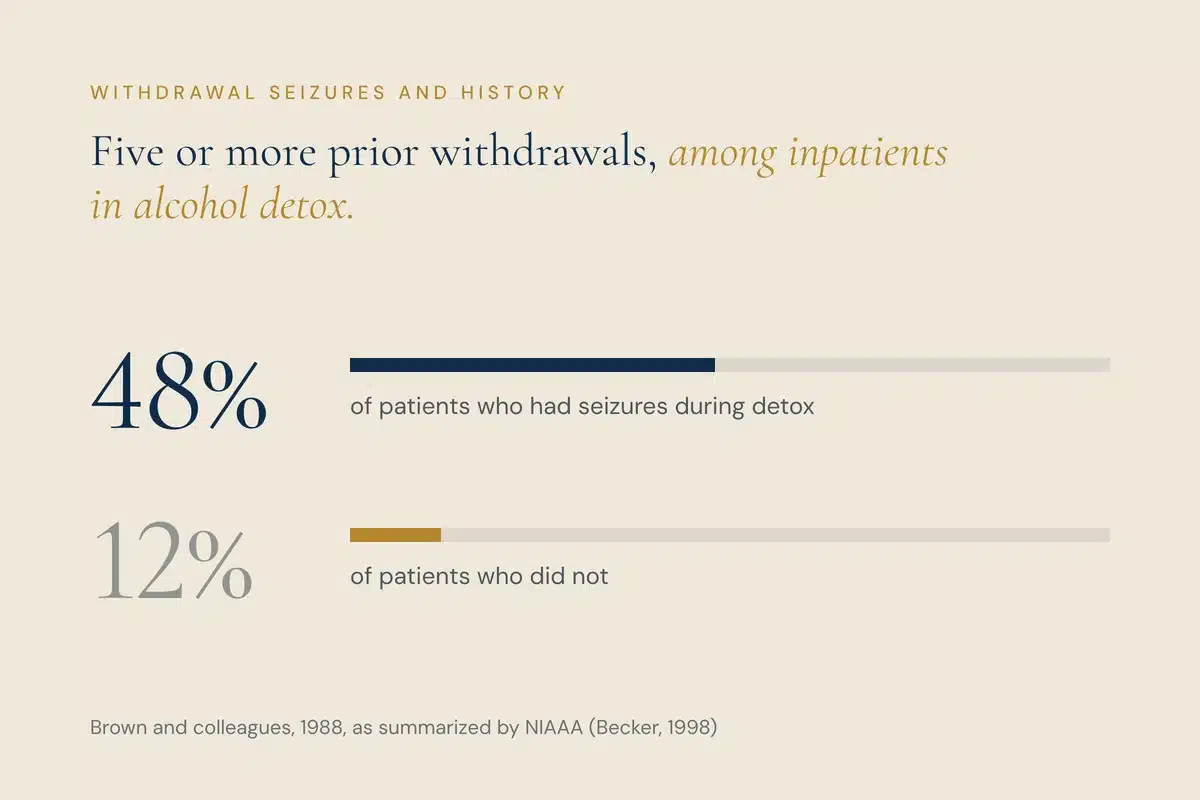
The clinical studies Becker describes point in one direction. In a 1988 study by Brown and colleagues, 48 percent of hospitalized patients who had seizures during alcohol detox had been through five or more previous withdrawal episodes, compared with 12 percent of hospitalized patients who had no seizures. Later studies also linked withdrawal seizures to a history of prior detoxifications.
A larger Veterans Affairs study of 6,818 men treated at 172 hospitals, published in 1993, found that a history of detox was associated with more severe withdrawal and a higher chance of readmission. It did not find that prior detox significantly changed the risk of dying from a seizure, a reminder that the evidence is about severity and complications rather than a fixed timeline. Animal studies add the cleanest signal: mice with earlier withdrawal experience had more severe withdrawal seizures than mice going through it for the first time.
None of this means every person who has quit before will have a seizure next time. It means that history matters, and that “I got through it last time” is not the reassurance it sounds like.
What does a kindling pattern look like to a family?
It rarely looks like a medical event. It looks like a person who stops on a Sunday, shakes and sweats through Monday, feels anxious and sleepless by Tuesday, and has a drink by Wednesday to make it stop. A month or a season later, they try again. Each time the shakes may come sooner, the sleeplessness may run longer, and the drink that ends it may come earlier.
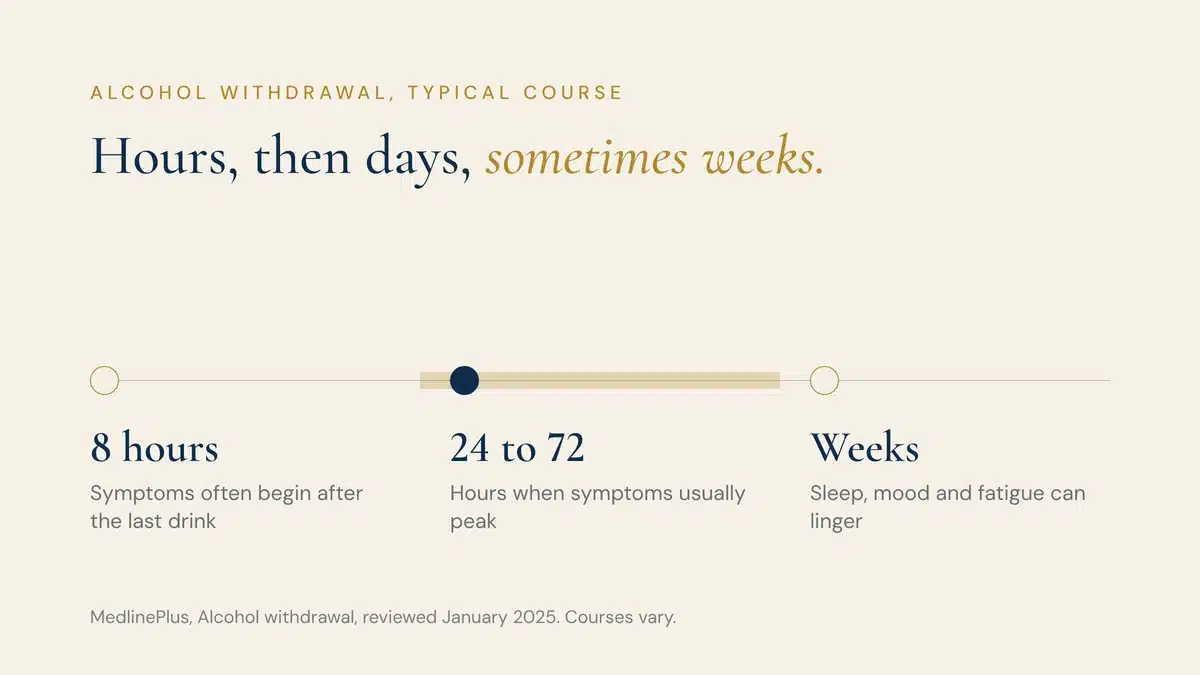
MedlinePlus describes the usual course: symptoms often begin within 8 hours of the last drink, though they can start days later, peak at 24 to 72 hours, and can last for weeks. Delirium tremens, the most severe form, can bring sudden confusion, fever, hallucinations and seizures. For someone with many past withdrawals, that window deserves a clinician watching it, not a family member hoping for the best.
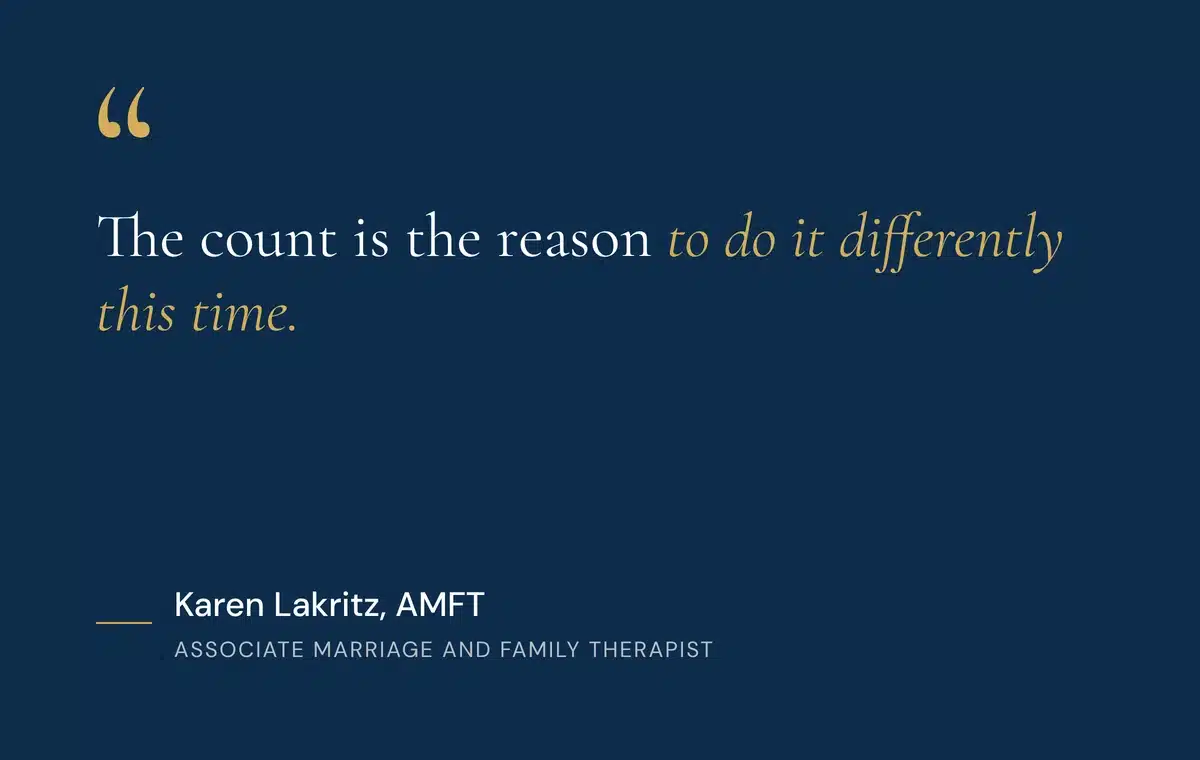
“Families often count the times their person has quit as proof they can do it again. I understand why. But the count is the reason to do it differently this time, with medical support and a plan for the weeks after.”
Karen Lakritz, AMFT, Associate Marriage and Family Therapist, My Limitless Journeys
Why is another weekend detox not the answer?
Because it adds one more withdrawal to the count without changing what drives the drinking. The American Society of Addiction Medicine’s alcohol withdrawal guideline makes the point directly: withdrawal management should be treated as one part of starting treatment for alcohol use disorder, not as a separate service that ends when the shaking stops.
That matches what MedlinePlus says about treatment settings. People with moderate to severe symptoms may need inpatient care with close monitoring of vital signs, fluids and medication until withdrawal is complete. Mild symptoms can sometimes be managed at home, but only with a companion present and usually daily visits with a provider until the person is stable. A history of many withdrawals, past seizures or past delirium tremens moves most people out of the home category.
For families weighing what comes next, alcohol rehab for Los Angeles families at My Limitless Journeys begins with medically supervised withdrawal in a private bedroom and continues in the same house with the same team. The goal is to make this the last withdrawal rather than the next one.
“Most people who come to us for alcohol have quit before, sometimes many times. We plan admission around the last drink, so they are already here, with staff and a private room, before the first hard night begins.”
Casey Flores, RADT, Retreat Manager, My Limitless Journeys
How does supervised withdrawal change the pattern?
It replaces a cycle of stopping and restarting with one planned stop. In a supervised setting, withdrawal is treated with medication before it escalates, vital signs are watched through the first days, and vitamins depleted by heavy drinking are replaced. Our hour by hour alcohol withdrawal timeline explains what clinicians look for in each phase, and our guide to medical detox versus quitting at home sets out who can safely do which.
What happens after detox matters just as much. Residential treatment, typically 30 to 90 days at our residence, gives the brain time to settle and gives the person time to work on why they drank: the anxiety, the grief, the calendar built around alcohol. Step-down care through partial hospitalization and intensive outpatient treatment follows, so the first weeks back in Los Angeles life are not faced alone. Our detox and residential program and relapse prevention program describe that continuum.
Where should a Los Angeles family start?
Start by counting, honestly. How many times has your person tried to stop in the past year? What happened on the second and third days? Was there ever confusion, a fall, or a seizure? Those answers help a clinician judge risk, and they are the first questions our admissions team will ask. You can read more on our page about private alcohol rehab in Los Angeles, see every level of care on the Los Angeles location overview, or start with a confidential insurance check. If you would rather begin anonymously, SAMHSA’s free National Helpline, 1-800-662-4357, refers callers to treatment in any state.
Frequently asked questions
Does kindling mean my next withdrawal will cause a seizure?
Not necessarily. Kindling raises the likelihood of more severe withdrawal, including seizures, but it does not predict any one person’s course. What it does mean is that past withdrawals are a risk factor, and that a clinician should assess the history before anyone decides to stop drinking at home.
Does the effect of past withdrawals ever wear off?
The research does not give a reliable answer. Studies show that prior withdrawals are linked to more severe later ones, but they do not show how long that sensitivity lasts. The safest approach is to treat every past withdrawal, especially any with seizures or confusion, as part of the medical history.
Is it safe to taper off alcohol at home?
For some people with mild symptoms and no history of complicated withdrawal, outpatient care can work, with a companion present and frequent provider visits. For someone with many past withdrawals, prior seizures or delirium tremens, or serious medical problems, supervised withdrawal is the safer choice.
How long is alcohol rehab after detox?
It depends on the person. At our Encino residence, residential treatment typically runs 30 to 90 days, followed by partial hospitalization, intensive outpatient care and alumni support. Our guide to 30, 60 and 90 day programs explains how that length is decided.
If your family has watched someone quit and restart more than once, talk with us about supervised alcohol detox and the treatment that follows it.
This article is general information, not a diagnosis or a substitute for an assessment by a clinician. If someone is in immediate danger, call 911. In a mental health or substance use crisis, call or text 988.
Sources
- Becker HC. “Kindling in Alcohol Withdrawal.” Alcohol Health and Research World, 1998;22(1):25 to 33. National Institute on Alcohol Abuse and Alcoholism. pubs.niaaa.nih.gov (PDF)
- MedlinePlus Medical Encyclopedia, “Alcohol withdrawal,” U.S. National Library of Medicine, reviewed January 1, 2025. medlineplus.gov
- American Society of Addiction Medicine, Clinical Practice Guideline on Alcohol Withdrawal Management. asam.org
- SAMHSA, National Helpline, 1-800-662-HELP (4357). samhsa.gov
Every article on this site is written by our editorial team and reviewed by a licensed clinician. Read how we write and review content.
Keep reading: Alcohol rehab for Los Angeles families · Alcohol withdrawal timeline · Signs of a high-functioning alcoholic · Holiday drinking when you have been cutting back