

Is detox medically necessary?
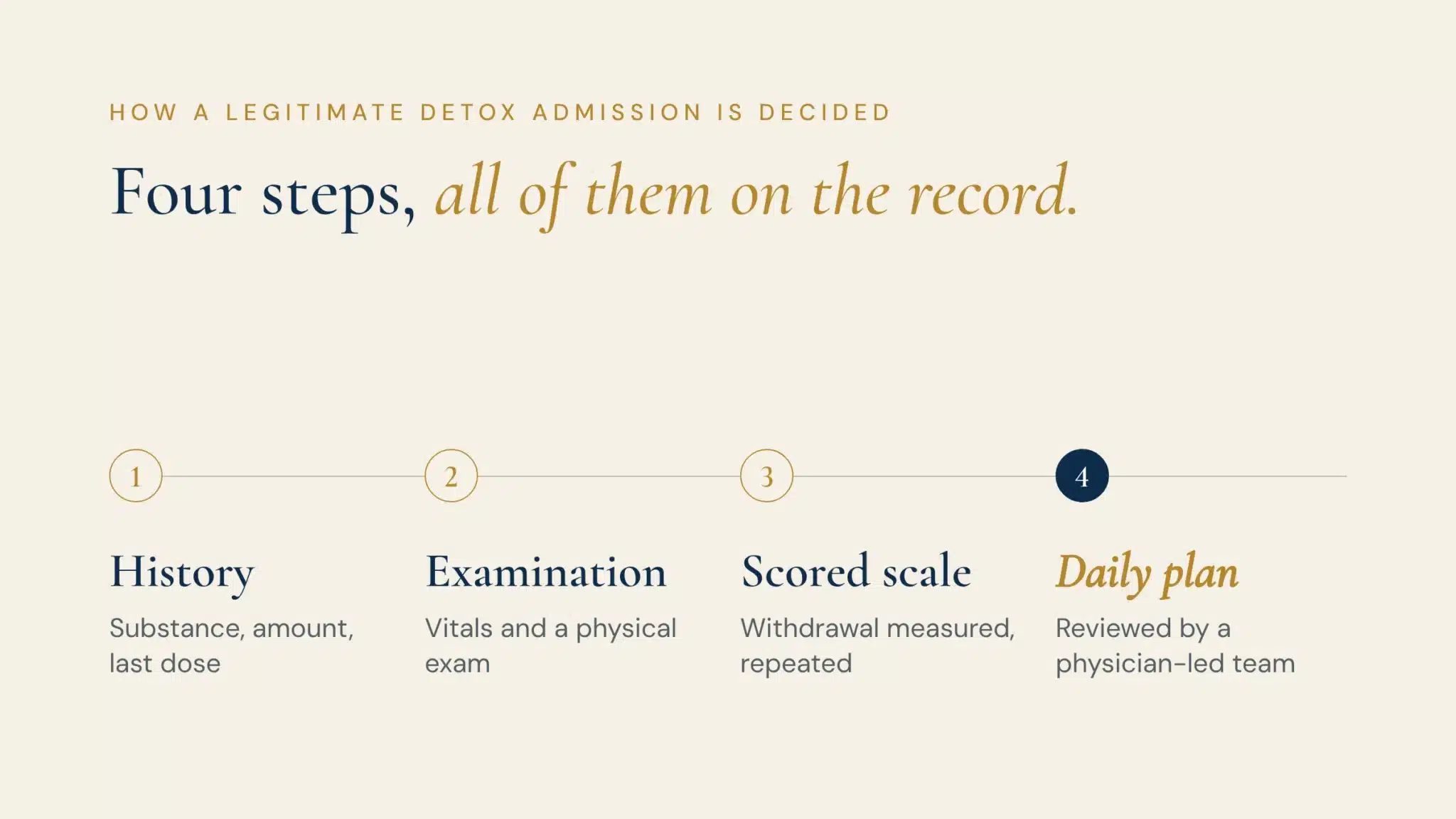
Detox is medically necessary when stopping a substance would bring on withdrawal that is dangerous, or severe enough to need monitoring and medication. A clinician decides that from the substance, the amount, how long it has been used, past withdrawals and the signs in front of them, measured on standard scales. A script cannot decide it.
What the Los Angeles charges describe
On October 22, the U.S. Department of Justice announced charges against 15 defendants in a Los Angeles health care fraud takedown. The largest piece involves a father and son, Nathan and David Young, who prosecutors say controlled dozens of purported substance abuse treatment companies in the Los Angeles area and elsewhere, with two co-defendants from Texas acting as “body brokers.” The department says the companies billed private insurers more than $1.6 billion, the largest case of its kind it has prosecuted.
The details are what matter to a family. According to the release, employees coached patients to fabricate symptoms so they would be eligible for detox, and some patients were encouraged to use drugs or alcohol in order to qualify. Patients were recycled through facilities to keep billing, whether or not treatment was necessary or delivered, and some who tried to leave were allegedly drugged. An area manager for several of the detox facilities has pleaded guilty to helping submit $199 million in fraudulent claims. The others are charged, not convicted, and are presumed innocent.
Patient brokering, the recruiting half of this story, is covered in our guide to how families spot patient brokering in California. This article is about the clinical half: what actually makes a detox admission necessary, and how to tell a measured decision from a coached one.
Who actually needs medically supervised detox?
The short answer is people whose bodies have adapted to a substance enough that stopping it will cause withdrawal that is unsafe or unmanageable without help. The substance matters a great deal.
Alcohol. According to MedlinePlus, alcohol withdrawal symptoms usually begin within 8 hours of the last drink, tend to peak by 24 to 72 hours and can go on for weeks. Its most severe form, delirium tremens, is a medical emergency, and MedlinePlus notes that moderate to severe withdrawal may need treatment in a hospital or another facility that treats it.
Benzodiazepines. After sustained daily use, stopping abruptly can cause seizures. These are tapered slowly under supervision, never stopped cold.
Opioids, including fentanyl. Withdrawal is rarely life threatening by itself, but it can be severe, and untreated it is one of the most reliable routes back to use. Medication makes it manageable, and the timing of that medication is a physician’s call.
Stimulants. The crash after cocaine or methamphetamine is mostly psychiatric: exhaustion, low mood and, for some people, dangerous thoughts. It calls for close watching, but not always a detox bed.
Beyond the substance, clinicians weigh the daily amount, how long it has been used, the time since the last dose, what happened during any previous withdrawal (a past seizure changes everything), other medications, medical and psychiatric conditions, and whether the person has a safe place to go afterward.
How do clinicians measure withdrawal?
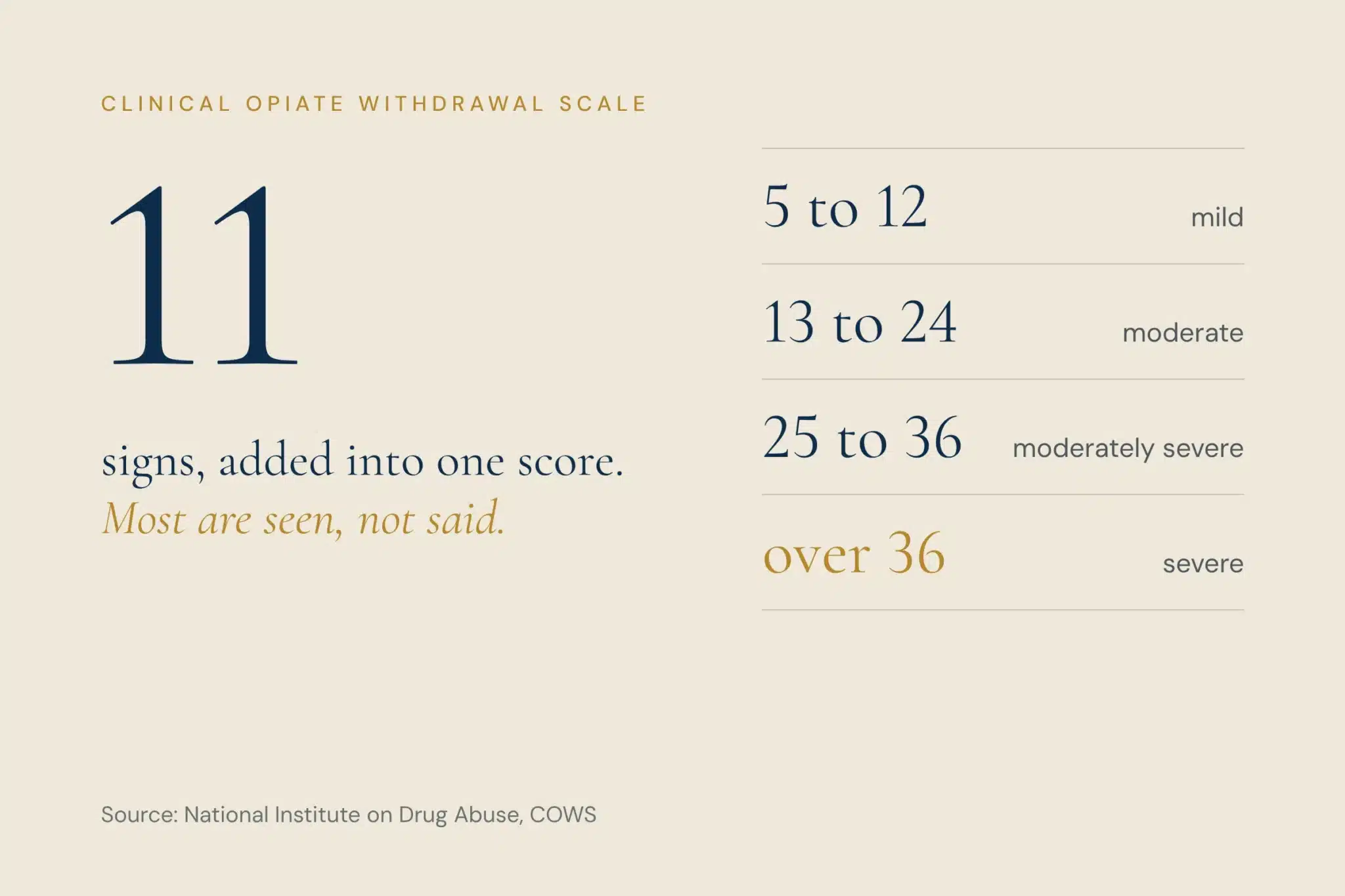
They score it. The Clinical Opiate Withdrawal Scale, published by the National Institute on Drug Abuse, adds up 11 items: resting pulse, sweating, restlessness, pupil size, bone or joint aches, runny nose or tearing, stomach upset, tremor, yawning, anxiety or irritability, and gooseflesh. A total of 5 to 12 is mild, 13 to 24 moderate, 25 to 36 moderately severe and anything above 36 severe. Alcohol withdrawal is scored with a similar structured tool.
Notice what most of those items are. A pulse rate, pupil size, gooseflesh, a visible tremor: these are things a clinician observes, not things a patient reports. That is the point of the scale, and it is why a coached story on the phone should never be enough to admit anyone. The scoring is repeated through the day and night, and the medication plan follows the scores.
“On a detox night the job is to keep checking: pulse, blood pressure, sweating, tremor, sleep. If someone is getting worse, the nurse and the physician hear about it that hour, not at the morning meeting.”
Brianna Ayles, RADT, Behavioral Health Technician, My Limitless Journeys
What does a coached detox admission look like?
None of these proves fraud by itself. Two or more together are a reason to stop and verify before anyone is admitted, or to get someone out if they are already there.
- 1Someone tells the person what symptoms to describe, or what to say about how much they use.
- 2The person is encouraged to drink or use before arriving so they will “qualify.”
- 3Admission happens without vital signs, a physical examination or questions about past withdrawal.
- 4Everyone seems to get the same length of stay, whatever the substance.
- 5The same person goes through detox again and again, weeks apart, at related programs.
- 6Phones, belongings or contact with family are cut off, and leaving is discouraged or blocked.
- 7Nobody can describe the plan for the day detox ends.
Can someone need treatment but not detox?
Yes, often. Level of care is decided by a multidimensional assessment, and the ASAM Criteria are the framework most programs use to match a patient to the right level. Withdrawal risk is one of six dimensions, not the whole picture. A person whose use is serious but who is not physically dependent may need residential or outpatient treatment and no detox at all. Our page on the six ASAM dimensions walks through the rest.
“Sometimes the honest answer on an assessment is that a person does not need detox. They may still need treatment, and we would rather say that plainly than fill a bed.”
Maria Dahlman, MA, LCSW, Regional Clinical Director, Emend Healthcare
How can a family check a detox program?
Start with the license. The California Department of Health Care Services publishes a list of every licensed and certified residential and outpatient program, alphabetical by county. Ask the program for its legal name and license number and find both on the list. Then ask three clinical questions: who does the assessment on arrival, how withdrawal will be scored and how often, and what happens on the day detox ends.
If something already feels wrong, DHCS takes complaints about licensed programs online, by email at sudcomplaints@dhcs.ca.gov or at (877) 685-8333. To find legitimate care anywhere in the country, the SAMHSA National Helpline at 1-800-662-4357 is free, confidential and open around the clock in English and Spanish.
How detox is decided at our Encino residence
We hold ourselves to the test above. Detox in Encino begins with a medical and psychiatric assessment on arrival: what has been used, how much, for how long, the last dose, other medications and every previous withdrawal. Withdrawal is scored on a schedule, the plan is reviewed daily by a physician-led team, and it happens in a private bedroom in our six-bed home. Our license is DHCS 191135CP; look it up.
“A symptom you were told to describe is not a symptom. Withdrawal is something we measure, at the bedside, more than once, and the plan changes when the numbers do.”
Maria Dahlman, MA, LCSW, Regional Clinical Director, Emend Healthcare
When the assessment says detox is not needed, we say so and talk about what is. When it is needed, residential care follows in the same house with the same team, which is how our detox and residential program is built. For the neighborhood and the residence itself, see our Encino location, and for what the first week inside actually involves, read what medically supervised detox in Encino looks like. Our explainer on what “medically supervised” should mean covers the standard any program should meet.
Frequently asked questions
Can you go to detox if you are not in withdrawal yet?
Yes. Many people are admitted before symptoms start, because the clinical team knows withdrawal is coming from the history: the substance, the daily amount and the time of the last dose. What matters is that the expected withdrawal is real and documented, and that someone examines the person and scores symptoms as they appear.
How long does medically supervised detox take?
It depends on the substance. Many detoxes run several days to about a week, while benzodiazepine tapers can take considerably longer. A program that assigns the same length to everyone, regardless of what was used and how the person responds, is worth questioning before admission.
Does insurance pay for detox if it is not medically necessary?
It should not. Insurers generally require documentation that a level of care is medically necessary, which is one reason a coached admission is fraud and not a shortcut. If you receive an explanation of benefits for services that were not provided, report it to the insurer and keep the paperwork.
What should I do if a program told someone to use before admission?
Treat it as a serious warning sign and do not go. Using more to qualify for a bed adds risk with no clinical benefit. Ask for the program’s license number, report it to DHCS, and use the SAMHSA National Helpline to find a licensed program that assesses first.
Ask us how an admission is decided before you decide anything. Who assesses, how withdrawal is measured, and what happens on the day detox ends, answered plainly.
Begin a conversation · (866) 209-4246 during business hours · Verify your benefits
This article is general information, not a diagnosis or a substitute for an assessment by a clinician. If someone is in immediate danger, call 911. In a mental health or substance use crisis, call or text 988.
Sources
- U.S. Department of Justice, Office of Public Affairs. “Los Angeles Health Care Fraud Takedown Results in Charges Against 15 Defendants, Including 6 Medical Professionals, Nearly $2 Billion in Loss,” October 22, 2026. justice.gov
- MedlinePlus Medical Encyclopedia, “Alcohol withdrawal,” National Library of Medicine, reviewed January 2025. medlineplus.gov
- National Institute on Drug Abuse, Clinical Opiate Withdrawal Scale (COWS). nida.nih.gov
- American Society of Addiction Medicine, “About the ASAM Criteria.” asam.org
- California Department of Health Care Services, Directories for Substance Use Disorder Services. dhcs.ca.gov
- California Department of Health Care Services, Licensing and Certification Complaints. dhcs.ca.gov
- SAMHSA National Helpline. samhsa.gov
Every article on this site is written by our editorial team and reviewed by a licensed clinician. Read how we write and review content.
Keep reading: Detox in Encino · What medically supervised detox actually means · Patient brokering in California rehab · Medical detox vs. quitting at home