
What is patient brokering?
Patient brokering is paying, or being paid, to steer a person into addiction treatment. A recruiter offers free travel, housing or cash, delivers the person to a program that bills their insurance, and collects a fee per admission. It is illegal under federal law and California law, and it usually ends when the coverage does.
What happened in the San Fernando Valley this fall
On October 29, MindSite News republished an investigation by The Frontier and The Curbside Chronicle, two Oklahoma nonprofit newsrooms, into recruiters who bring Oklahomans to Southern California for treatment. One couple, told by a friend about a program that offered housing and new clothes, travelled roughly 1,400 miles in the spring of 2024 to a detox run out of a mansion in the San Fernando Valley. They describe care that was mostly medication and occasional check-ins, followed by months of moves between outpatient programs and sober living homes, with group therapy over Zoom.
According to the reporting, their insurance was billed about $440,000 and the providers were paid about $72,000. When it was over, staff would not help arrange a ride home, and the couple bought bus tickets with a monthly disability payment. In August, Blue Cross Blue Shield of Oklahoma sued dozens of providers in federal court, alleging fraudulent enrollment and inflated or fake claims involving more than $20 million. Those are allegations, and the providers named have not been found liable. The pattern, though, is not new. Oklahoma Watch reported in 2025 that more than 880 Oklahomans were allegedly recruited to facilities in California and Arizona between 2020 and 2025.
We are a six-bed residence in Encino, a few miles from where that detox operated. Families from across the San Fernando Valley and well beyond it call us every week, and some of them have already heard a pitch like this one. What follows is how the pitch works and how to check any program before you accept it.
How a brokered admission usually works
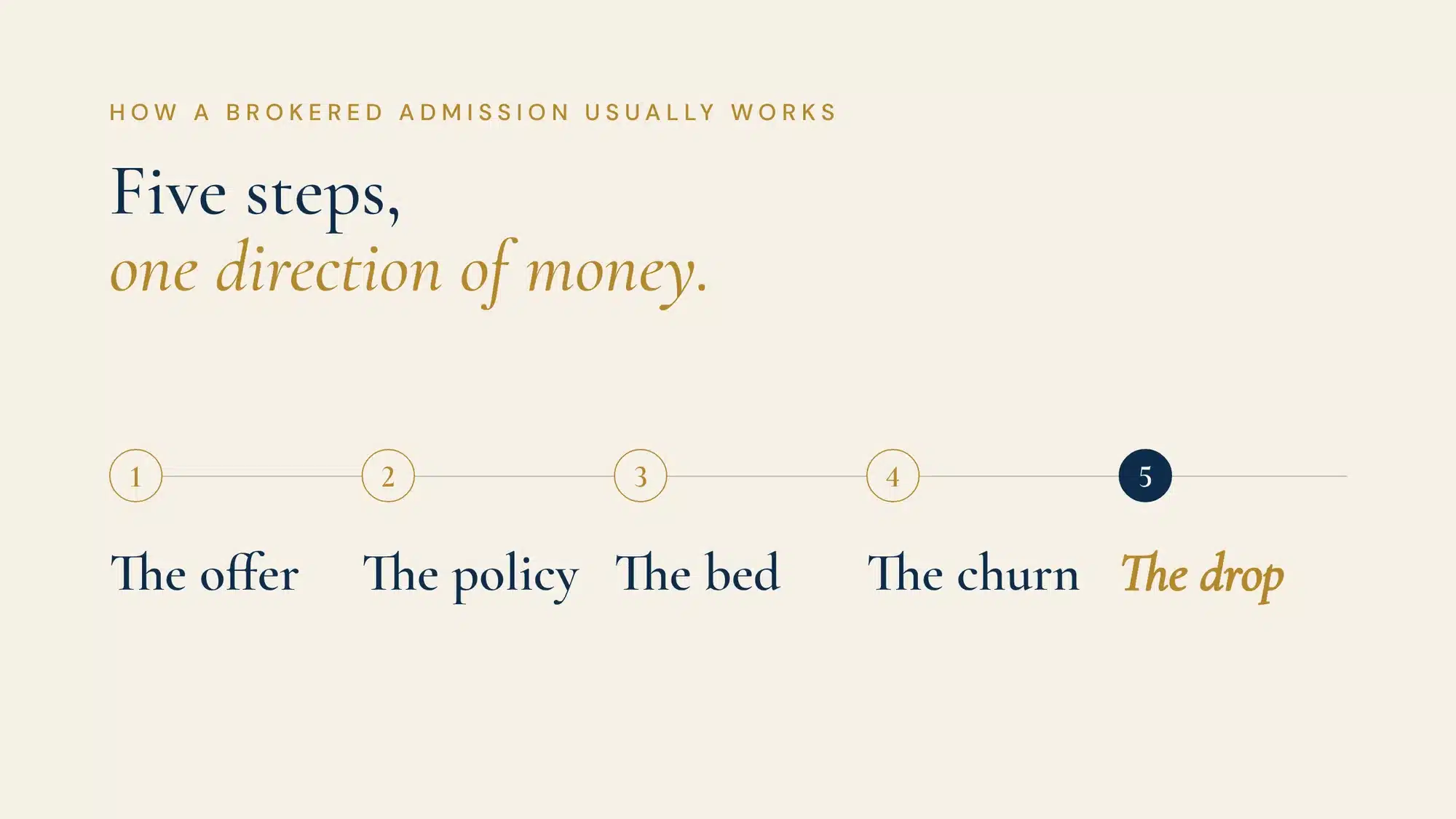
The reporting from Oklahoma and California describes the same sequence again and again.
- The offer. A recruiter, often a friend of a friend or a stranger met online, promises a flight, a place to live and a bed in a nice house in California.
- The policy. According to the lawsuits described by Oklahoma Watch, recruits were coached to misstate their income so they would qualify for a marketplace policy that pays out-of-state claims.
- The bed. A short detox stay, light on therapy and heavy on billing. The recruiter is paid when the person arrives.
- The churn. Moves between outpatient programs and sober living homes for as long as claims are paid.
- The drop. Coverage stops, and so does the help, often with no discharge plan and no way home.
The tell is in step one. Real treatment begins with an assessment of the person. A brokered admission begins with an assessment of the policy.
Seven red flags on the first call
None of these proves fraud on its own. Two or more together mean you should stop and verify before anyone travels.
- 1Free flights, free rent, cash, gift cards or a phone offered for coming in.
- 2“You will never pay a thing,” promised before anyone has checked your benefits. Under federal and California law, providers may not promise in advance to waive your out-of-pocket costs as a way to recruit you.
- 3An offer to buy, switch or “fix” your insurance so you can be admitted.
- 4Pressure to travel today, before any clinician has assessed you.
- 5No license number or legal business name when you ask for it.
- 6A caller who cannot say which facility they work for, or who works for “a network of programs.”
- 7No clear answer to a simple question: what happens on the day the coverage ends?
“A legitimate program does not need to fly you anywhere or find you an apartment to earn your admission. If the first thing you hear is what you will get for free, ask for the license number instead.”
Garrett Braukman, Executive Director, SoCal West Region, Emend Healthcare
What the law says about paying for referrals
Federal law makes it a crime to knowingly pay or receive anything of value for referring a patient to a recovery home, clinical treatment facility or laboratory. Under 18 U.S.C. § 220, passed in 2018 as part of the federal response to the opioid crisis, each offense can bring a fine of up to $200,000, up to ten years in prison, or both.
California went further the same year. SB 1228 bars licensed and certified programs, their owners and their staff from giving or receiving anything of value for a referral, with suspension or revocation of the license as the penalty. A companion law, SB 992, requires programs to disclose any financial interest in sober living homes, and AB 3162 requires licensed services to be delivered at the licensed facility. That last rule matters more than it sounds: if a program describes detox “at the house” and the house is not the address on the license, ask why.
How to check a California program before anyone travels
You do not need a lawyer or an insider. You need a pen, the program’s legal name and about fifteen minutes.
1. Find it on the state list
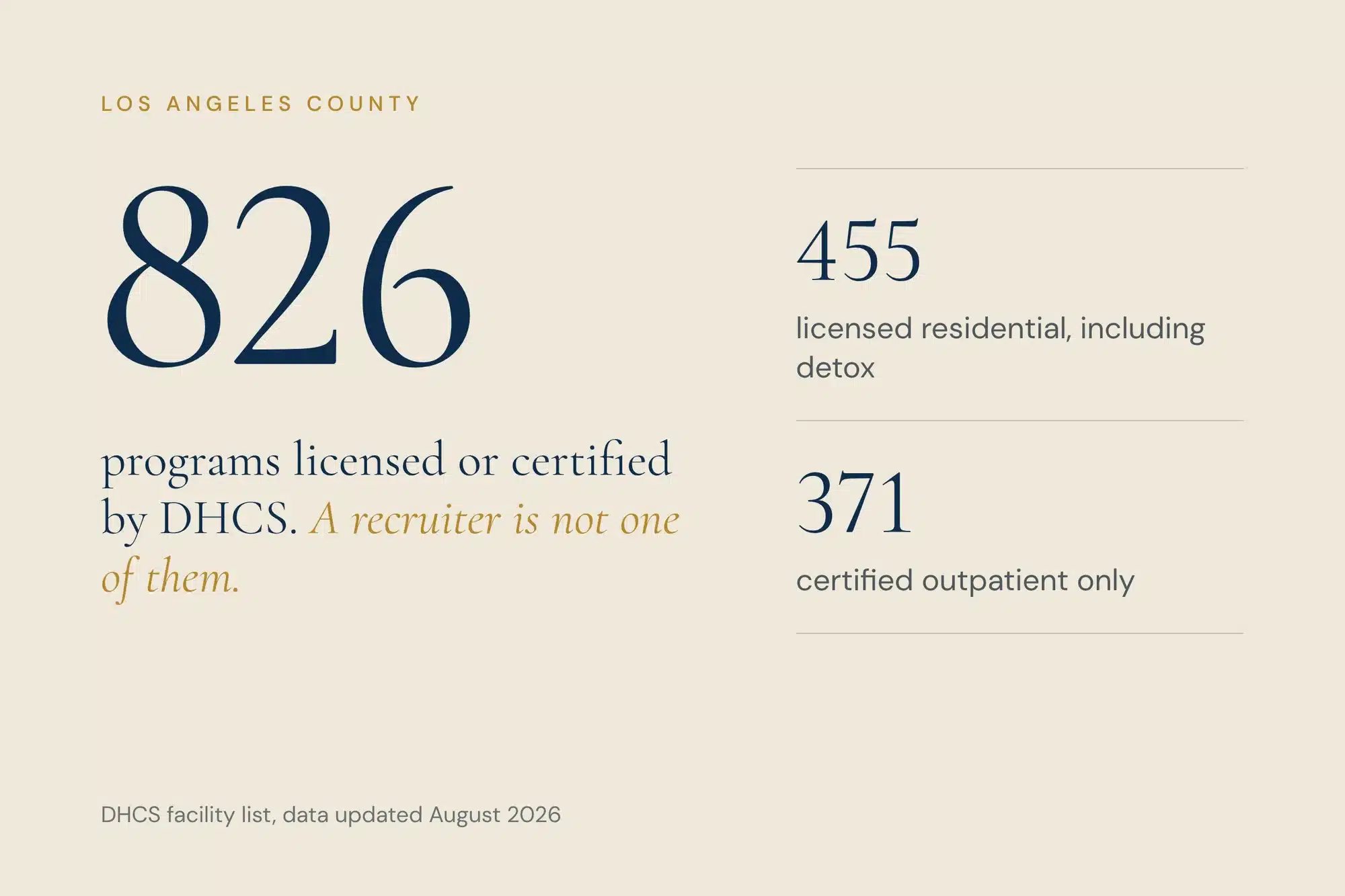
The California Department of Health Care Services licenses residential programs and certifies outpatient ones, and it publishes every one of them in its licensed and certified facilities list. Ask the program for its legal entity name and license number, then find both on the list. Check the address, the type of service (residential detox is listed as such), the bed capacity and the expiration date. If the name on the phone and the name on the list do not match, ask the program to explain the relationship in writing.
2. Check accreditation separately
A state license is the floor. Accreditation is a voluntary, outside review on top of it. The Joint Commission’s Quality Check lets anyone search accredited organizations by name, city or ZIP code. SAMHSA lists accreditation first among its five signs of quality treatment, along with medication when appropriate, evidence-based therapy, a role for the family and ongoing support after discharge.
3. Verify benefits yourself, in writing
Call the member services number on the back of the insurance card and ask whether the program is in network, what the deductible and out-of-pocket maximum are, and whether prior authorization is needed. A legitimate program will run the same check and share the result; ours is a confidential benefits verification that commits you to nothing. If you are told an out-of-network stay will cost you nothing, ask how, and read our plain guide to in-network, out-of-network and single-case agreements.
4. Ask the discharge question first
Ask what the plan is after detox, who builds it, and what happens if coverage ends early. A program that cares about the person can describe the step down to residential, partial hospitalization, intensive outpatient and life at home. For the rest of the call, our list of twelve questions to ask a rehab on the phone picks up where this one leaves off. New state deadlines for complaint investigations, described in our guide to vetting a luxury rehab in California, add one more thing to check.
“Detox is the start of an assessment, not the end of treatment. When a stay is built around billing instead of the person, the discharge plan is the first thing to disappear, and the days after discharge are when people are most at risk.”
Maria Dahlman, MA, LCSW, Regional Clinical Director, Emend Healthcare
If it has already happened to someone you love
Start with safety. After detox or any break from use, tolerance falls quickly, and a dose the body once handled can cause an overdose. The New York City Health Department’s guidance on tolerance names discharge from a treatment program as one of the highest-risk moments. Keep naloxone on hand, and if someone is unresponsive or not breathing normally, call 911.
Then get them somewhere stable. SAMHSA’s free, confidential National Helpline, 1-800-662-4357, refers to treatment in any state regardless of insurance. If the person wants to go home, help them go home and find care there; a good program will help with that handoff even when it means losing the admission.
Then report it. DHCS takes complaints about licensed and certified programs online, by email at sudcomplaints@dhcs.ca.gov, or through its Licensing and Certification Division at (877) 685-8333. Tell the insurer as well; its fraud line is usually listed on the plan’s website. Keep texts, names, addresses and any explanation of benefits you receive.
How we handle referrals at My Limitless Journeys
We hold ourselves to the same test we just described. Ask us for our license number (DHCS 191135CP) and our legal entity name and look both up; ask for our Joint Commission record and check it. Every admission starts with a clinical conversation about the person, not the policy, and a level-of-care decision made by our team rather than a recruiter. Care happens in one place, our six-bed residence in Encino, from medically supervised detox through residential care and planning for the return home.
“Families should feel free to ask who is being paid for a referral. In California the honest answer from a licensed program is nobody, and any program should be able to say that plainly.”
Garrett Braukman, Executive Director, SoCal West Region, Emend Healthcare
If you are a parent, partner or sibling trying to make sense of an offer someone has already received, our guidance for families and the walkthrough of what happens on an admissions call are good places to start.
Frequently asked questions
Is it illegal for a rehab to pay for my travel?
Offering free travel, housing or other things of value to induce someone to enroll can violate federal and California anti-kickback laws, especially when insurance is billed. Some narrowly defined, disclosed assistance can be lawful, which is why the safest course is to treat any freebie offered before an assessment as a reason to verify the program first.
How do I check whether a California rehab is licensed?
Ask for the program’s legal entity name and DHCS license number, then find both on the Department of Health Care Services licensed and certified facilities list. Confirm the address, the service type, the capacity and the expiration date, and check accreditation separately through The Joint Commission’s Quality Check.
Are sober living homes licensed in California?
Generally not by DHCS. Sober living and transitional housing are not licensed treatment, and DHCS investigates them only when they provide services that require a license. That is why a referral chain that ends in a sober living home deserves extra questions about who owns it and who is paid.
What should I do if a recruiter has already contacted my son or daughter?
Do not argue about the recruiter; ask for the program’s name and license number and verify it together. If they are already there, focus on safety and a clear discharge plan, keep naloxone available, and use the SAMHSA National Helpline to find legitimate care closer to home if that is what they want.
Ask us the hard questions first. License, accreditation, who builds the discharge plan and what it costs, answered plainly before anyone decides anything.
This article is general information, not a diagnosis or a substitute for an assessment by a clinician. If someone is in immediate danger, call 911. In a mental health or substance use crisis, call or text 988.
Sources
- Arvin, J. “Promised rehab, left stranded in California.” MindSite News, October 29, 2026, republishing The Frontier and The Curbside Chronicle. mindsitenews.org
- Oklahoma Watch, “How an Oklahoma insurance scheme brought hundreds to California for drug treatment,” via KGOU and HPPR, September 9, 2025. hppr.org
- 18 U.S.C. § 220, Illegal remunerations for referrals to recovery homes, clinical treatment facilities, and laboratories. Legal Information Institute, Cornell Law School. law.cornell.edu
- Nelson Hardiman, “California enacts four new addiction treatment laws banning patient brokering, strengthening licensure requirements and increasing penalties” (SB 1228, SB 992, SB 823, AB 3162). nelsonhardiman.com
- California Department of Health Care Services, Directories for Substance Use Disorder Services and the SUD Recovery or Treatment Facilities dataset (data updated August 2026). dhcs.ca.gov
- California Department of Health Care Services, Licensing and Certification Complaints. dhcs.ca.gov
- The Joint Commission, Quality Check. jointcommission.org
- SAMHSA, Finding Quality Treatment for Substance Use Disorders (PEP18-TREATMENT-LOC). library.samhsa.gov
- NYC Health Department, Drug Tolerance and Risk of Overdose. nyc.gov
- SAMHSA National Helpline. samhsa.gov
Every article on this site is written by our editorial team and reviewed by a licensed clinician. Read how we write and review content.
Keep reading: How to choose a rehab · Finding recovery meetings in the San Fernando Valley · He says he can stop on his own · After treatment