
Functioning is not the same as living.
Depression in a working adult rarely looks like staying in bed. It looks like getting everything done and feeling nothing about any of it, with something at the end of the day to make the flatness bearable. This page covers how depression and substance use tangle, how we tell them apart, and how a stay here treats both.
Authored by the MLJ Clinical Team. Reviewed under board-certified psychiatric oversight. Last updated September 2026.
Key Takeaways- Major depression is common, medical, and treatable; in adults who drink or use, it is often misread, because alcohol and withdrawal both produce depressive symptoms.
- A meaningful share of depression seen in heavy drinkers lifts within three to four weeks of abstinence. What does not lift is the depression we treat as its own condition.
- Early detox is a period of elevated suicide risk, which is one reason it belongs in a monitored setting rather than at home.
- Antidepressants work, but the choice changes when alcohol, stimulants or benzodiazepines are involved, and some common options carry specific risks during withdrawal.
- Structure, movement, sleep and daylight are the part of depression treatment that keeps working after the stay ends.
- What depression looks like when it has been self-medicated
- Substance-induced or independent? The four-week question
- Detox when the mood is already low
- Antidepressants alongside substance use
- Depression through the four domains
- What a stay looks like
- When residential care is the right call
- For families and partners
What depression looks like when it has been self-medicated.
Major depressive disorder is diagnosed when low mood or loss of interest persists most of the day, nearly every day, for at least two weeks, along with changes in sleep, appetite, energy, concentration, self-worth, and sometimes thoughts of death. The National Institute of Mental Health estimates that more than eight percent of American adults have a major depressive episode in a given year.
In the adults we treat, the loss of interest is the loudest symptom and the least visible. Work still gets done, often well, because work is scaffolding. What has gone is the reason for it. Food is fuel. Weekends are something to get through. The people who love you are slightly out of focus. Depression here is not sadness; it is subtraction.
Substances enter as a way to feel something, or to stop feeling the nothing. Alcohol is the most common, because it briefly lifts mood and then reliably numbs. Stimulants are chosen by people who want to feel "on" again for a few hours. Cannabis softens the evenings. Some arrive on a stimulant prescription that has drifted upward because it was the only thing that made the day feel worth starting. In every case the substance is doing a job the person has not found another way to do. Our overview of co-occurring disorders explains why treating either half alone tends to fail.
Substance-induced or independent? The four-week question.
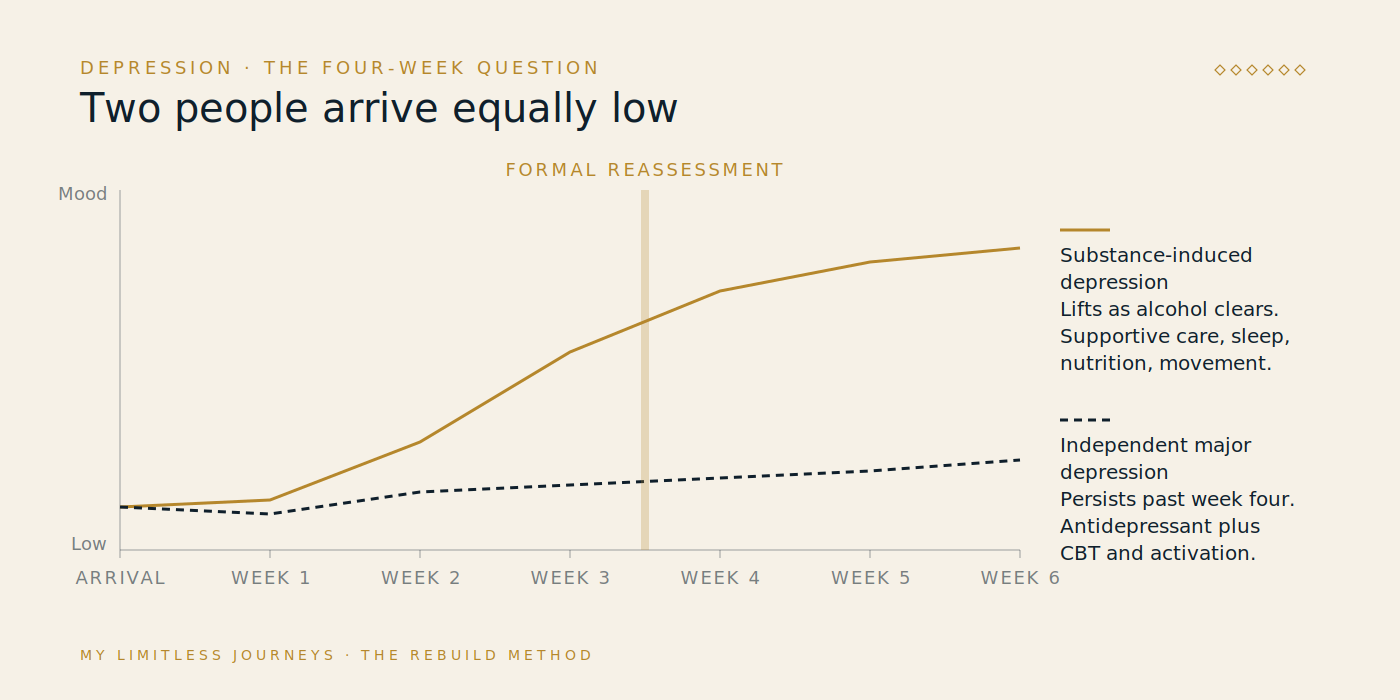
Alcohol is a central nervous system depressant. Drink enough of it for long enough and you will meet criteria for a depressive episode whether or not you have a mood disorder. Stimulant withdrawal produces a crash of low mood, exhaustion and anhedonia that can last for weeks. So when someone arrives depressed and using, the honest answer to "do I have depression?" is that we need time to find out.
Research going back decades has shown that a substantial share of depressive symptoms in people hospitalized for alcohol use disorder improve markedly within three to four weeks of abstinence without antidepressant treatment. The DSM-5 handles this with the category of substance-induced depressive disorder, distinguished from an independent depression by timing: does the mood resolve as the substance clears, or does it persist? That distinction is why the SAMHSA treatment guidance for co-occurring disorders recommends ongoing assessment rather than a single intake diagnosis.
In practice, we take a careful history on arrival, looking especially for depressive episodes that predate the drinking, episodes during past periods of sobriety, and family history. We start a structured mood measure in week one and track it. If the depression is clearly independent, treatment starts immediately. If the picture is ambiguous, we treat the person supportively, protect them, and reassess formally around the end of week three. Waiting is how we avoid medicating someone who did not need it or, worse, missing someone who did.
Detox when the mood is already low.
The medical side of detox for a depressed client follows the substance: alcohol and benzodiazepines are managed with monitored, symptom-triggered dosing and tapers; opioids with buprenorphine or a comfort protocol; stimulants with rest, nutrition and sleep support. Our detox hub covers each. What changes with depression is the level of psychiatric attention.
The first two weeks of abstinence are a period of elevated suicide risk. Withdrawal intensifies low mood and hopelessness, and the substance that had been blunting everything is suddenly gone. Every client is screened for suicidal thinking on arrival and daily during detox, with a safety plan built on the first day. Sleep is treated as a medical priority. We also check thyroid function, B12, folate and vitamin D, because deficiencies common in heavy drinkers can present as depression and are correctable.
If you or someone you love is in crisis right now, call or text 988 to reach the Suicide and Crisis Lifeline, or call 911.
Antidepressants alongside substance use.
SSRIs and SNRIs remain first-line for major depression and are compatible with recovery. Several considerations are specific to our clients. Bupropion, often attractive because it does not blunt libido or cause weight gain, lowers the seizure threshold and is avoided during active alcohol or benzodiazepine withdrawal, when seizure risk is already raised. Mirtazapine can be useful when insomnia and appetite loss dominate. Where alcohol use disorder is present, we consider naltrexone or acamprosate alongside the antidepressant; they work on different systems and can be combined.
For depression that has not responded to two or more adequate trials, options include augmentation strategies and newer treatments such as transcranial magnetic stimulation or esketamine, which we discuss and coordinate with outside specialists when appropriate. The psychiatrist who starts a medication follows you through residential and outpatient care, so dosing is adjusted against what is actually happening rather than a monthly snapshot.
Depression through the four domains.
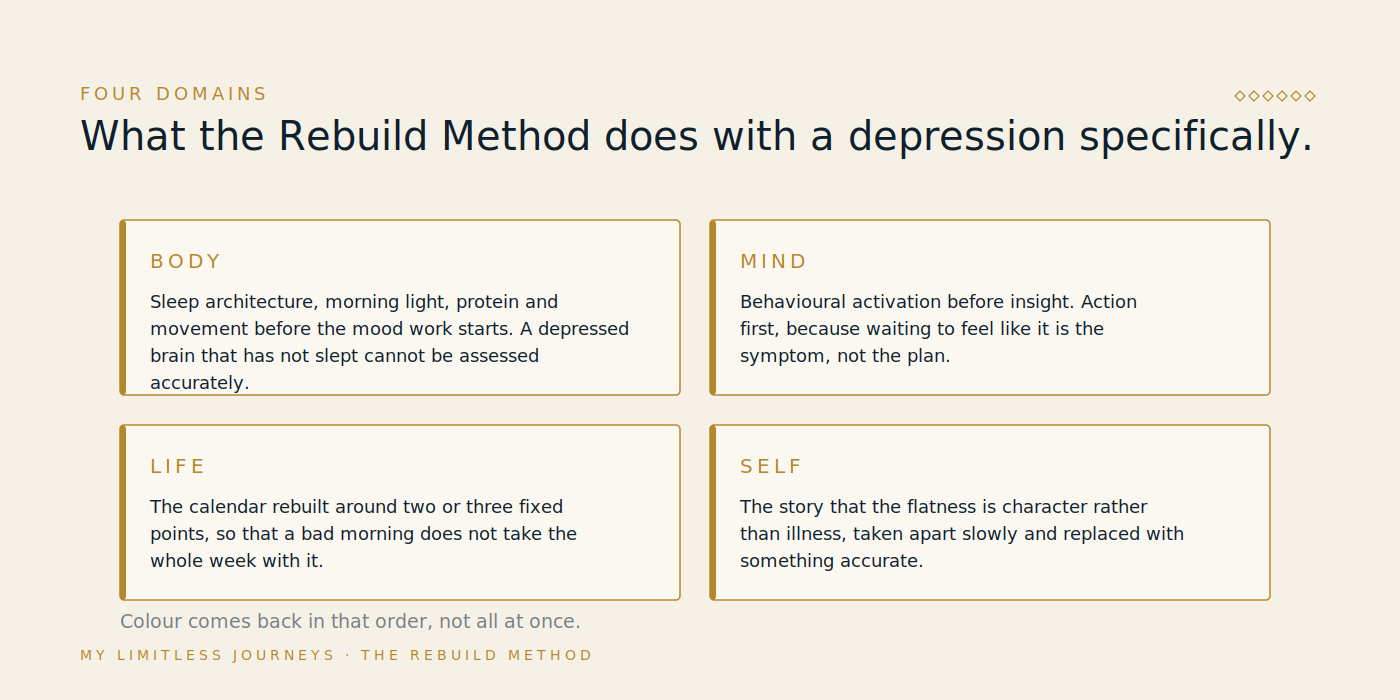
Every condition at MLJ is treated through The Rebuild Method: Body, Mind, Life and Self, inside a perimeter of discretion. Depression gives each domain a particular job.
Body. Depression flattens the circadian rhythm, and alcohol finishes the job. We rebuild it deliberately: a fixed wake time, morning daylight, movement before the day's first decision. Aerobic exercise has an antidepressant effect large enough to appear in treatment guidelines, and here it is coached one-to-one as clinical work. Nutrition addresses the deficiencies above.
Mind. CBT for depression works on two fronts: behavioral activation, which means scheduling and doing valued activities before the feeling of wanting to returns, and cognitive work on the harsh, global self-judgments depression generates. Where trauma or grief sit under the depression, EMDR and grief therapy follow once you are stable. ACT helps with the depressive habit of waiting to feel better before living.
Life. Depressed adults often have a life that is all obligation and no structure of their own. We rebuild the week from the ground up: work hours with edges, relationships tended on purpose, the evening no longer organized around a drink. Family sessions address what has gone unsaid. Return-to-work planning is concrete.
Self. Depression tells you that nothing matters. Recovery from it involves discovering, not deciding, what does. Values work, spiritual exploration for those who want it, and the return of curiosity are how color comes back.
What a stay looks like.
Week one is detox, safety, sleep and a physician's full workup. You meet your primary clinician and your psychiatrist, and the mood tracking begins. By week two you are moving every morning, eating regularly, and starting behavioral activation in small, scheduled steps. Around the end of week three comes the formal reassessment: is the depression lifting with abstinence, or does it need direct treatment? The plan sharpens from there.
Weeks four through eight are where the deeper work happens: trauma or grief processing, family sessions, the cognitive work, fitness that has become a habit. The last stretch is transfer planning. Most clients step down to PHP or IOP with the same team, and many use transitional living so that the rebuilt routine has somewhere to live before home does.
When residential care is the right call.
Mild to moderate depression without substance dependence is well treated by weekly therapy and, where indicated, medication from an outpatient psychiatrist. Residential care is the right level when detox is required, when suicidal thinking is present, when depression has not responded to good outpatient care, or when the home environment has become part of the problem. It is also right when depression is severe enough that you cannot reliably do the things that would help; a setting where movement, meals, sleep and therapy happen on a schedule that does not depend on your energy is the mechanism, not a luxury. Our guide to levels of care for co-occurring disorders walks through how we decide.
For families and partners.
Living with a depressed person who drinks is lonely in a specific way: they are present and absent at once, and you cannot tell which problem you are looking at. First, take any talk of death or not wanting to be here seriously, every time, and say so plainly. Second, understand that the flatness is a symptom, not a verdict on you. In family sessions we work on rebuilding contact without demanding cheerfulness, and on how the household can support routine after discharge. Our family therapy page describes what to expect.
- Mental health treatment at MLJ. The hub for every condition we treat.
- Bipolar disorder. When depression is one pole of a wider pattern.
- Anxiety. The condition that most often travels alongside depression.
- Alcohol addiction. The substance most often woven into depression.
- Residential treatment. How the 30–90 day program is built.
- Anhedonia in week three. Why the flatness peaks and then passes.
This guide is educational and is not a substitute for medical advice. If someone is in immediate danger, call 911.