
Trauma lives in the body long after the event ends.
PTSD is a nervous system that learned, correctly, that the world was dangerous and never got the message that the danger had passed. Alcohol, opioids and sedatives are the most reliable off-switches most people ever find. This page explains how the two feed each other and how we treat them together.
Authored by the MLJ Clinical Team. Reviewed under board-certified psychiatric oversight. Last updated September 2026.
Key Takeaways- PTSD has four symptom clusters: intrusion, avoidance, negative mood and hyperarousal. Substances target the last one first and end up worsening all four.
- Adults with PTSD are several times more likely to have a substance use disorder, and the combination is more disabling than either alone.
- Detox for someone with PTSD is medically ordinary and psychologically not: withdrawal amplifies hyperarousal and returns the dreams the substance had suppressed.
- Benzodiazepines are not recommended for PTSD by the VA/DoD guideline; SSRIs and trauma-focused therapy are, and the two conditions are treated at the same time rather than in sequence.
- Trauma work here is phased: stabilize, process when you are ready, integrate before you leave. Nobody tells their story on day one.
The alarm that never reset.
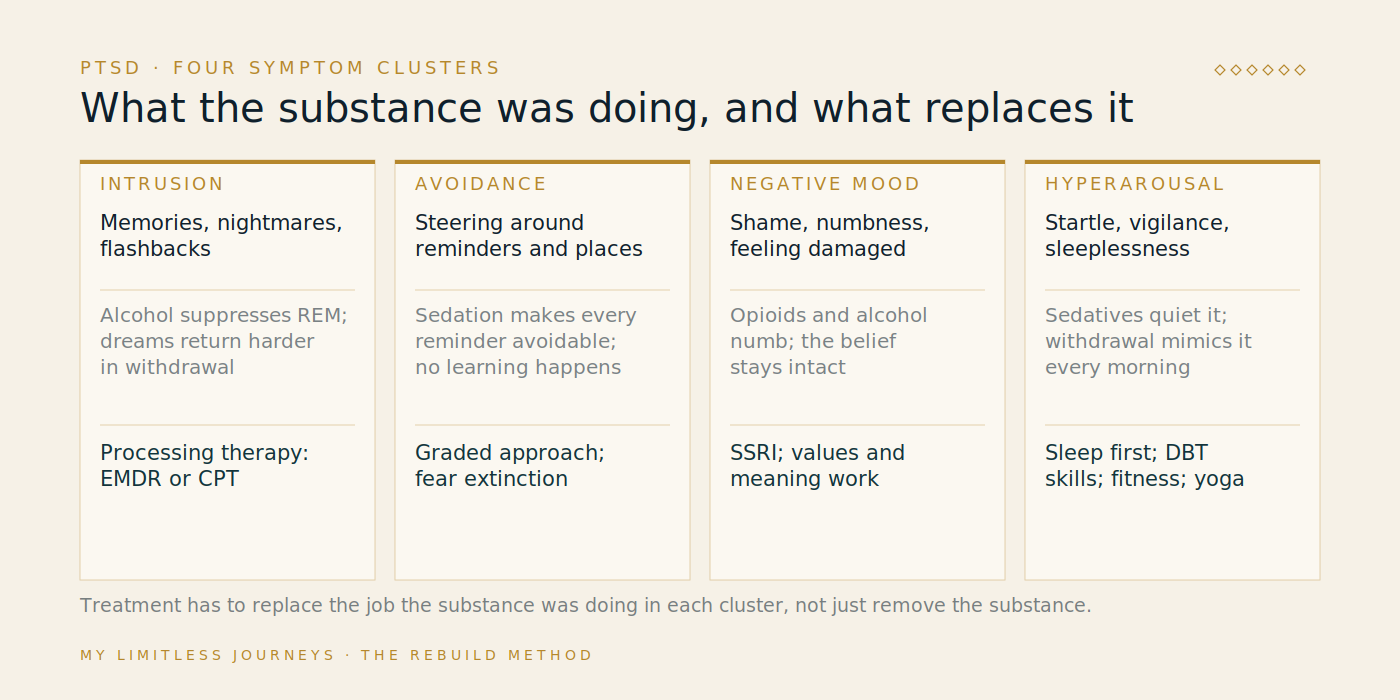
PTSD is diagnosed when, more than a month after exposure to death, serious injury or sexual violence, a person continues to have symptoms across four clusters. Intrusion: memories, nightmares, flashbacks. Avoidance: of reminders, places, conversations. Negative changes in mood and thinking: shame, numbness, a sense of being permanently damaged. And hyperarousal: startle, irritability, hypervigilance, sleeplessness. The National Institute of Mental Health estimates that roughly six to seven percent of American adults will have PTSD in their lifetime.
In the adults we treat, the event is often years back and sometimes never named. A childhood that required constant vigilance. An assault in college. A set, a tour, a shift where someone died. What persists is less the memory than the body's response to it: a stress system that runs hot, sleeps badly, scans every room, and cannot be argued into calm. Many of our clients have built careers on that vigilance. They are also exhausted in a way rest does not touch.
Why trauma and substances travel together.
Large national surveys have repeatedly found that adults with PTSD are several times more likely to have an alcohol or drug use disorder than adults without it, and the National Institute on Drug Abuse identifies PTSD as one of the conditions most tightly bound to substance use. The National Center for PTSD reports the overlap is especially high among veterans.
Each substance medicates something specific. Alcohol and benzodiazepines dampen hyperarousal: they quiet the startle, soften the vigilance, and, for a while, suppress dreaming. Opioids do something more specific to the numbing and emotional pain that sit in the negative-mood cluster. Cannabis is used for sleep and distance. Stimulants are the exception: used to feel in control, they reliably make hypervigilance worse.
The problem is that every one of these substances also blocks the process by which trauma resolves. Fear extinction, the brain's way of learning that a reminder is not the event, requires that you be present for the reminder. If you are sedated for every reminder, the learning never happens, and the alarm stays armed. And withdrawal from alcohol or sedatives is physiologically almost identical to hyperarousal, so each morning confirms to the nervous system that the world is still dangerous. Our post on PTSD and substance use explores this cycle.
Detox with PTSD in the picture.
The medical protocol follows the substance. Alcohol is managed under the ASAM withdrawal guideline with monitored, symptom-triggered dosing; benzodiazepines are tapered, never stopped; opioids are managed with buprenorphine or a structured comfort protocol. What PTSD changes is the environment around the protocol.
Three things predictably happen. First, the hyperarousal the substance had been holding down returns, often harder, on top of withdrawal's own arousal. Second, dreaming comes back. Alcohol and many sedatives suppress REM sleep; when they are removed, REM rebounds, and with it the nightmares. Clients who have not dreamed in years may have their worst nights in week one, and if nobody warned them, they conclude sobriety is unbearable. Third, dissociation can increase under stress. Our nursing staff are trained to recognize it and to ground rather than escalate.
This means a few adjustments. We take a brief, gentle trauma history before detox begins so we know what to expect. Routines are predictable and vital signs are explained before they are taken. Nightmares are treated as a medical symptom from the first night. And nobody talks about what happened until acute withdrawal has passed and they choose to. Our page on sleep in early recovery covers REM rebound in depth.
Medication: what the evidence supports.
The VA/DoD Clinical Practice Guideline for PTSD recommends sertraline, paroxetine or venlafaxine as first-line pharmacotherapy. Sertraline and paroxetine carry FDA approval for PTSD. These take several weeks to work. Prazosin, a blood-pressure medication, is widely used for trauma-related nightmares; trial results have been mixed, and we use it selectively where nightmares dominate and the response can be tracked.
The same guideline recommends against benzodiazepines for PTSD. They do not treat the disorder, they interfere with the learning that trauma-focused therapy depends on, and in a population already prone to alcohol and sedative misuse they carry an obvious dependence risk. If you arrive on one, we build a taper. Where alcohol use disorder is present, naltrexone can be paired with an SSRI; where opioid use disorder is present, buprenorphine is continued as long as it is needed. Medication supports the therapy; it does not replace it.
Trauma-focused therapy and when it starts.
The treatments with the strongest evidence for PTSD are trauma-focused psychotherapies: prolonged exposure, cognitive processing therapy, and eye movement desensitization and reprocessing (EMDR). The American Psychological Association's clinical practice guideline recommends these over medication as first-line treatment. Each helps the brain do the fear-extinction learning that avoidance and substances have prevented: approaching the memory in a controlled way until it becomes a memory rather than a live event.
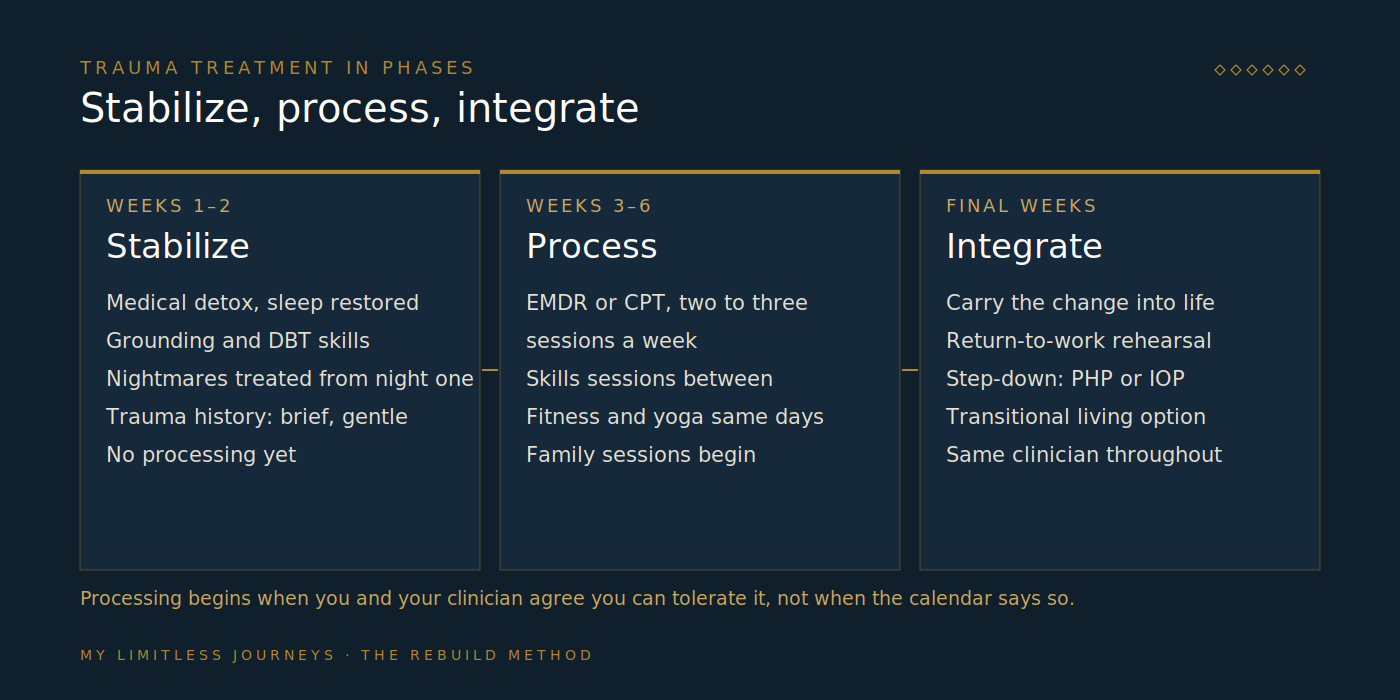
For years, addiction programs deferred trauma work for months on the theory that processing would trigger relapse. The evidence has moved. Integrated approaches that treat PTSD and substance use in the same episode of care have been shown to reduce PTSD symptoms without worsening substance outcomes, and often improve both. We treat them together, but in phases. Weeks one and two are stabilization: safety, sleep, grounding skills, DBT-based distress tolerance, a working relationship with your clinician. Processing, using EMDR or CPT depending on your history and preference, begins when you and your clinician agree you can tolerate it, typically in week three or four. Integration, the last phase, carries the changed relationship to the memory into your actual life.
Trauma through the four domains.
The Rebuild Method gives trauma work a frame beyond the therapy room.
Body. PTSD is a disorder of the stress-response system, and the body is where treatment starts. Sleep is restored first, because nothing else works on a nervous system that has not slept. One-to-one fitness coaching uses movement to discharge the arousal that has nowhere to go; yoga and breath work teach the vagal brake directly.
Mind. This is where the trauma-focused work lives: EMDR, CPT, and DBT skills for the emotional storms that come with processing. Co-occurring depression and anxiety, almost universal alongside PTSD, are treated here rather than treated around.
Life. Trauma narrows a life to what feels safe. We widen it deliberately: structure that does not depend on vigilance, family sessions that teach the people around you what a trigger actually is, and return-to-work planning that anticipates the set, the courtroom, or the shift where the trauma occurred.
Self. Trauma teaches shame and a sense of being permanently marked. Values and meaning work, and for many clients spiritual exploration, address that directly. Moral injury, for clients whose trauma involved something they did or failed to prevent, is worked with here.
What a stay looks like.
The first two weeks are quieter than most people expect: detox, sleep, a physician's workup, and daily sessions about grounding and skills rather than history. The house holds six people at most, with the same staff every day; for trauma, predictability is the treatment's precondition. From week three, processing sessions begin, usually two or three a week, with skills sessions between them and fitness or yoga on the same days to help the body settle. Family work starts once you are stable enough to want it. The final weeks are integration and transfer, stepping down to PHP or IOP with the same clinician, and often to transitional living so the new routine has a home before you go back to yours.
Residential or outpatient?
If you are not physically dependent on a substance, are sleeping, and have a stable home, weekly EMDR or CPT with a skilled clinician may be all you need. Residential care is the right level when detox is needed, when the substance has become the only way you sleep or function, when dissociation or suicidal thinking make outpatient processing unsafe, or when earlier trauma therapy stalled because the drinking kept resetting it. The levels-of-care guide for co-occurring disorders lays out how we make the call.
For families.
You may not know what happened, and your person is not obliged to tell you. What you can know is that the irritability, withdrawal and drinking were symptoms of a nervous system under siege, not a judgment of you. In family sessions we teach what triggers are, how to respond without taking over, and how to rebuild trust. Our families hub is a good place to start.
- Mental health treatment at MLJ. The hub for every condition we treat.
- Anxiety. Often the diagnosis given before the trauma is found.
- Co-occurring disorders. How integrated treatment works.
- Dialectical behavior therapy. The skills used in the stabilization phase.
- Residential treatment. The setting most trauma clients begin in.
- Trauma, cortisol and craving. The biology behind why EMDR belongs in addiction treatment.
This guide is educational and is not a substitute for medical advice. If someone is in immediate danger, call 911.