What counts as prescription drug misuse?
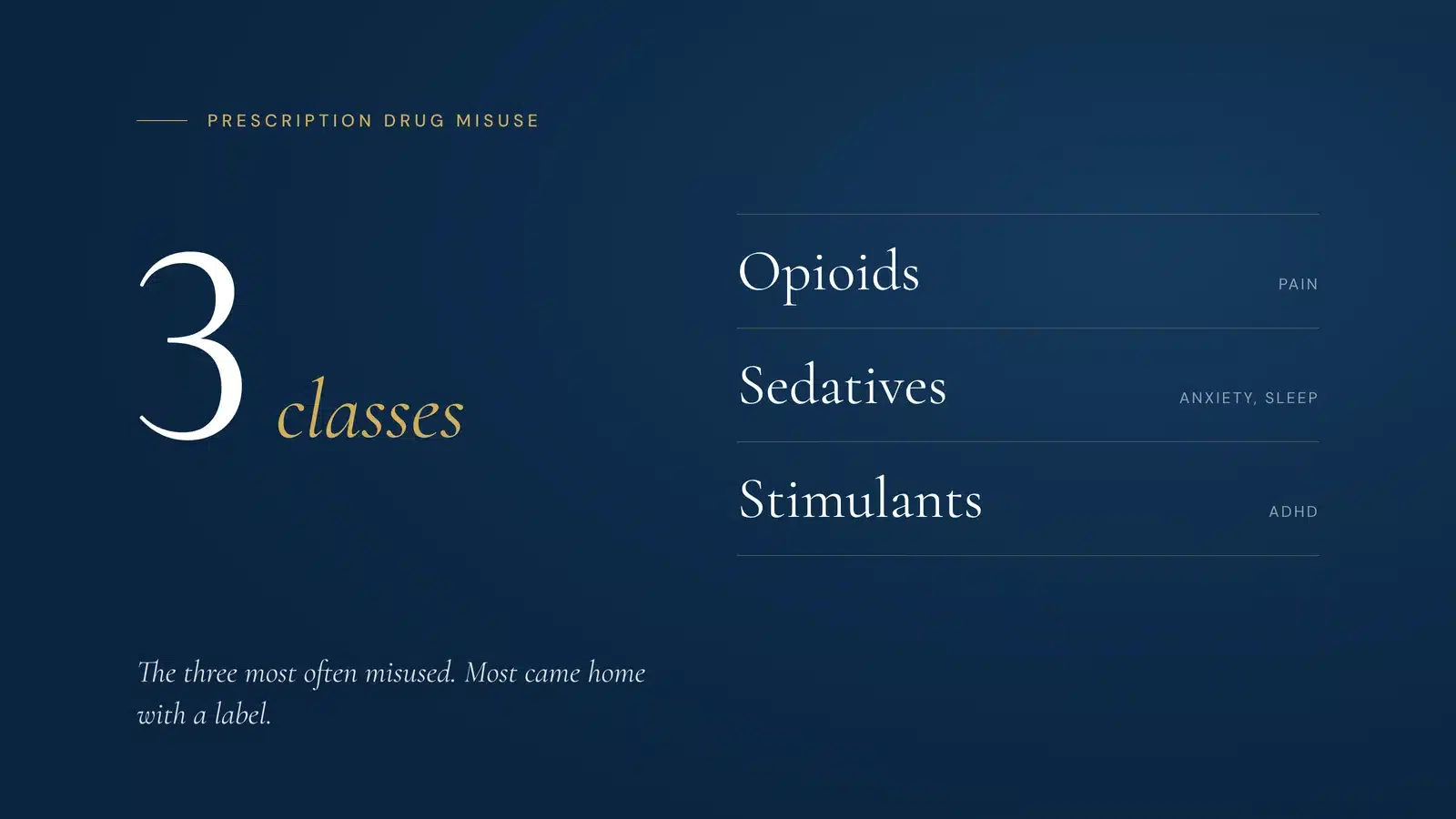
Prescription drug misuse means taking a medication in a different dose, way or reason than prescribed, or taking someone else’s. NIDA names three classes most often misused: opioids for pain, sedatives such as benzodiazepines, and stimulants for ADHD. Unused pills can be dropped off safely, but misuse that has become dependence needs medical care.
Why Orange County is talking about medicine cabinets
On October 20, the Orange County Health Care Agency asked residents to clear out unneeded medications for National Prescription Drug Take Back Day on Saturday, October 24, when drop-off sites across the county accepted pills from 10 a.m. to 2 p.m., free and anonymously. “Prevention begins at home,” said Dr. Veronica Kelley, the agency’s director.
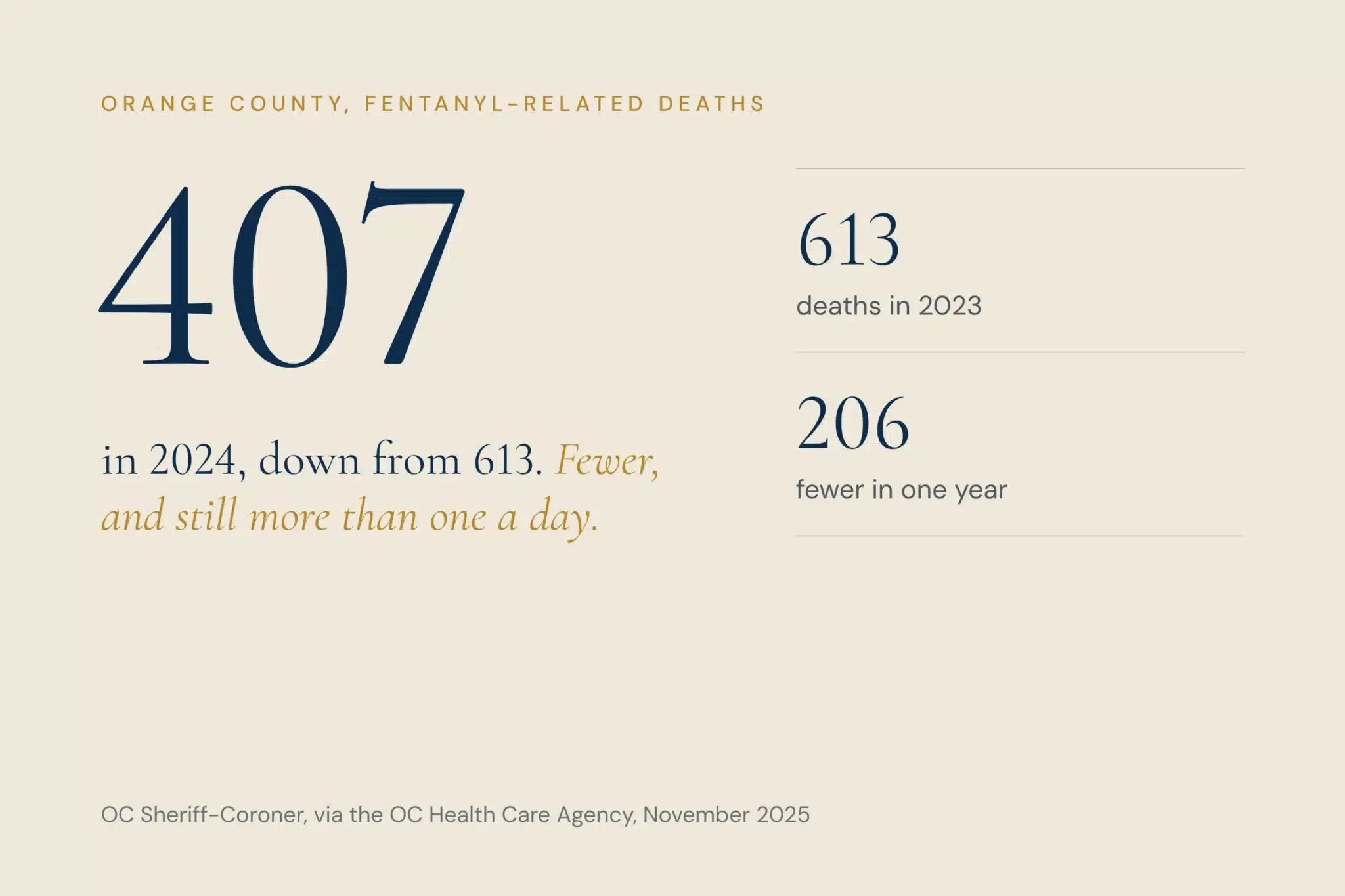
The event has passed; the cabinet has not. The agency’s Alcohol and Drug Education and Prevention Team notes that take-back days happen every April and October, and points residents to drop boxes and at-home disposal in between. The reminder lands against a county backdrop that has improved without being resolved. In a joint release with the Sheriff-Coroner last November, the county reported 407 fentanyl-related deaths in 2024, down from 613 in 2023. Sheriff-Coroner Don Barnes called the decline encouraging, and Board Chair Doug Chaffee added: “The fight isn’t over.”
Fentanyl and the medicine cabinet are different problems, but they meet more often than families expect. NIDA’s Prescription Opioids DrugFacts notes that about 80 percent of people who used heroin first misused prescription opioids. Most people who misuse a prescription never make that move. The ones who do usually start somewhere ordinary.
What misuse looks like in a household that would never call it that
NIDA’s summary of prescription drug misuse identifies three classes of medication as the most commonly misused: opioids, usually prescribed for pain; central nervous system depressants, including the tranquilizers, sedatives and sleep medicines used for anxiety and insomnia; and stimulants, most often prescribed for ADHD. Misuse includes taking a medicine in a dose or way other than prescribed, or taking someone else’s.
In the professional households we hear from in Newport Beach, Irvine and South County, it rarely looks like a drug problem. It looks like this:
- 1A refill that runs out early, most months, with a reasonable explanation each time.
- 2A second prescriber, or a telehealth service, that the first doctor does not know about.
- 3A parent’s or spouse’s old bottle that is lighter than it should be.
- 4An evening sedative that started as a sleep aid and now arrives with the first glass of wine.
- 5A stimulant prescription that has quietly become the reason the workday works.
NIDA also notes that older adults are at higher risk of accidental misuse because they typically have multiple prescriptions and chronic conditions. In many Orange County homes the most crowded cabinet belongs to a parent, and a crowded cabinet is easy to take from without anyone noticing.

“People rarely think of it as using drugs when the label has their own name on it. The conversation gets easier when we start with what the medication was helping with, because that need is real and it still deserves care.”
Brett Cronon, Counselor, My Limitless Journeys
How to clear the cabinet safely
The FDA’s disposal guidance starts with take-back: drop medicines at an authorized collection site or use a prepaid mail-back envelope, and check with local law enforcement or the DEA’s locator for a site near you, year round. Only medicines on the FDA flush list should go down the toilet. When no take-back option is available, the FDA’s household method takes four steps.
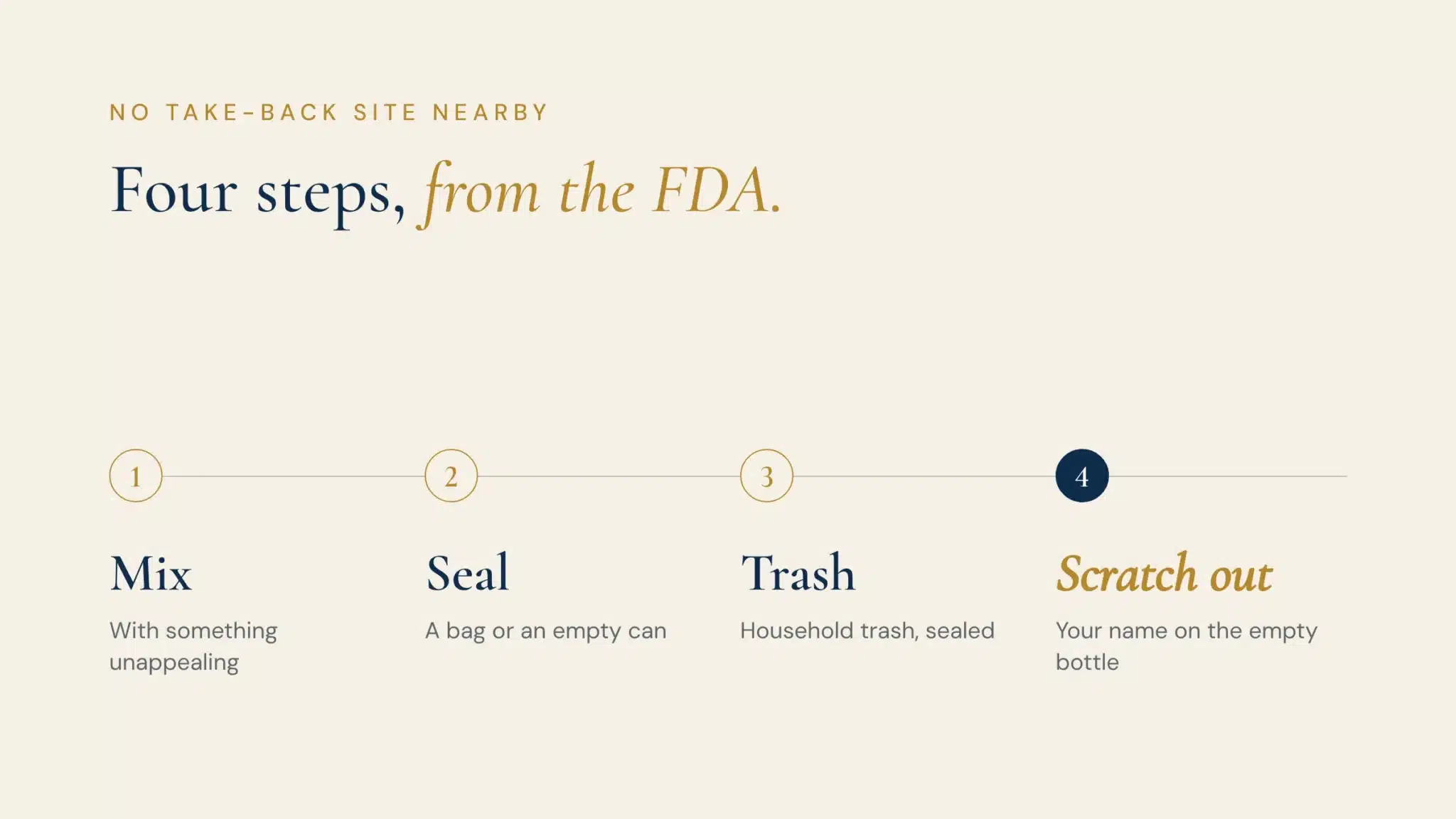
- Remove the medicine from its original container and mix it with something unappealing.
- Put the mixture in something you can seal, such as a resealable bag or an empty can.
- Put the sealed container in the household trash.
- Scratch out your personal information on the empty bottle or packaging before you throw it away.
If someone in the house is in recovery, go further. Keep any medication that has to stay, from a few days of pain medication after surgery to a teenager’s ADHD prescription, in a locked box, and count it. That is not an accusation. It is the same precaution any careful household takes.
When the bottle is not the problem
Clearing a cabinet prevents misuse. It does not treat dependence. If someone has been taking an opioid, a benzodiazepine or a stimulant regularly, especially at higher doses than prescribed, removing the supply can start withdrawal, and withdrawal is where people get hurt or go looking for pills elsewhere.
The risks differ by class. Opioid withdrawal is miserable but rarely dangerous on its own; the danger comes afterward, when tolerance has fallen. Benzodiazepine withdrawal after sustained use can cause seizures, which is why our benzodiazepine tapering guide describes a supervised taper measured in weeks. Stimulant withdrawal brings a crash of exhaustion and low mood that needs psychiatric attention. Our medically supervised detox handles each of these in a private bedroom, with the same team that runs the residential work that follows.
“In detox, some of the people most surprised by their withdrawal took exactly what was prescribed, just for longer than anyone planned. We watch them closely, and we tell families this is a medical process, not a test of character.”
Brianna Ayles, RADT, Behavioral Health Technician, My Limitless Journeys
For Orange County families, the question of where is often as loaded as the question of whether. A professional whose prescriptions come from a local physician and a local pharmacy may not want treatment in the same few square miles. That is the case for drug rehab for Orange County residents at our Encino residence, about an hour north: a small house in another county, away from the prescribers, the pharmacies and the people who know you. Our Orange County hub explains the drive and which levels of care travel well, and our page on prescription drug abuse treatment covers the clinical side.
How to raise it with someone you love
Start with the medication’s purpose, not the pill count. Pain, anxiety, sleep and focus are real needs, and the person is more likely to hear you if you acknowledge them. Describe what you have seen rather than what you conclude, choose a calm morning, and bring one concrete next step: an appointment with the prescriber, an assessment, or a call to a program that can explain the options. Our guide on how to talk to a loved one about getting help goes further, and the Orange County drug rehab page describes what treatment involves if it comes to that.
Frequently asked questions
Where can I dispose of prescription drugs in Orange County?
Take-back days run every April and October, and drop-off is free and anonymous. Between events, the DEA lists year-round authorized collection sites, local law enforcement can point you to one, and the FDA describes a safe household trash method when no take-back option is nearby.
Is it dangerous to stop taking benzodiazepines suddenly?
It can be. After regular use, stopping abruptly can cause severe withdrawal, including seizures. A supervised taper, usually over weeks, is the safe approach. Talk with the prescriber or a detox program before stopping.
Can you become addicted to a medication prescribed to you?
Yes. Opioids, benzodiazepines and stimulants can all lead to dependence or a use disorder, even when they started for a legitimate reason. Taking more than prescribed, running out early or using a second prescriber are signs to raise with a clinician.
Should we lock up medications if someone at home is in recovery?
Yes. Keep any medication that has to stay in the house in a locked box, count it, and dispose of anything no longer needed. It protects the person in recovery, visitors and teenagers alike, and it takes the question out of everyday life.
If a prescription has become the problem, a confidential conversation can sort out what is safe to stop, what needs a taper and where care would happen. Business hours, no commitment.
This article is general information, not a diagnosis or a substitute for an assessment by a clinician. If someone is in immediate danger, call 911. In a mental health or substance use crisis, call or text 988.
Sources
- Orange County Health Care Agency, “Safe Disposal Saves Lives: OC Residents Encouraged to Join Drug Take Back Day,” October 20, 2026. ochealthinfo.com
- Orange County Health Care Agency and Orange County Sheriff’s Department, “Fentanyl-Related Deaths in Orange County See Five-Year Low,” November 13, 2025. ochealthinfo.com
- Orange County Health Care Agency, Alcohol and Drug Education and Prevention Team (ADEPT). ochealthinfo.com
- National Institute on Drug Abuse, “Summary of Misuse of Prescription Drugs,” Research Report. nida.nih.gov
- National Institute on Drug Abuse, “Prescription Opioids DrugFacts.” nida.nih.gov
- U.S. Food and Drug Administration, “Where and How to Dispose of Unused Medicines,” April 16, 2025. fda.gov
Every article on this site is written by our editorial team and reviewed by a licensed clinician. Read how we write and review content.
Keep reading: Drug rehab for Orange County residents · Benzodiazepine tapering · Prescription drug abuse treatment · Opioid and fentanyl detox · Recovery support groups in Orange County