
Drug rehab without running into your neighbor's attorney.
Opioids, fentanyl, cocaine, methamphetamine, benzodiazepines, prescription stimulants, and the combinations most people actually use. Treated with medicine first, then with the slow work of rebuilding, in a six-bed home in Encino roughly an hour north of Orange County. There is no MLJ facility in OC. For drug use in particular, that distance is doing something specific.
Authored by the MLJ Clinical Team. Reviewed under board-certified psychiatric oversight. Last updated September 2026.
Key Takeaways- Every drug has a different withdrawal course and a different set of medications; MLJ uses substance-specific detox protocols under board-certified psychiatric oversight, in a private bedroom rather than a ward.
- Drug use, unlike drinking, depends on a supply network that is local and personal; sixty miles between you and that network during the first weeks is a clinical intervention, not a travel inconvenience.
- Fentanyl has changed the arithmetic of relapse: tolerance falls fast during treatment, and a return to a prior dose can be fatal, which is why relapse-prevention planning starts in week one.
- Most drug use in adults is entangled with something else: untreated ADHD, chronic pain, trauma, anxiety, or depression. We assess for and treat those conditions from the start.
- Aetna, Anthem, Cigna, Kaiser Southern California, and UnitedHealthcare plans are verified before admission; private pay is accepted.
The supply network is the problem distance solves.
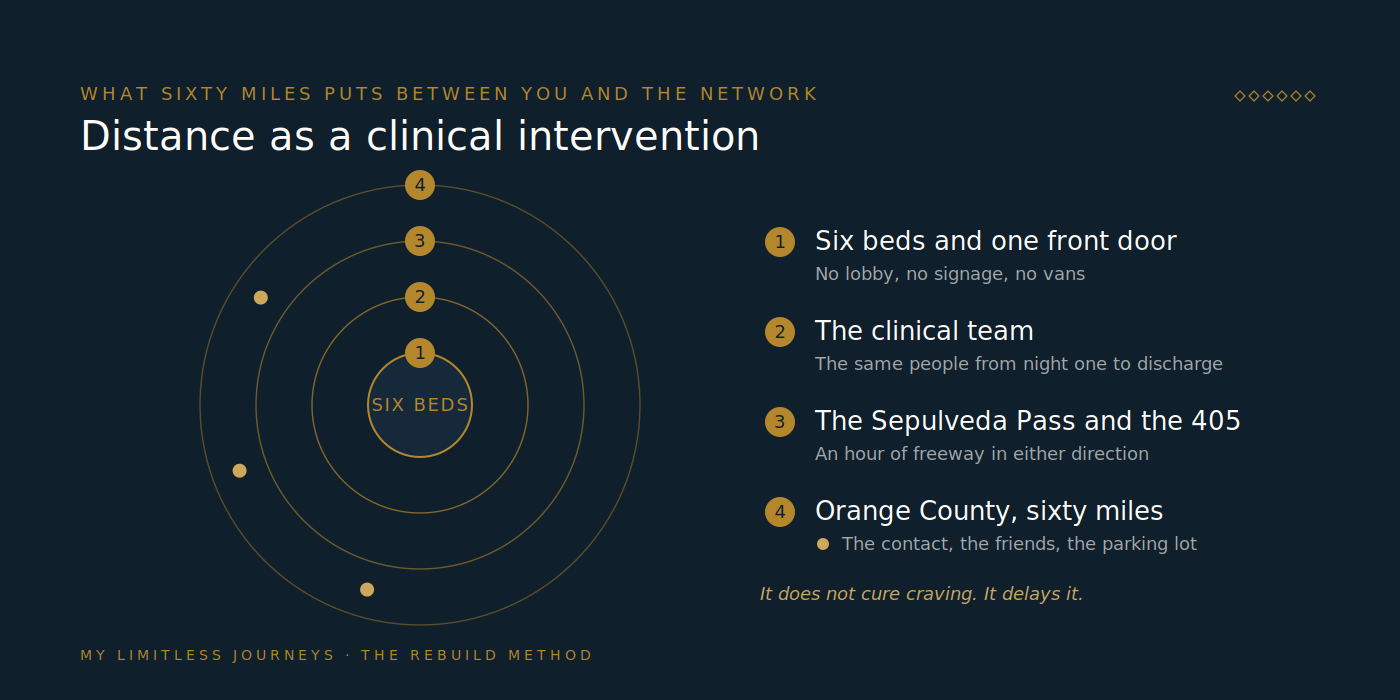
Alcohol is everywhere. Drugs are not. Whatever you use, it arrives through a small number of people and places: a contact who texts back, a friend's medicine cabinet, a pharmacy that has stopped asking questions, a parking lot behind a shopping center in Santa Ana or Costa Mesa. That network is personal and it is geographic, and it is the single most reliable predictor of what happens in the first ninety days after treatment.
Treatment programs located inside the county you use in cannot do much about this. A residential program in Newport is still fifteen minutes from the person who has always answered. Some clients in Orange County programs have their supply delivered to the curb. This is not an indictment of those programs; it is a description of what proximity permits.
Our residence in Encino is roughly sixty miles from most of Orange County, on the far side of the Sepulveda Pass. Nobody is going to drive that in the first week of withdrawal to make a delivery, and the client who would need to leave the house, find a ride, and cross two counties to reach a familiar contact has been given something very valuable: a delay. Craving, as the National Institute on Drug Abuse describes it, is a conditioned response to cues, and conditioned responses fade when they stop being reinforced. Distance is how you stop reinforcing them long enough for the therapy to have a chance.
There is the other reason, too, the one in the headline. A drug problem in a professional's life is a secret with a particular shape. Orange County is full of treatment programs and full of people who know each other. Six beds on a hillside in another county keeps the secret smaller. Our guide on how six beds changes anonymity spells out the math.
Substance by substance: what detox involves.
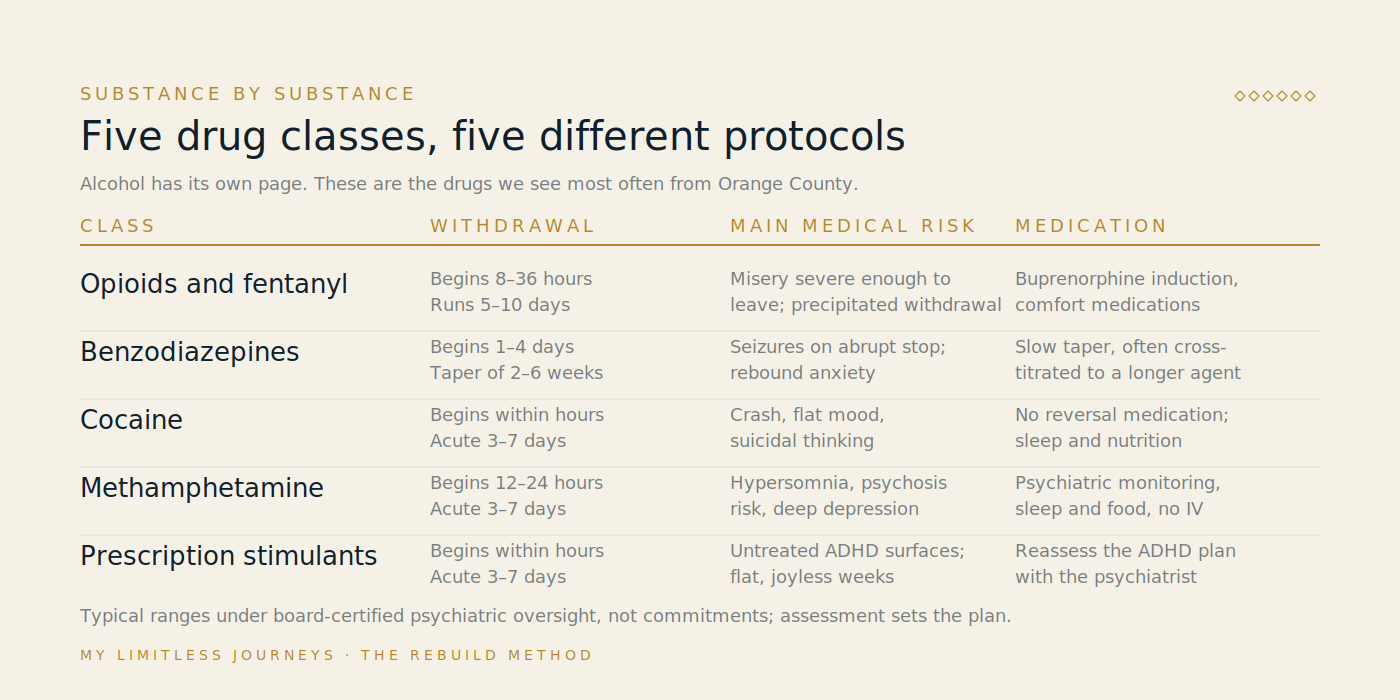
Drug detox is not one procedure. It is several, and the one you need depends on what is in your system and for how long. Every protocol at MLJ is run by nursing staff under a board-certified psychiatrist, inside the residence, in a private bedroom with a private bathroom. Our medical detox hub goes deeper on each; here is the short version for the drugs we see most from Orange County.
Opioids and fentanyl. Withdrawal is rarely life-threatening on its own but is miserable enough that people leave treatment to end it. We manage it with buprenorphine induction where appropriate, plus comfort medications for nausea, blood pressure, sleep, and muscle pain. Fentanyl complicates timing, which gets its own section below. The opioid and fentanyl detox page covers induction in detail.
Benzodiazepines. Xanax, Klonopin, Ativan, and Valium are the drugs people most underestimate. Abrupt discontinuation after sustained use can cause seizures. Benzodiazepine detox is a taper measured in weeks, not days, and the residential portion of a stay often begins while the taper is still under way. Read benzodiazepine tapering before you decide to stop on your own.
Cocaine, methamphetamine, and prescription stimulants. There is no medication that reverses stimulant withdrawal. What there is instead is a crash: profound sleep, appetite swings, and a flat, joyless depression that can include suicidal thinking. This is why stimulant detox needs psychiatric oversight even though it does not need an IV. Sleep and nutrition are the medicine, and they are treated as clinical work in the Body domain.
Combinations. Most real cases are polysubstance: opioids and benzodiazepines, stimulants and alcohol, a "downer" to land after an "upper." Sequencing matters, and interactions between withdrawal syndromes are where inexperienced detox goes wrong. Our polysubstance detox page explains how we prioritize.
Fentanyl, specifically.
Fentanyl has changed how drug treatment has to be done, and Orange County has felt it as much as anywhere in Southern California. Two things are different. First, withdrawal timing: fentanyl is lipophilic and accumulates in fat tissue, so withdrawal can begin later and last longer than with heroin or oxycodone, and starting buprenorphine too early can trigger precipitated withdrawal, a sudden and severe worsening. Managing induction correctly requires clinicians who do this every week, and the SAMHSA treatment improvement protocols on medications for opioid use disorder are the standard we work from.
Second, and more important for someone reading this from Irvine: fentanyl has made relapse deadlier. Tolerance drops during any period of abstinence, including a stay in treatment. A person who returns to a dose their body tolerated a month ago can stop breathing. This is not a scare tactic; it is the reason relapse-prevention planning at MLJ begins in the first week rather than the last, why we discuss naloxone with every client and family, and why we favor continuing medication for opioid use disorder into residential and beyond rather than treating detox as the finish line. Our relapse-prevention program is built around this reality.
What the drug was doing for you.
Adults do not usually start using stimulants at forty for fun. They start because the mornings became impossible, or because a diagnosis of ADHD in their twenties turned into an unsupervised prescription in their thirties and something else in their forties. People do not usually end up on fentanyl by accident; they end up there after a back surgery, a prescription that ran out, and a pain that did not. Benzodiazepines almost always begin as treatment for an anxiety that was real.
This is why the Mind domain of The Rebuild Method runs in parallel with detox rather than after it. A psychiatric assessment in the first days looks for what the drug was managing: ADHD, chronic pain, trauma, an anxiety or mood disorder. Treating those is not optional; sending someone home with untreated ADHD and a stimulant history is sending them back to the pharmacy. Our page on ADHD treatment describes how we handle stimulant medication decisions in people with a use history, and the co-occurring disorder page covers the broader picture.
The therapeutic work uses what the evidence supports: cognitive behavioral therapy for the use itself, EMDR and trauma-focused therapy where trauma is present, dialectical behavior therapy for the emotional dysregulation that so often rides alongside stimulant and benzodiazepine use, and ACT for the values work that gives sobriety a reason. None of this is drug-specific; all of it is person-specific, and with six clients and true 1:1 ratios there is time to do it properly.
What a stay looks like from Orange County.
The admissions call is where the plan starts. We will ask what you use, how much, when you last used, and what has happened when you have stopped before; that last question decides how urgent detox is. We will ask about medical history and medications, because benzodiazepine and opioid detox interact with heart and liver conditions. We will ask about insurance and run verification while you are still deciding. And we will ask who can drive you, because nobody in early withdrawal should be on the 405 alone. The admissions call guide walks through all of it.
Arrival is timed around your last use so that a nurse meets you before withdrawal peaks. Detox runs three to ten days for most drugs, longer for a benzodiazepine taper. Residential treatment follows in the same bedroom, thirty to ninety days by assessment. Step-down into PHP and IOP happens from our transitional housing in the Valley, not by commuting from Orange County, and the Orange County PHP page explains why. Throughout, family sessions are clustered so that a weekend drive north holds real clinical time.
One thing we ask families to understand about drug treatment in particular: phone access early in the stay is limited, and the reason is the network. A phone is how the network reaches you. We restore access by clinical stage, and we explain the policy before admission so it is not experienced as a surprise or a punishment.
Returning to a county where the dealer still lives.
The hardest part of drug treatment for an Orange County client is not the detox. It is the drive home. The contact still has your number. The parking lot is still there. The friend who uses is still your friend. Distance protected you for two or three months; it cannot protect you on day one back in Huntington Beach.
So the plan for that day is written during the stay, in detail. Which numbers get blocked, and who does it. Which routes home from work change. Whether a new phone number is warranted. What happens the first time the contact reaches out anyway, because they will. Who your local psychiatrist is, whether medication for opioid use disorder continues and who prescribes it, which meetings you have already attended by video, and what your alumni contact at MLJ will do if you call at 2 a.m. Our guide to the first ninety days back at work covers the professional side, and the After Treatment hub covers the rest. The sixty miles were never the treatment. They were the space in which the treatment could happen.
- Orange County hub. The whole picture from an OC address.
- Orange County detox. Protocols and arriving safely.
- Orange County alcohol rehab. When alcohol is part of the mix.
- Fentanyl addiction treatment. The substance page.
- Detox and residential program. What the first weeks contain.
- Fentanyl warning signs and risks. For families reading this first.
This guide is educational and is not a substitute for medical advice. If someone is in immediate danger, call 911.