
Can you go to treatment without telling anyone? Almost. Here is the honest version.
The number of people who genuinely have to know is smaller than you fear and larger than zero. This page separates the people who must know from the people who will notice, and explains what a six-bed residence can and cannot do about each.
Authored by the MLJ Clinical Team. Reviewed under board-certified psychiatric oversight. Last updated September 2026.
Key Takeaways- Legally, you can enter treatment as an adult without notifying anyone; the program cannot notify anyone for you without your written consent.
- Practically, we will ask you for an emergency contact and a medical history, and you choose who that contact is.
- The real obstacle is not the law but the calendar: a residential stay is an absence that the people who expect to see you will register.
- A small residence removes most of the incidental exposure of treatment: no lobby, no shared transport, no large groups, no address on the internet.
- Complete secrecy is possible but is rarely the clinically wise goal; one trusted person usually makes recovery more durable, and we will help you choose who.
The legal answer is short.
An adult may consent to their own medical care, and addiction treatment is medical care. No law requires you to inform a spouse, a parent, an employer, or a physician that you have entered a program. And the program cannot do it for you. Under 42 CFR Part 2, the federal rule governing substance use disorder records, we may not disclose that you are a patient, or anything in your record, without your written consent, subject to a short list of exceptions we set out below. The Part 2 explainer walks through the rule; the privacy hub places it alongside HIPAA.
So the question is not really whether you are allowed to keep this to yourself. You are. The question is who will find out anyway, through channels the law does not reach, and what you can do about each of them. That is a practical problem, and it deserves a practical answer.
Who has to know.
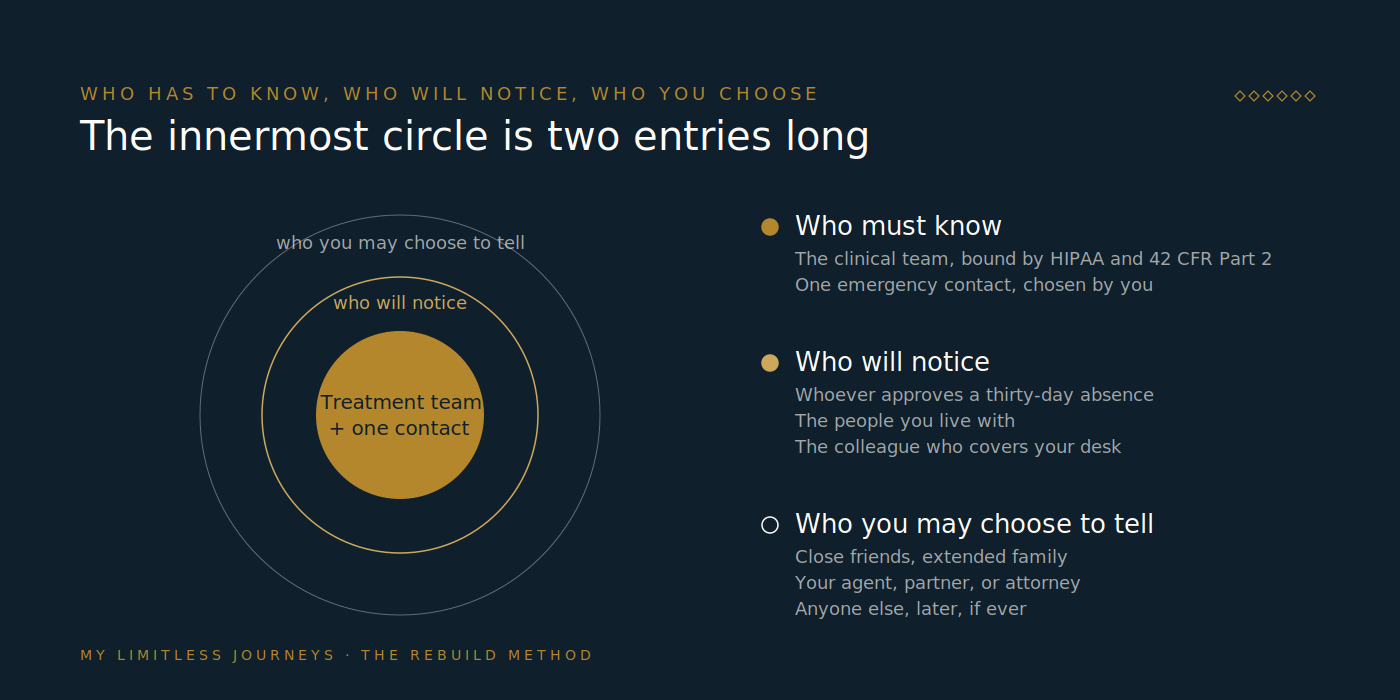
Two entries, and you control the second.
The first is us. The clinical team treating you needs a truthful account of what you have been using, how much, for how long, what medications you take, and what medical conditions you have. We gather this directly from you on the admissions call and at intake. We do not need to call your primary care physician to do it, and we will not contact any outside clinician without a consent that names them. If medication reconciliation or a prior record would materially improve your safety in detox, we will tell you why and ask; you decide.
The second is an emergency contact. We ask every client for one, because a medical emergency during detox is rare but real, and someone should be reachable if you cannot speak for yourself. The person does not have to be a family member. Clients have named an attorney, a business manager, a longtime friend, a sponsor. The contact does not receive updates, is not told anything about your treatment in the ordinary course, and is reached only if a situation arises that you cannot handle yourself. Choosing this person carefully is the first privacy decision you make, and it is a small one.
That is the whole mandatory list. Everyone else, including the people discussed in the rest of this page, is there because of logistics rather than law.
Who will notice.
Privacy law protects information. It does not protect against inference, and inference is how most people are found out. The people who will notice you are gone fall into predictable groups, and each has a different remedy.
| Who | What they will observe | What closes the gap |
|---|---|---|
| Household | An empty bed for weeks | Realistically, nothing; a cohabiting partner is almost always the one person who should know |
| Employer | A leave request or an unexplained absence | Medical leave paperwork that does not name a diagnosis; a planned coverage story |
| Clients, collaborators, cast | Unavailability | Timing around a natural break; a single point of contact who says "unavailable for personal reasons" |
| Policyholder on your insurance | An explanation of benefits | A confidential-communications request before the first claim, or private pay |
| Friends and extended family | Silence on the usual channels | Scheduled phone access at later clinical stages; a plausible reason for being offline |
The first row is the one people most want to argue with, so we will be direct. If you share a home with a partner, a residential stay without telling them is not a privacy strategy; it is a second secret layered on the first, and it tends to end badly for the relationship and for the recovery. The family confidentiality spoke explains how narrowly you can define what a partner is told, which is a far better tool than silence.
The thirty-day absence problem.
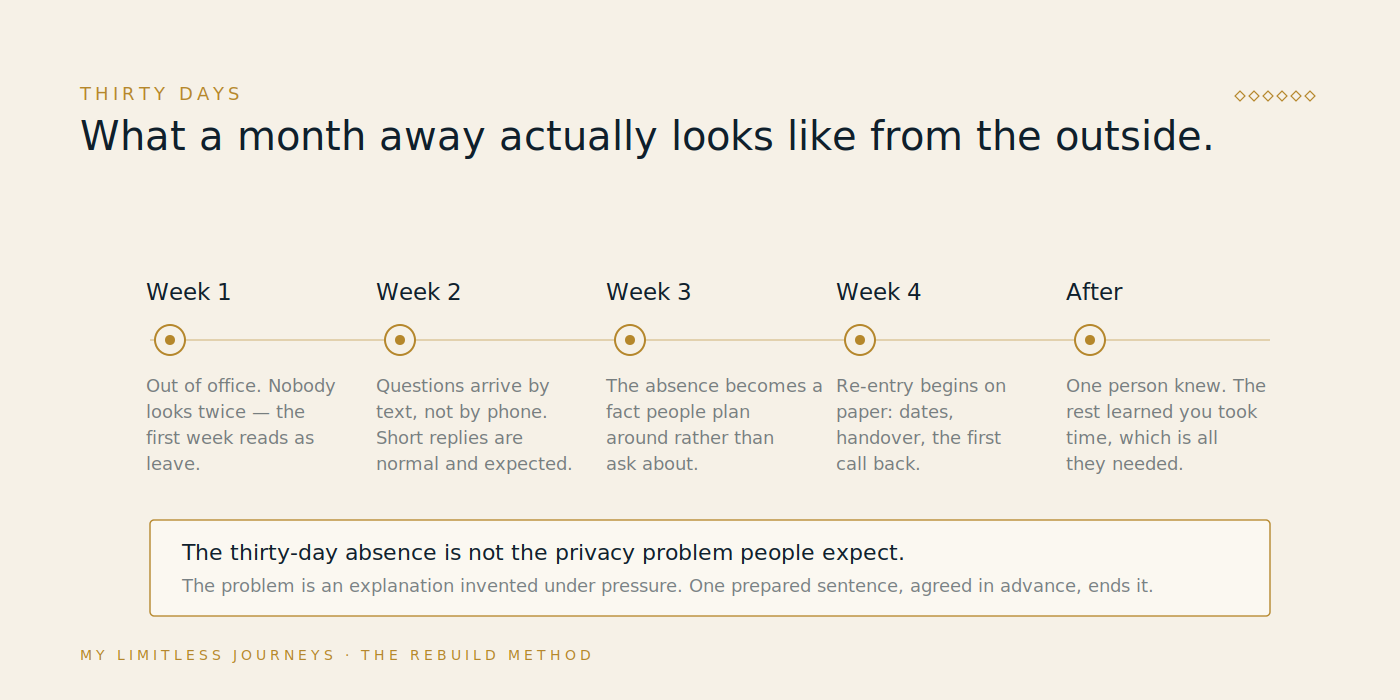
Here is the obstacle that no statute addresses. A residential stay of thirty to ninety days is a hole in the calendar, and the people whose lives intersect yours will see the hole even if they never learn what filled it. For a professional with a visible role, the absence is the disclosure.
Three things shrink the hole. The first is level of care. Not everyone needs residential treatment; for some people, a partial hospitalization program or an intensive outpatient program is clinically appropriate and lets you sleep at home and keep some working hours. The residential decision should be made on clinical grounds, not convenience, but where outpatient care is genuinely sufficient it also happens to be quieter. The second is timing. A hiatus, a gap between engagements, the weeks after a case closes, the summer a production goes dark: absences are expected in these windows and go unremarked. The third is a coverage story that is true without being complete. "I'm taking a medical leave" is accurate, ordinary, and ends most inquiries. "I'm dealing with a health issue and will be back in October" is the same sentence for someone without an HR department.
What does not work is improvisation. People who arrive without having decided what to say tend to say too much in the first week and too little afterward. We spend part of the admissions process on exactly this, and the scripts page gives you language to adapt.
What a small residence makes possible.
Most incidental exposure in treatment has nothing to do with records. It comes from the physical experience of a large facility: a lobby where visitors and new arrivals pass one another, a branded van pulling up to a meeting, a group room with forty people in it, a parking lot with a sign. Every one of those is a chance to be recognized, and every one of them is a design choice.
We made different choices. The residence is a private hillside home in Encino with six beds, never more, and its street address is not published; you receive it at intake. There is no lobby, because it is a house. There is no van, because six people do not need one. Groups have at most five other people in them, and the same clinical team works with you from detox through transitional living, so your history is never handed off to a new staff. Everyone on that team is trained to treat your identity, your work, and your reputation as sensitive by default, without being told. The facility page describes the house; the spoke on how six beds changes anonymity does the arithmetic on who could ever know.
Phone access is set by clinical stage rather than by blanket rule, which matters for someone maintaining a presence. In early detox the phone is set aside because the clinical work requires it; as you stabilize, scheduled access returns, and a person who needs to answer a message a day to remain plausibly "traveling" can usually do so from the second week onward. We are honest that this is a clinical judgment, not a concierge service; the working during treatment page explains how it varies by level of care.
The honest limits.
A page like this earns its trust by naming what it cannot promise, so here is that list.
In a genuine medical emergency, Part 2 permits us to give treating medical personnel the information they need, and we will, because your life comes before your privacy. If a report is required under state child abuse law, Part 2 does not prevent it. A court may order disclosure of your record after making the specific findings Part 2 requires; a bare subpoena cannot, but a proper order can. If you use insurance held by someone else, an explanation of benefits will reach them unless you redirect it first, and the insurance versus private pay spoke explains how. And the other five people in the house are not bound by any law. We set clear expectations about photography, social media, and discretion, and in our experience people in early recovery guard one another's anonymity fiercely, but we cannot sign a contract on their behalf.
Finally, and most importantly, we cannot make you invisible in your own life. You will still be a person who was gone for a month. What we can do is make sure that fact is the only fact anyone outside your chosen circle ever has.
Why one person is usually the right number.
We have described how far secrecy can go. We would be poor clinicians if we did not also say how far it should. Substance use disorders are, among other things, diseases of isolation. The drinking or the using was almost certainly something you hid, and the hiding was part of what kept it going. Entering treatment in total secrecy reproduces that structure at the moment you are trying to dismantle it, and it removes the person who could notice if things go wrong afterward.
The evidence and our experience agree that recovery is more durable when at least one person outside the treatment team knows the truth. It does not need to be a family member. It does not need to be more than one. It needs to be someone who can hear "I was in treatment for alcohol" without flinching, and who will still be in your life at the ninety-day mark, when the after-treatment period asks the most of you. Choosing that person is a decision we will help you make, at your pace, and we would rather you arrive having told nobody than not arrive at all. But if you can find one, find one.
- Privacy in treatment — the hub, on what the law protects and what a residence adds.
- What to tell your team — the exact words for an assistant, an agent, a partner, or a colleague.
- Family confidentiality — how narrowly you can define what a partner or parent is told.
- Timing treatment around a production calendar — using natural breaks so the absence goes unremarked.
- Residential treatment — what the thirty to ninety days actually contain.
- Signs of a high-functioning alcoholic — a post for the reader who has been hiding it well, and knows it.
This guide is educational and is not a substitute for medical or legal advice. If someone is in immediate danger, call 911.