
Phones and social media in treatment: the fear that someone else posts.
The question we hear most from professionals is not "can I keep my phone." It is "what stops another client from photographing me." Here is how phone access works at each stage of care, what we do about cameras, and why several weeks away from the feed turns out to be part of the treatment.
Authored by the MLJ Clinical Team. Reviewed under board-certified psychiatric oversight. Last updated September 2026.
Key Takeaways- Phone access at MLJ follows clinical stage: very limited during detox, scheduled during residential, expanding through PHP and IOP, and unrestricted in transitional living.
- No client may photograph, record, or identify another client, anywhere on the property, at any stage. Staff hold the same standard and do not use personal devices in clinical spaces.
- With six beds, the people who could break that rule are few and known, and we screen for conflicts before admission rather than after.
- A period without social media is not a punishment. It removes a reliable trigger for comparison, craving, and sleep disruption while the brain recalibrates.
- You will re-enter the feed before you leave, deliberately and with a plan, so that the first scroll happens with a clinician nearby rather than alone in a car.

The real fear, named.
When someone whose face or name is recognizable considers treatment, one image tends to surface: a stranger in the next room, a phone held low, a photo that surfaces online a week later. It is not an irrational fear. The HIPAA Privacy Rule binds the provider. It does not bind the person eating breakfast across from you.
So we want to be direct about three things. First, the rule: no client photographs, records, or identifies another client, ever, on or off the property. Second, the structure that makes the rule enforceable: six beds, a screened and known community, and phone access that is limited during exactly the stages when judgment is least reliable. Third, the honest limit: no residential program can make a legally binding promise on behalf of its other clients. What we can do is make the population small, the culture explicit, and the consequences immediate.
Phone access by clinical stage.
Our phone policy is not a single rule. It is a gradient that tracks the level of care you are in, because what a phone does to a person in their third day of alcohol withdrawal is different from what it does to a person six weeks into IOP.
During medically supervised detox, typically the first three to seven days, your phone is held by staff. You can make and receive calls through us, and you will have a scheduled window each day to reach the people who need to hear from you. The reason is medical as much as anything. Withdrawal disrupts sleep, mood, and impulse control, and a device that delivers every unread message and every headline at once is not something we want in the hands of a person whose nervous system is recalibrating.
In residential treatment, phones return on a schedule. Typical access is a defined block in the late afternoon or evening, outside of clinical programming, with the device returned overnight. Laptops for essential work can be arranged with your therapist for professionals who genuinely need them, within clear time limits; our page on working during treatment explains how those boundaries are set and why. Social media apps are typically off during this stage, and we will talk with you about whether to remove them from the device or simply log out.
In PHP, you have your phone for most of the day outside of sessions, and social media re-entry begins as a planned clinical exercise, not a default. In IOP, access is essentially unrestricted, because you are living your life and coming to programming. In transitional living, there are no device rules beyond the shared household expectations about photographing others.
| Stage | Phone | Social media | Photographing others |
|---|---|---|---|
| Detox | Held by staff; daily call window | None | Never |
| Residential | Scheduled block; returned overnight | Off by default | Never |
| PHP | Yours outside sessions | Planned re-entry with your therapist | Never |
| IOP | Unrestricted | Your plan, reviewed in session | Never |
| Transitional living | Unrestricted | Unrestricted | Never |
Cameras, recording, and the people around you.
The no-photography rule is the one commitment on this page that does not vary by stage. It is reviewed with every client at admission, in writing, and it covers photographs, video, audio, screenshots of group video calls, and any post that names or describes another resident, even admiringly, even after discharge. A client who photographs another client is discharged. We have never needed to soften that, and we do not intend to.
Rules alone are not what make people safe, though. Two features of a small residence do more work than the policy. The first is that during detox and early residential, the stages when someone might act impulsively, no one has a phone in hand without a staff member aware of it. The window for a careless photo is narrow because the window for any phone use is narrow.
The second is the size of the community. In a forty-person group, the person across the circle is a stranger who will discharge before you learn their last name. In a home of six, that person is someone you have eaten dinner with for two weeks, whose children's names you know, who has told you things they have told no one else. People do not photograph the people they are in that kind of relationship with. Where a large program relies on a rule, we rely on a rule plus a relationship, and the relationship is the stronger of the two.
We also ask, during the admissions process, about professional connections and overlapping circles. If an incoming client works in the same industry as a current resident, or is likely to recognize them, we address it before admission. Six beds makes that screening possible. Sixty does not.
What we ask of staff.
Clients are half of the picture. The other half is the people who work here. Every member of the MLJ team is bound by HIPAA and by 42 CFR Part 2, which treats substance use treatment records as more protected than general medical records and makes unauthorized disclosure a federal matter. That is the floor.
Above the floor, our standards are practical. Staff do not use personal devices in clinical spaces or common areas during programming. Staff do not follow, friend, or search for current or former clients on any platform, and they do not respond if a client reaches out that way after discharge except to redirect the conversation to appropriate channels. Staff do not post about their work in any way that could identify a client, a client's industry, or a client's schedule, and "could identify" is read broadly. A photo of a sunset from the property with a recognizable car in the frame is a violation. So is a vague post about "an interesting week with a client from the industry."
Beyond the written policy, we train people to treat identity, work, and reputation as sensitive by default, so that the standard is applied by reflex. That training is part of how we define Discretion as the perimeter around the Rebuild Method, and it is why our clinical team is small and stays the same from detox through alumni.
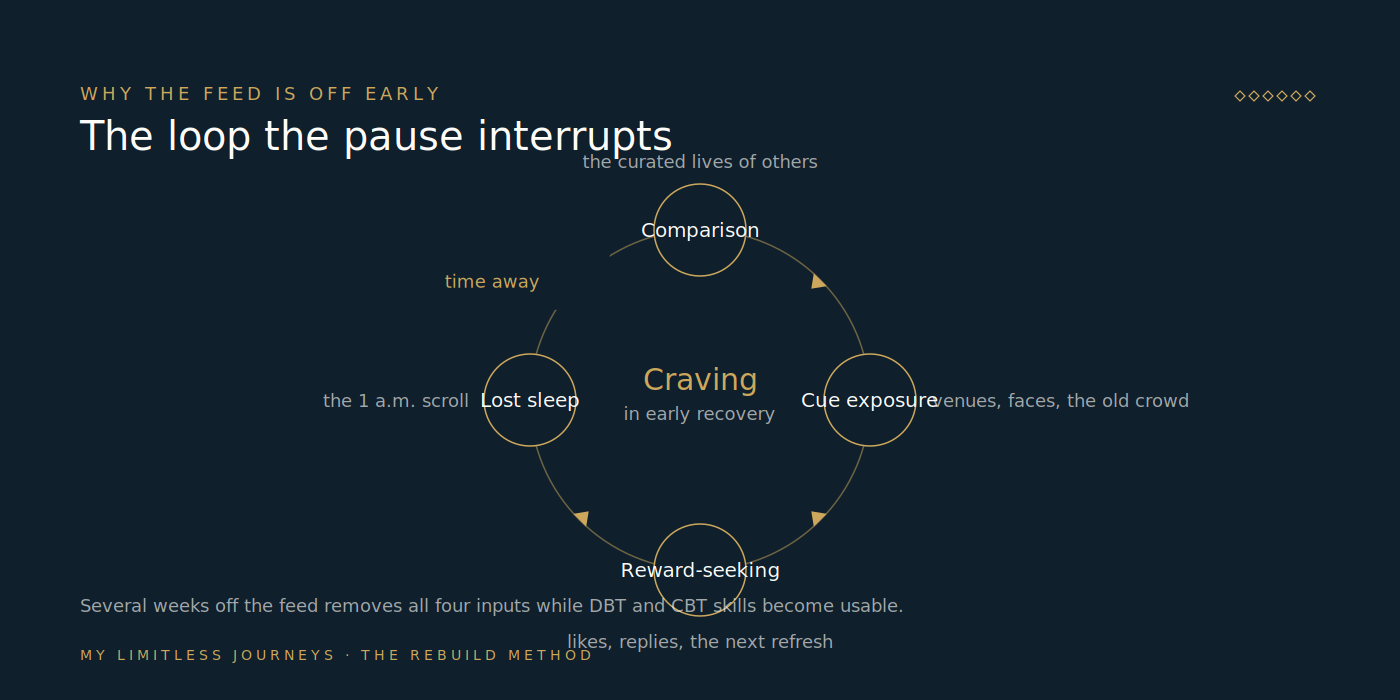
Why time off the feed is clinical, not punitive.
Clients sometimes experience the social media pause as a privacy measure dressed up as treatment. It is the reverse. The privacy benefit is real, but it is secondary. The primary reason we keep the feed off during detox and early residential is that the feed reliably aggravates three things we are trying to steady.
The first is reward. Substance use disorders alter how the brain's reward circuitry responds to natural and artificial reinforcers, and the National Institute on Drug Abuse describes early recovery as a period in which that circuitry is recalibrating. Social platforms are engineered around intermittent, unpredictable reward: the notification, the like, the reply. Asking a brain three days into abstinence to sit quietly with itself while a device in its pocket offers a small hit every few minutes is asking a lot. Removing the device removes the competition.
The second is sleep. Insomnia is among the most common and most relapse-relevant symptoms of early recovery, and late-night scrolling is one of its most consistent aggravators. Our detox pillar has a full guide on sleep in early recovery; the short version is that a phone in a bedroom at 1 a.m. undoes a great deal of careful clinical work on sleep architecture.
The third is cue exposure. For many of our clients, the feed is where their using life lived: the accounts of people they drank with, the venues, the photos from the parties. Scrolling through that in week one is not neutral. It is a series of cues, delivered in rapid succession, to a person who has not yet built the skills to sit with the craving they produce. Those skills come from DBT and CBT work, and they take a few weeks to become usable. The pause buys that time.
There is also a quieter benefit. For people whose public image is part of their work, several weeks without the constant low-grade performance of being seen is often the first sustained rest they have had in years. That is not a side effect. It is the Self domain of the Rebuild Method doing what it is meant to do.
Re-entering the feed before you leave.
The worst way to return to social media after treatment is in the car on the way home, alone, with a month of accumulated notifications. We do not let that happen. Re-entry is scheduled, usually in PHP, and it happens as a clinical exercise: you open the app in or near a session, you notice what the first ten minutes do to your body and your mood, and you talk about it.
From there, you and your therapist build a plan. It usually covers which accounts to mute or unfollow, whether to post about your absence at all, how to handle direct messages that ask where you have been, what time of day the apps are available to you, and what to do the first time the feed produces a craving. For clients whose public image is professionally important, the plan also covers what you will and will not say publicly, which we discuss at length in our guide to social media, image, and recovery in the public eye.
None of this is about staying offline forever. Most of our clients return to normal use of their devices. The goal is that the return happens on your terms, with the skills in place, rather than as the first thing you do when the door closes behind you.
- Privacy in Treatment. The hub: what the law protects, and what we add.
- How six beds changes anonymity. Why a small census is the strongest privacy tool we have.
- Family confidentiality. Releases of information and who can reach you.
- Working during treatment. Laptops, calls, and clinical boundaries by level of care.
- Residential treatment. What a day looks like, including when you have your phone.
- Social media, image, and recovery in the public eye. What to post, what to stop, and how a team handles a leak.
This guide is educational and is not a substitute for medical advice. If someone is in immediate danger, call 911.