
Published by the Clinical Team at My Limitless Journeys. Reviewed under board-certified psychiatric oversight.
The feed is a slot machine, and you already know how those work
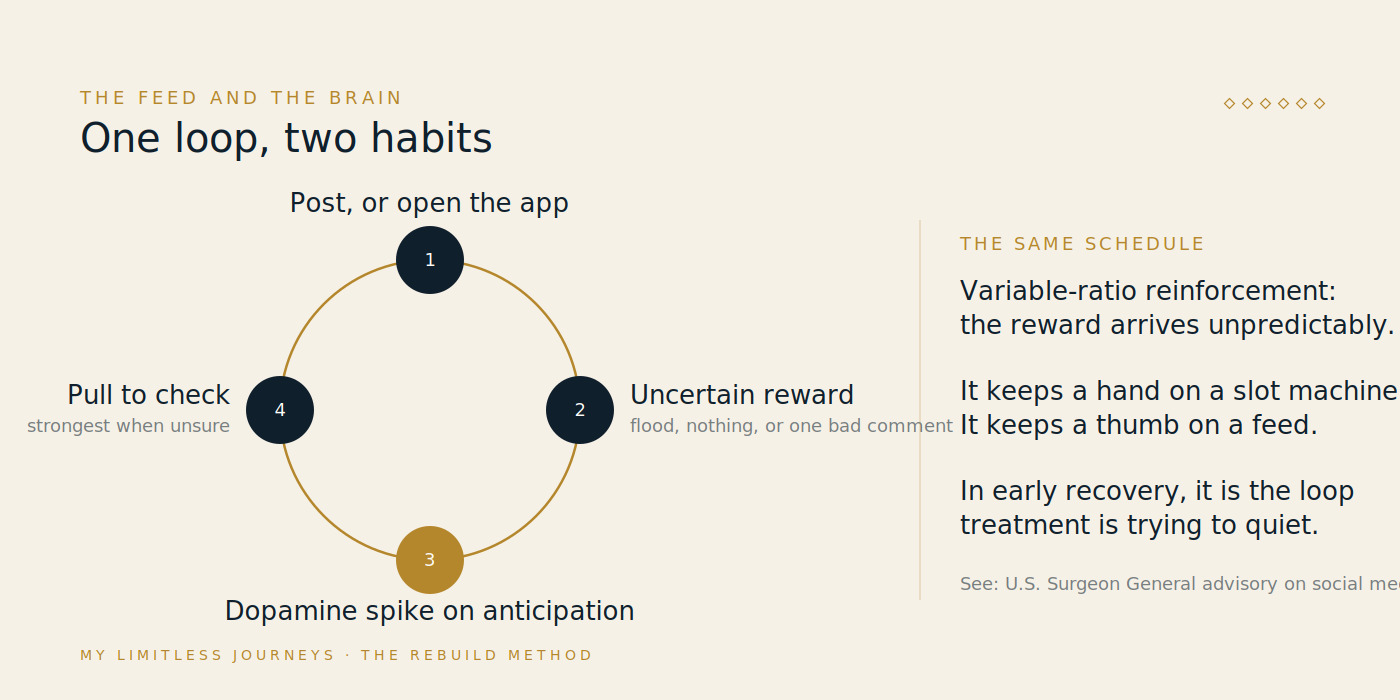
Every platform you use is built around a mechanism psychologists call variable-ratio reinforcement. You post, you wait, and the reward arrives on an unpredictable schedule: sometimes a flood of attention, sometimes nothing, sometimes a single comment that ruins the afternoon. The unpredictability is the point. It is the same schedule that keeps a person at a slot machine long after the money is gone, and it is the same schedule that a brain in early recovery from alcohol, cocaine, or opioids is trying, with real effort, to stop responding to.
The science here is not speculative. Dopamine, the neurotransmitter most associated with anticipation and craving, is released more strongly in response to uncertain rewards than to reliable ones, which is why the pull to check is strongest when you do not know what you will find. The U.S. Surgeon General’s 2023 advisory on social media described these design features plainly, noting that platforms are engineered to maximize engagement in ways that can be difficult for users to resist. The advisory was written about adolescents. Adults in early recovery, whose reward systems are recalibrating after years of chemical override, are not in a stronger position.
This is why we treat phone access in residential treatment as a clinical question rather than a rule about manners, and why our page on phones and social media in treatment describes the early restriction as a benefit. A nervous system that is not being pinged every four minutes by an uncertain reward has a chance to find its own baseline. For most clients, that baseline turns out to be quieter than they have felt in years.
Why the public eye changes the math
For most people, the cost of a bad week on social media is a bad week. For an actor, a musician, an on-air host, a founder with a following, or anyone whose name is a search term, the account is also a business asset, a contractual obligation, and a surveillance target. Fans notice when the cadence changes. Trade press notices when a public person goes quiet during a production. A single photograph from a treatment residence, posted by another client or a stranger at a nearby trailhead, is not an embarrassment. It is a story.
So the ordinary advice, delete the apps and go for a walk, is not wrong, but it is insufficient. Public people in treatment need three things the rest of us do not: a plan for the account while they are away, a plan for the moment someone finds out, and a plan for the relationship with the feed when they return to it. Those three plans are what the rest of this article is about. They are drawn from the work we do with clients in the professionals program, where discretion is the perimeter around everything else, and they are the reason a six-bed residence with no lobby, no vans, and no group photograph exists in the first place.
What to stop, now
Stop posting from treatment. This sounds obvious and is violated constantly, usually in the third week, when someone feels well enough to want the world to know they are fine. A sunset from the hillside, a coffee cup, a caption about growth: each one is a geotag, a timestamp, and a mood reading handed to anyone paying attention. The residence is also home to five other people whose anonymity depends on nobody photographing the living room.
Stop reading the comments, and stop reading about yourself. If your name is searchable, someone on your team can monitor it and tell you if there is anything you genuinely need to know. There almost never is. What there will be is a stranger’s theory about your absence, and in week two of recovery that theory will occupy your afternoon in a way that no clinical hour can compete with.
Stop explaining. The urge to post a clarifying note, to correct the record, to get ahead of a rumor with a partial truth, is powerful and almost always wrong. Silence is not an admission. It is the default setting of a person on medical leave, which is what you are.
And stop the direct messages, at least from a specific group. The people you used with will reach out. Some of them are worried. Some of them are curious. Some of them are the reason the last six months went the way they did. We wrote about this network directly in when your using network is your professional network; the short version is that the DM thread with the person who always had something is the last thing your recovery needs to see light up.
What to post: the quiet holding pattern
The account should not go dark. A public person who has posted daily for three years and then stops for thirty days has announced something. The alternative is a holding pattern: a reduced, scheduled cadence of low-information content prepared before admission and posted by a team member on your behalf. Archive material. Project promotion that was already in the pipeline. A repost of a collaborator. Nothing with a location, a date, or a face in a room anyone could identify.
Build it in the week before you admit, with whoever manages the account, and give them one instruction: this runs without me, and you do not send me screenshots. If you are in production, the publicist and the studio should already know you are unavailable for personal reasons, in the language we lay out in what to tell your team. The holding pattern is simply the public-facing version of the same sentence.
One rule for the team as well: no one on it posts about you either. The assistant’s story from the wrap party, the manager’s tag at a dinner you were not at, the friend’s “thinking of you” with a heart: these are the small leaks that add up to a timeline. The people close to you should be as boring online as you are for the duration.
How a team handles a leak
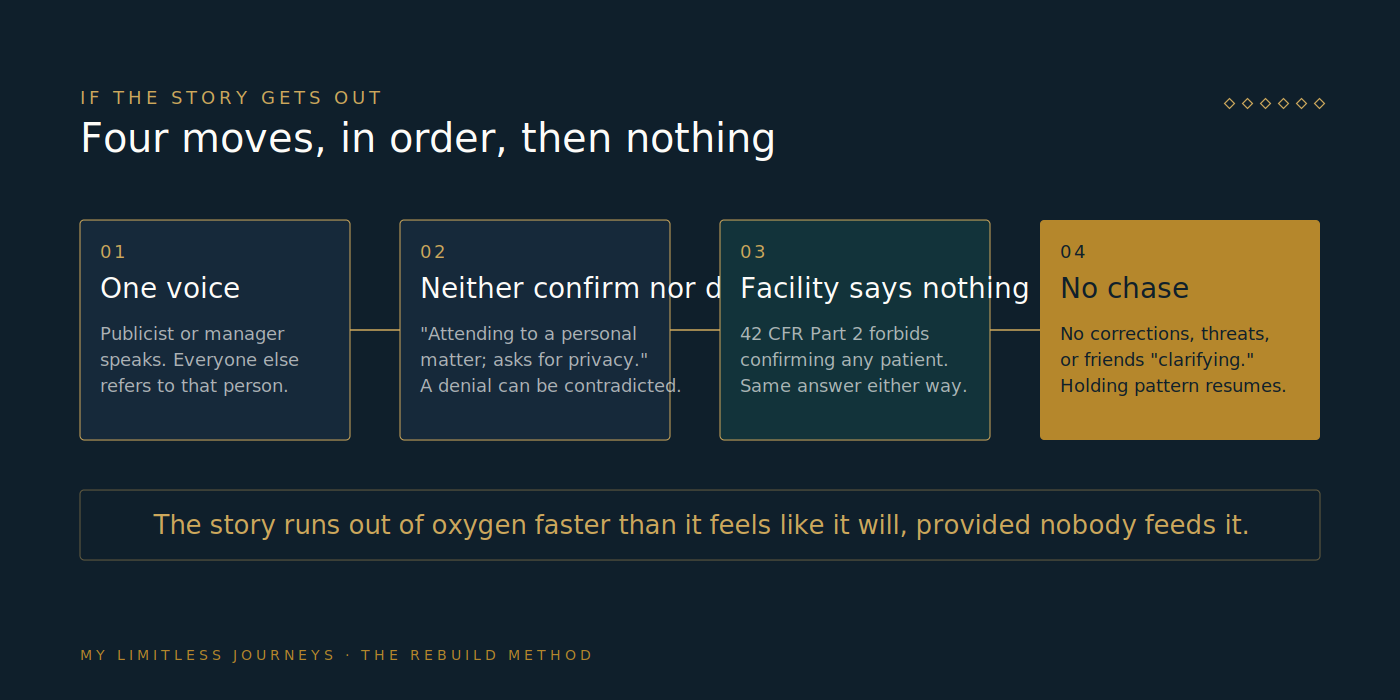
Sometimes the story gets out anyway. A neighbor, a former assistant, a photograph from a distance, a data breach at an unrelated company. When it happens, the response should already exist, and it has four parts.
One voice. A single person, usually a publicist or manager, is the only one who speaks. Everyone else, including you, says nothing and refers inquiries to that person. Two voices produce two versions, and two versions produce a second story.
No confirmation and no denial. The statement, if there is one, is that you are taking time to attend to a personal matter and ask for privacy. A denial that is later contradicted is worse than the original story. A confirmation is a disclosure you cannot take back. The middle position is not evasive; it is the position every person on medical leave is entitled to.
The facility says nothing, and cannot. Under HIPAA and the stricter federal rule known as 42 CFR Part 2, a substance-use treatment program may not confirm or deny that any person is or has ever been a patient, to a journalist or anyone else, without written consent. When a reporter calls MLJ, the answer is the same whether you are here or not. That symmetry is a protection: our silence tells no one anything.
No chase. The instinct to correct, to threaten, to engage the account that posted it, or to have a friend “clarify” in the comments is the instinct that turns a two-day story into a two-week one. The holding pattern resumes on schedule. The story runs out of oxygen faster than it feels like it will, provided nobody feeds it.
Whether to speak about recovery publicly, and when
Some public people eventually decide to talk about their recovery, and some of that talk has done enormous good. Other people decide that their sobriety is the one part of their life that is not content, and that decision has protected them. Both are legitimate. What we ask is that the decision not be made in the first ninety days.
Early recovery produces a particular kind of clarity, and with it a particular urge to testify. That urge is real, and it is also a symptom of the same reward loop we began with: the announcement will land, the response will be uncertain and probably warm, and the dopamine will be considerable. A public statement about sobriety at day forty also creates a public stake in a private process, so that the slip at day seventy, if it comes, is no longer a clinical event but a news item. Our page on the first ninety days back at work describes the inflection point near day ninety when confidence outruns stability; the decision to speak publicly belongs on the far side of it, made with your therapist, from a position where you have nothing to prove.
Rebuilding a relationship with the feed
When the phone comes back, it should come back the way work does: scheduled, bounded, and observed. We work with clients on a return that treats the feed as a professional instrument rather than a companion. Check it at set times, from a desk, not from bed. Let the team keep managing what can be managed. Turn off every notification that is not a person you know. And notice, in the first weeks, what a session on the app does to your mood, because the answer is data your therapist can use.
In the Rebuild Method, this falls under the Self domain: the question of who you are when nobody is watching, which for a public person is a question that has often gone unasked for years. Treatment is one of the few places that question gets asked without an audience. The approach is built around it. The feed will still be there when you are done. The difference is that you will be deciding what it is for.
Frequently asked questions
Can another client at the facility post about me?
At MLJ, no photography of other clients or of the residence is permitted, phones are held during detox and scheduled afterward, and every client is bound by the same confidentiality expectations. With six beds, the number of people who could ever know you were here is smaller than most dinner parties. Our page on how six beds changes anonymity goes into the arithmetic.
Should my accounts go completely dark while I am in treatment?
For most public people, no. A sudden silence is itself a signal. A reduced, pre-scheduled cadence of low-information posts, managed by your team, is less conspicuous and asks nothing of you while you are here.
What will MLJ say if a journalist calls?
Nothing about any individual, ever, without written consent. Federal law prohibits a substance-use treatment program from confirming or denying that a person is or was a patient. The response is identical whether you are here or not.
Is compulsive social media use itself something treatment addresses?
Yes, as part of the broader work on reward, regulation, and identity rather than as a separate diagnosis. Many clients discover that the feed was doing the same job as the substance, and the skills that address one address the other.
If your name is a search term and you need to get well without it becoming a story, that is what we are built for. The conversation is confidential, and it starts wherever you are.
Keep reading: Privacy in Treatment · Phones and social media in treatment · For actors and on-camera talent · Purpose, dopamine, and recovery