
Anxiety that performs well is still anxiety.
If you have been managing a racing mind with a drink at six, a pill at eleven, or both, you already know the relief is shrinking and the mornings are getting worse. This page explains why that happens, what safe detox looks like when anxiety is part of the picture, and how we treat the anxiety itself rather than just removing the thing that was quieting it.
Authored by the MLJ Clinical Team. Reviewed under board-certified psychiatric oversight. Last updated September 2026.
Key Takeaways- Anxiety disorders are the most common mental-health conditions in adults, and alcohol and benzodiazepines are the substances most often used to manage them.
- That shared chemistry is the trap: the relief is real for a few hours, and the rebound is worse than the baseline, so the dose creeps and the anxiety grows.
- Withdrawal from alcohol or benzodiazepines produces anxiety, so detox is medically supervised and we do not diagnose the underlying disorder until the curve settles.
- Lasting treatment relies on non-habit-forming medication, CBT and exposure work, and rebuilding the body's own capacity to settle.
- Residential care makes sense when anxiety and substance use have fused, when outpatient attempts have stalled, or when detox is needed at all.

How anxiety shows up in adults who drink or use.
The textbook picture of generalized anxiety disorder is six months or more of persistent, hard-to-control worry with restlessness, fatigue, poor concentration, irritability, muscle tension and disturbed sleep. The National Institute of Mental Health estimates that close to a third of American adults meet criteria for an anxiety disorder at some point in life.
In the adults we treat, the textbook picture is usually hidden. What we see instead is a competent person whose anxiety has been outsourced to a substance. The worry is still there, but it has been scheduled: fine until the late afternoon, then a drink that is less about pleasure than about turning the volume down. Or a benzodiazepine prescribed years ago for flying, now taken most nights and carried in a bag "just in case." Or a stimulant to get through the day and alcohol to come down from it, with anxiety underneath both.
The tell is not the quantity. It is the function. When the first question you ask about any evening is whether you will be able to drink, and when the physical symptoms of anxiety (tight chest, racing heart, a stomach that will not settle) show up on schedule in the hours before the first dose, the anxiety and the substance have stopped being two problems. They are one system. Our post on high-functioning anxiety and quiet alcohol use describes that pattern.
Why alcohol, benzodiazepines and anxiety lock together.
Anxiety, at the level of brain chemistry, involves an imbalance between excitatory signaling (largely glutamate) and inhibitory signaling (largely GABA). Alcohol and benzodiazepines both enhance GABA activity. That is why they work: for a few hours, they supply the brake the anxious brain is short on.
The brain does not tolerate an external brake for long. It reduces its own GABA sensitivity and upregulates glutamate to compensate. When the drug wears off, the person is left with less inhibition and more excitation than they started with, which is experienced as anxiety, often sharper than the original. The natural response is another dose, a little sooner. Over months, the baseline climbs. This is the same mechanism that makes alcohol and benzodiazepine withdrawal medically dangerous, and it is why the National Institute on Drug Abuse lists anxiety disorders among the conditions most strongly associated with substance use disorders. The arrow points both ways: anxiety drives use, and use manufactures anxiety.
Detox when anxiety is in the room.
Anxiety is a withdrawal symptom of alcohol, benzodiazepines, and, to a lesser degree, stimulants and cannabis. In the first week of detox nearly everyone looks anxious, and we cannot tell on day two how much is the disorder and how much is rebound. We do not pretend to.
For alcohol, we follow the ASAM Clinical Practice Guideline on Alcohol Withdrawal Management: symptom-triggered benzodiazepine dosing under nursing observation, thiamine and electrolyte repletion, and physician review of anything that looks like escalation. Alcohol withdrawal typically peaks between 24 and 72 hours; our alcohol withdrawal timeline walks through it. For benzodiazepines, abrupt cessation is unsafe in someone who has been taking them daily. We convert to a long-acting agent and taper over a schedule set by how long and how much you have been taking, which often means the taper continues well into the residential stay.
Anxiety-specific detox measures include reducing caffeine, protecting sleep aggressively from the first night, and using non-sedating supports (hydroxyzine, propranolol for the physical symptoms, sometimes gabapentin) so that the taper does not simply substitute one dependence for another. We formally reassess anxiety around day ten to fourteen, once the acute curve has passed. What remains at that point is the disorder we treat.
Medication: what helps, what we avoid.
First-line medication for generalized anxiety, panic and social anxiety is an SSRI or SNRI. These take three to six weeks to work, do not produce dependence, and pair well with therapy. Hydroxyzine and beta-blockers help with the body's contribution (tremor, palpitations, the sensation of adrenaline) without touching the reward system.
What we avoid, in someone with a history of alcohol or sedative use, is a standing benzodiazepine prescription. Benzodiazepines are excellent short-term tools and dangerous long-term ones for this population, and the FDA's boxed warning now names abuse, addiction, dependence and withdrawal reactions explicitly. If you arrive on a benzodiazepine, our job is to get you off it safely and to make sure something durable replaces it. If you arrive on a stimulant, we look at whether it is feeding the anxiety. Medication is one piece of the Body domain; it is not the treatment.
Anxiety through the four domains.
The Rebuild Method treats every condition across Body, Mind, Life and Self, inside a perimeter of discretion. For anxiety, the domains look like this.
Body. Anxiety is a body state before it is a thought. We restore sleep first, because sleep deprivation is itself anxiogenic. Fitness is prescribed as clinical work: aerobic exercise has a measurable anxiolytic effect, and heart-rate-variability biofeedback teaches the vagal brake the substance used to supply. Nutrition removes the blood-sugar swings that mimic panic.
Mind. Cognitive behavioral therapy is the most studied treatment for anxiety disorders. In practice that means identifying the catastrophic predictions your mind makes automatically, testing them, and deliberately approaching the situations you have been avoiding, in graded steps, without the chemical buffer. For panic, interoceptive exposure teaches your body that a racing heart is not an emergency. Where trauma sits underneath the anxiety, and it often does, EMDR and trauma-focused work begin once you are stable enough to tolerate them.
Life. Anxious adults build lives that look organized and feel like narrowly avoided disasters. We rebuild the daily structure so that regulation is built in rather than improvised: consistent wake time, movement before screens, defined work hours, a plan for the six o'clock hour that used to hold the drink. Return-to-work planning is specific, down to the first client dinner sober.
Self. Many high-functioning anxious people have never separated who they are from what they are afraid of failing at. Values work and acceptance-based therapy help you decide what actually matters, so that the constant threat-scanning has less to attach to. This is quiet work, and it tends to hold.
What a stay looks like.
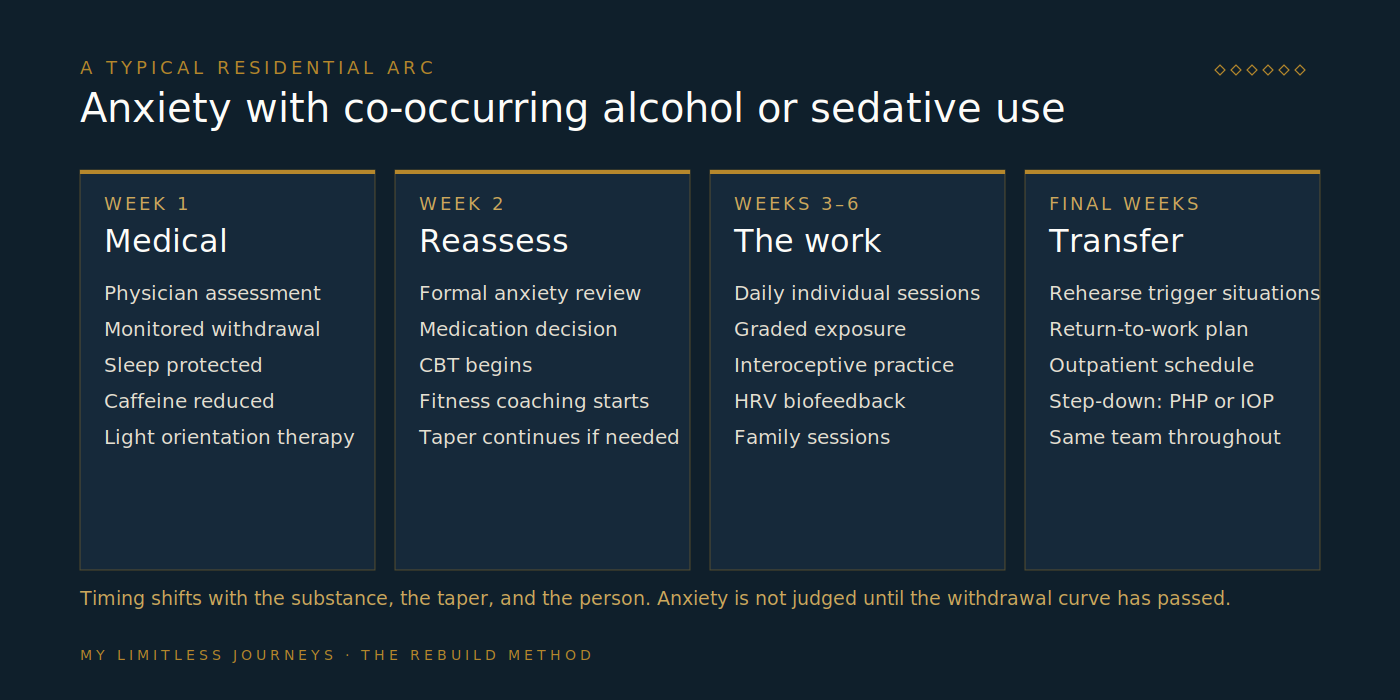
The first week is medical. You are seen by a physician on arrival, monitored through withdrawal, and allowed to sleep. Therapy in week one is light: orientation, a working relationship with your primary clinician, and a first map of how anxiety and use have fed each other.
Week two brings the formal psychiatric reassessment, a medication decision if one is indicated, and the start of structured CBT. Weeks three through six are the working middle: daily individual sessions, small groups (there are never more than five other people in the house), exposure exercises that get progressively more real, fitness coaching, and family sessions. The final stretch is about transfer: rehearsing the situations that used to trigger the drink, building the outpatient schedule, and deciding with your clinician whether you step down to PHP, IOP, or transitional living. The same team follows you through each step.
Residential or outpatient?
Plenty of anxiety is treated well in a therapist's office, and if that is you, we will say so on the phone. Residential care earns its place in three situations. The first is when detox is needed at all: daily alcohol or benzodiazepine use is not something to stop at home, and the anxiety spike during withdrawal is exactly when people give up. The second is when the anxiety and the substance have fused, so that every attempt at outpatient therapy is undermined by the evening's relief. The third is when you have tried outpatient care in good faith and the pattern has not moved.
Outpatient care, including our own IOP, makes sense when there is no physical dependence, the anxiety is uncomfortable but not disabling, and home is a stable place to practice. Our guide on whether you need residential treatment lists the questions we ask.
A note for families.
Anxiety is contagious inside a household. Partners learn to pre-empt and smooth so the drinking stays at two instead of five. That accommodation is loving, and it is part of the system. In family sessions we do not assign blame; we map the pattern and give everyone a different role. Expect your person to be more anxious, not less, in the first two weeks; that is the treatment working, not failing. Our families hub covers what to say and how to look after yourself while they are here.
- Mental health treatment at MLJ. The hub for every condition we treat.
- PTSD and trauma. When the anxiety has a history behind it.
- Co-occurring disorders. How we treat two conditions as one system.
- Benzodiazepine tapering. How a safe taper is built and paced.
- Residential treatment. The program most anxiety clients begin in.
- Sunday night dread, Monday drink. Anticipatory anxiety and the ritual around it.
This guide is educational and is not a substitute for medical advice. If someone is in immediate danger, call 911.