
The doubt that demands a ritual.
OCD is not a preference for order. It is a thought the brain misfiles as a threat and a ritual recruited to quiet it, which works for minutes and strengthens the loop every time. For many adults the ritual eventually becomes a drink.
Authored by the MLJ Clinical Team. Reviewed under board-certified psychiatric oversight. Last updated September 2026.
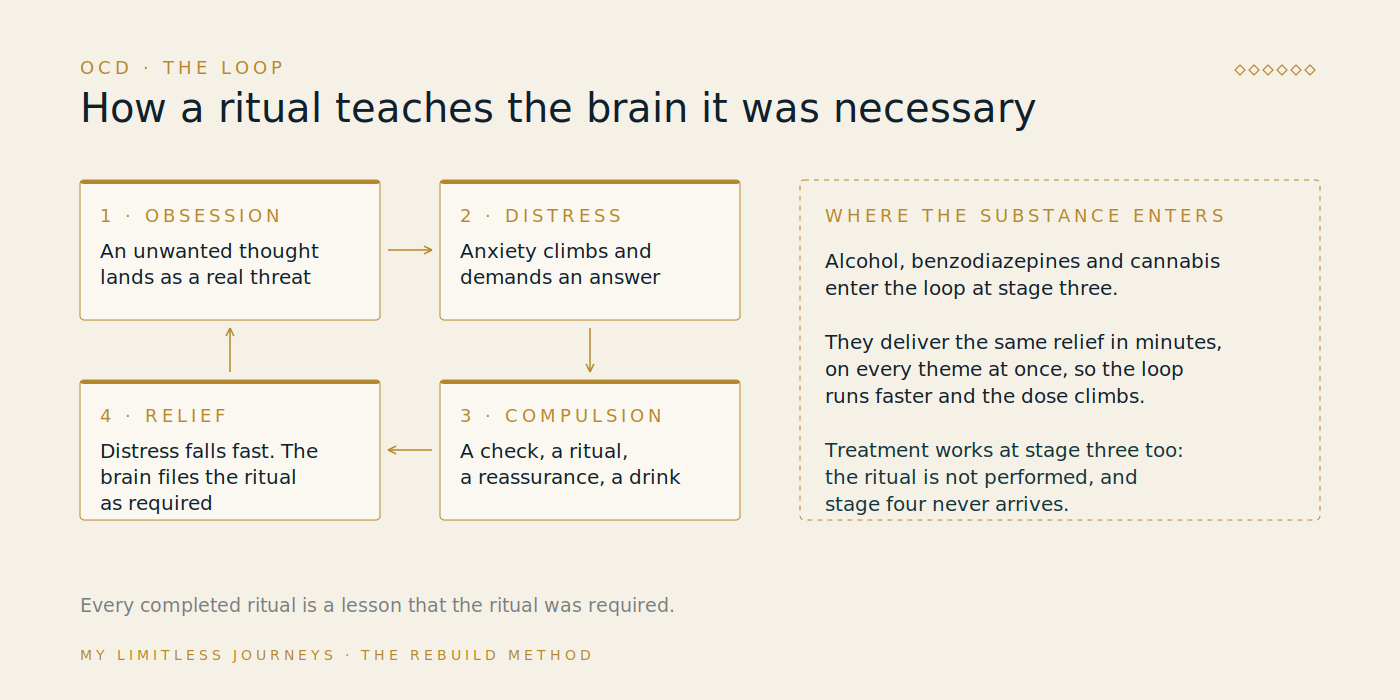
Key Takeaways- OCD runs as a loop: an intrusive thought, the distress it produces, a compulsion that relieves it, and a brain that concludes the compulsion was necessary.
- Alcohol, benzodiazepines and cannabis often become chemical compulsions. They work in minutes, which is exactly why they escalate.
- Withdrawal makes OCD louder before it makes it quieter. The first two weeks are a bad sample of recovery.
- Exposure and response prevention has the best evidence of any OCD treatment, and sedation is incompatible with it.
- SSRIs help OCD at higher doses and over longer trials than in depression. Benzodiazepines do not treat OCD at all.
The loop, not the person.
Obsessive-compulsive disorder has two moving parts. Obsessions are unwanted thoughts, images or urges that arrive uninvited and cause real distress. Compulsions are the acts, visible or internal, performed to make that distress stop. The diagnosis turns on time and interference, not content. The National Institute of Mental Health puts past-year prevalence among American adults at about 1.2 percent and lifetime prevalence at 2.3 percent.
The themes are familiar: contamination, harm you might cause through carelessness, symmetry and the feeling of not-quite-right, and the taboo intrusions about violence, sex or blasphemy that frighten people most. The content is the least useful part of the picture. What matters clinically is the relationship to it. The thought is treated as evidence, and something has to be done.
In the adults we treat, the compulsions are usually invisible. Rereading a sent email eleven times. Rewriting a clause until it feels safe rather than correct. Asking a partner one more time whether it was fine, the most socially acceptable compulsion there is. High-functioning people hide the ritual inside a work ethic, and the disorder is measured in hours lost, not tidiness.
When the drink becomes the compulsion.
Substance use is common in OCD populations. A study of adults in OCD treatment published in the Journal of Anxiety Disorders found that a substantial minority had met criteria for a substance use disorder at some point in their lives. The logic is not mysterious. OCD generates enormous anxiety on a schedule the person cannot control, and alcohol is the fastest anxiolytic on earth.
Look closely and a drink is not an escape from the loop but a new turn of it. An obsession spikes. The person acts. The distress falls. The brain files away that the act was required. That is the definition of a compulsion, and alcohol, benzodiazepines and cannabis all fit it, with one difference: they work in minutes and on every theme at once. Stimulants are the exception that proves the point, sharpening the checking rather than quieting it.
The deeper problem is that this compulsion disables the treatment. Recovery from OCD requires being present while anxiety rises and falls on its own, without doing anything about it. A sedated nervous system never runs that experiment. That is why both are treated together rather than in sequence, inside our co-occurring program, and why our page on alcohol addiction treatment belongs alongside this one.
Detox with OCD in the room.
The medical work follows the substance. Alcohol withdrawal is managed with monitored, symptom-triggered medication and regular vitals. Benzodiazepines are tapered rather than stopped, because abrupt discontinuation produces exactly the rebound anxiety OCD feeds on. Our medically supervised detox runs inside the same house, with the clinicians who will be there in week six.
What OCD adds is predictable if you know to look. Obsessions get louder in the first ten days, because baseline anxiety has risen and sleep is broken. Contamination themes find material in any clinical setting: shared bathrooms, blood pressure cuffs, other people's hands. And reassurance-seeking rises sharply, which is how a nurse ends up answering the same question at two in the morning for the fifth time.
So we plan for it. We take an OCD history before detox begins, name the main themes, and agree in advance how staff will answer reassurance requests: warmly, once, and then with an agreed phrase rather than a sixth answer, because each answer completes the ritual on the client's behalf. Nobody does formal exposure work during acute withdrawal. What we protect in those days is sleep, safety and the belief that this is survivable. The OCD you have in week one is not the OCD you will have in week five.
Medication: the doses are different.
This is where OCD is most often undertreated. Serotonin reuptake inhibitors help, but the doses that work for OCD are generally higher than those used in depression, and the trial is longer; guidance from the American Psychiatric Association describes an adequate trial in months rather than weeks. People arrive having been told an SSRI did not work, when a modest dose was stopped at six weeks. Clomipramine remains an option with real evidence, and where response is partial, low-dose antipsychotic augmentation is sometimes added under psychiatric supervision.
Benzodiazepines do not treat OCD. They reduce the anxiety attached to an obsession for a few hours without touching the loop that produces it, and in someone already using alcohol or sedatives they add a dependence problem to a disorder that was generating one. If you arrive on a prescribed benzodiazepine we build a taper, coordinate with your prescriber where appropriate, and time it around the therapy. Where alcohol use disorder is present, naltrexone can sit alongside the SSRI. None of it substitutes for the therapy.
Exposure and response prevention, plainly.
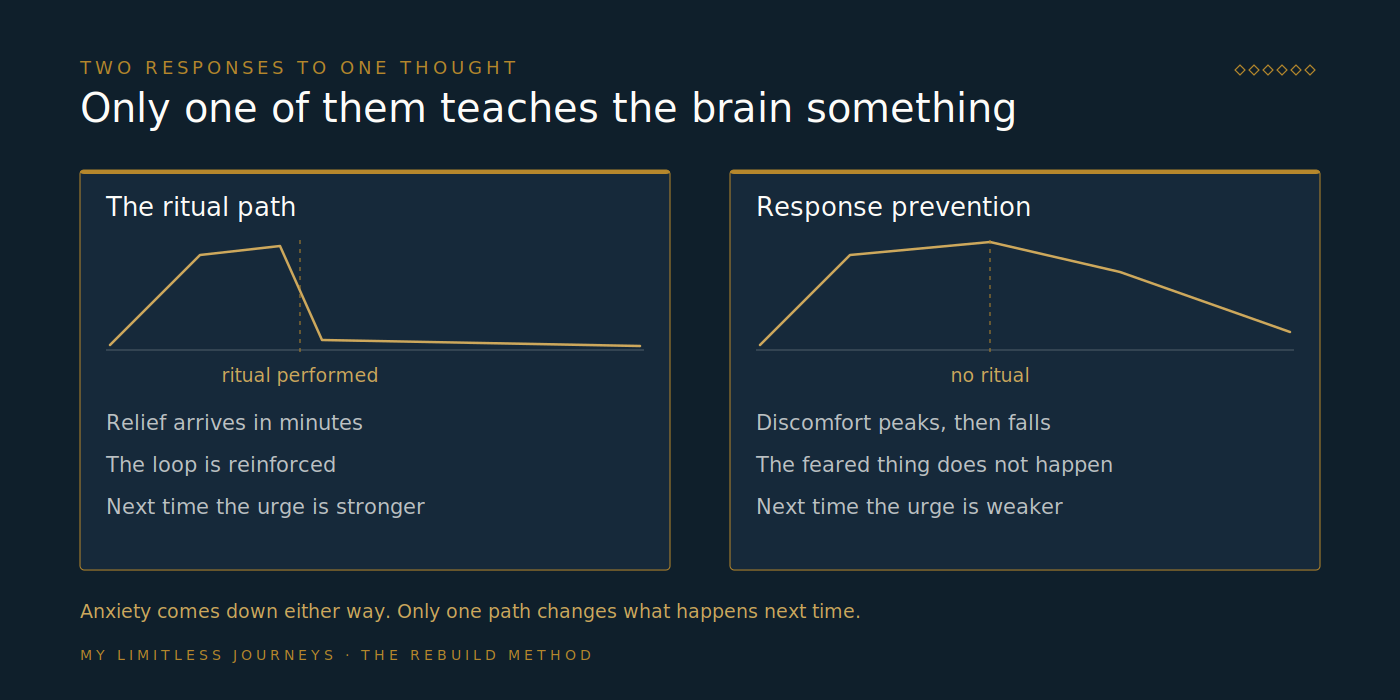
Exposure and response prevention is a specific form of cognitive behavioral therapy, and not what most people picture. You and your clinician build a list of triggers, ordered from mildly uncomfortable to genuinely difficult. You approach one on purpose and do not perform the ritual. That second half is the treatment. Exposure alone is just a bad afternoon. What changes the disorder is discovering, repeatedly, that anxiety climbs, plateaus and comes down by itself.
The evidence is unusually strong. A randomized trial in the American Journal of Psychiatry compared exposure and ritual prevention with clomipramine and with the two combined, and found the therapy outperformed the medication, with the combination adding little. Alongside it we use acceptance and commitment therapy for the relationship with the thought, and DBT distress-tolerance skills for the hours when the urge is loudest.
There is a practical reason this goes better in a residence. Rituals do not happen in a therapist's office at four in the afternoon. They happen at home, alone, at eleven at night, and outpatient care asks a person to do the hardest part of treatment unsupported. In a small house, staff can hold response prevention with you in the moment it is needed.
OCD through the four domains.
The Rebuild Method puts the exposure work inside a life rather than beside it.
Body. Sleep first, because sleep loss raises intrusion frequency in almost everyone. Detox, medication at the doses this disorder actually needs, and physical work that gives an over-recruited stress system somewhere to discharge.
Mind. The exposure hierarchy, the response prevention, and cognitive work on inflated responsibility and intolerance of uncertainty, the two beliefs sitting under most OCD regardless of theme. Co-occurring depression, common by the time people reach us, is treated here rather than later.
Life. OCD steals time, so we account for it and give the hours back. Daily structure that does not bend around rituals, family sessions that address accommodation, and life skills and return-to-work planning aimed at the inbox, the checklist, the closing document where the loop lives.
Self. Many people with taboo intrusions have concluded something terrible about who they are. Values work separates having a thought from endorsing one, and for clients with religious or moral themes, careful spiritual exploration is part of the treatment.
What a stay looks like.
The first week or two is medical and quiet: detox if it is needed, sleep restored, a psychiatric workup, an honest map of the themes and rituals, and skills practice rather than exposure. In week two or three, once the baseline has dropped, formal exposure and response prevention begins, several sessions a week with structured practice between them. Because the house holds six and the same clinicians are here daily, practice happens where the ritual lives. The last stretch is transfer: reducing family accommodation deliberately, building a maintenance plan, and stepping down to PHP or IOP with the same team.
Residential or outpatient?
Plenty of OCD is treated well on an outpatient basis. If you are not physically dependent on anything, are sleeping, can complete exposure homework between sessions and live with people who will not accommodate the rituals, weekly ERP with a clinician who genuinely does ERP is the right level. Residential earns its place when detox is required, when drinking has become the primary compulsion, when rituals consume most of the day, or when previous ERP stalled because the homework never happened. Our guide to levels of care for co-occurring disorders sets out how that call gets made.
For families.
There is one thing families need to understand about OCD, and it is counterintuitive. Answering the question, checking the lock, buying the extra soap, waiting outside the bathroom: these small kindnesses are called accommodation, and they keep the disorder alive. That is not a moral failing. It is what love does when given no other instructions. Reducing accommodation is an evidence-based part of treatment, done gradually, together, with the person's agreement rather than behind their back. We do that work in family sessions, and our families hub is where to start.
- Mental health treatment at MLJ. The hub for every condition.
- Anxiety. The diagnosis OCD is most often mistaken for.
- Co-occurring disorders. Both conditions, one plan.
- Cognitive behavioral therapy. The family ERP belongs to.
- Residential treatment. What a stay in the house involves.
- CBT in addiction treatment. The same tools, aimed at the drinking.
This guide is educational and is not a substitute for medical advice. If someone is in immediate danger, call 911.