
Feeling everything at full volume is treatable.
Borderline personality disorder is an emotional system with very little insulation: feelings arrive faster, hit harder, and take longer to settle than they do for most people. Substances are the most effective insulation many people find, and the most expensive. Here is how we treat the two together, with a team that stays the same from first day to last.
Authored by the MLJ Clinical Team. Reviewed under board-certified psychiatric oversight. Last updated September 2026.
Key Takeaways- BPD is a disorder of emotional regulation, not of character, and most people improve substantially with evidence-based therapy.
- Substance use disorders occur in a large share of people with BPD, usually as emotional anesthesia and often across several substances at once.
- Detox with BPD is volatile: the substance that managed the feelings is gone, and self-harm risk and interpersonal crises rise before skills are in place.
- No medication is approved for BPD itself. Dialectical behavior therapy, adapted for substance use, is the treatment with the strongest evidence, and here it is practiced daily rather than weekly.
- Staff consistency is a clinical intervention for BPD, not a nicety; a six-bed house with one team makes it possible.
An emotional system without insulation.
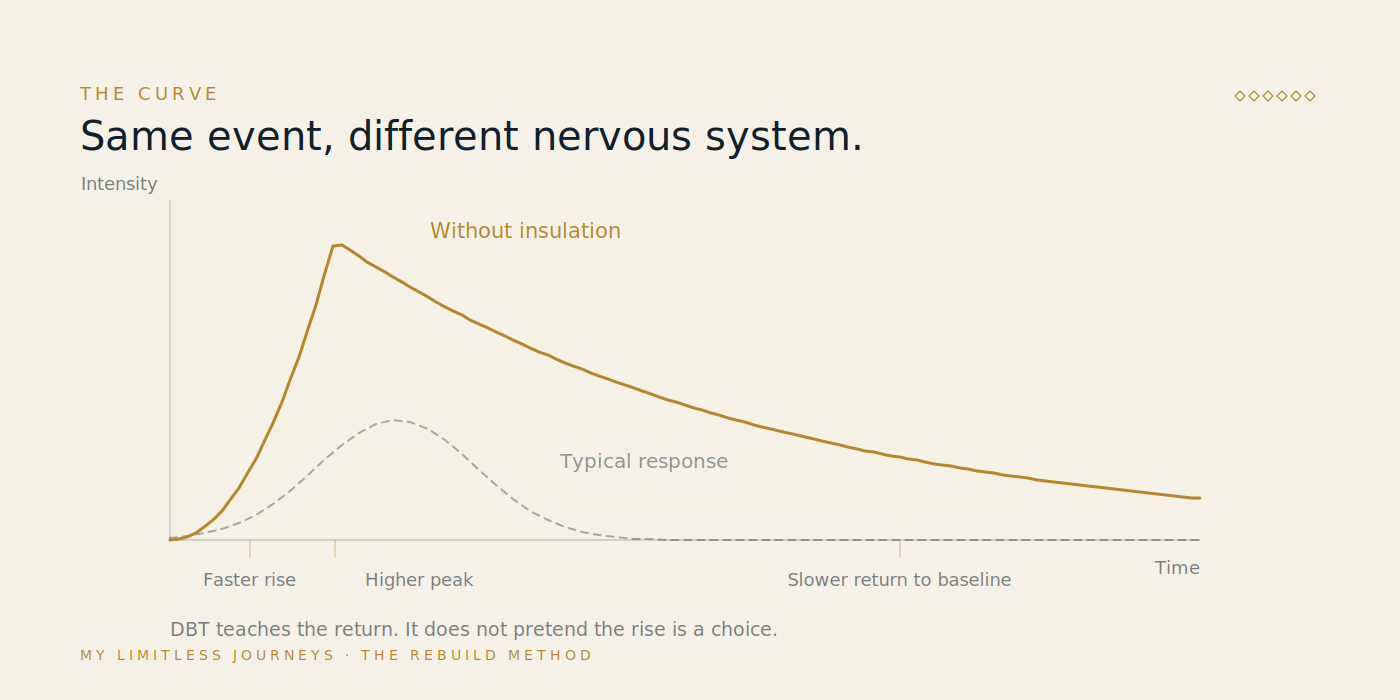
The diagnostic criteria for BPD describe a pattern of instability in relationships, self-image and emotion, with marked impulsivity: fear of abandonment, relationships that swing between idealization and contempt, an unstable sense of self, self-damaging impulsivity, recurrent self-harm or suicidal behavior, rapidly shifting moods, chronic emptiness, explosive anger, and stress-related paranoia or dissociation. The National Institute of Mental Health estimates that around 1.4 percent of American adults meet criteria, and notes that with treatment most people improve.
In the adults we treat, the criteria rarely arrive as a list. What arrives is a person who is brilliant in a room and devastated by a delayed text; who has been the most loyal friend and the most cutting one to the same people; who has changed careers, cities or partners in ways that looked bold from outside and felt like running from inside. Many carry other diagnoses first, usually bipolar disorder, depression or anxiety; some are also true. The distinguishing feature of BPD is that the mood shifts are fast, hours rather than weeks, and almost always triggered by something between people.
Emotional anesthesia: how substances enter.
Reviews of the research consistently find that a large minority to a majority of people with BPD meet criteria for a substance use disorder at some point, and that BPD is present in a substantial share of people entering addiction treatment. The National Institute on Drug Abuse lists personality disorders among the most common co-occurring conditions.
The function is almost always anesthetic. When an emotion arrives at full volume with no internal way to turn it down, anything external that does so will be used again. Alcohol is the most common. Opioids are attractive because they treat emotional pain directly. Benzodiazepines are frequently prescribed and frequently escalate. Stimulants fill the emptiness. Many of our clients use several, switching by mood, and the pattern is itself unstable: binges after a rupture, weeks of nothing, then a relapse that came from a conversation. Self-harm and substance use often serve the same purpose and substitute for one another, so we treat them as one behavior with two forms.
Detox when the feelings come back.
Medically, detox follows the substance: alcohol and benzodiazepines are managed with monitored, symptom-triggered dosing and tapers under the ASAM guideline; opioids with buprenorphine or a structured comfort protocol; stimulants with rest and sleep support. Because polysubstance use is the norm with BPD, the sequencing on our polysubstance detox page applies often.
Psychologically, detox is the most dangerous stretch of treatment for someone with BPD. The anesthesia is gone before any skill has replaced it. Emotions that were chemically managed return at full strength on top of withdrawal's irritability and sleeplessness. Self-harm urges rise. A client may decide on day three that this place is wrong and leaving is the only option. We plan for all of this. Suicide and self-harm risk is assessed on arrival and daily. The same clinicians work with you every day, so the relationship is stable even when the feelings are not. Distress-tolerance skills are taught from day one. And the urge to leave is treated as a symptom to be worked with, not a decision to be argued about. Our page on leaving treatment early describes that conversation.
Medication: modest, targeted, never stacked.
No medication has FDA approval for borderline personality disorder, and NIMH is direct that medication is not the primary treatment. What medication can do is take the edge off specific symptoms so therapy can proceed: an SSRI for co-occurring depression or anxiety, a low-dose mood stabilizer or antipsychotic for severe impulsivity or transient paranoia, prazosin or another non-habit-forming agent for sleep or trauma-related nightmares. The evidence for each is modest, and we say so.
What we work hard to avoid is the pattern many clients arrive with: five or six medications accumulated across years of crises, each added to treat the last one's side effects. Polypharmacy in BPD tends to sedate without stabilizing. Our psychiatrist's first job is often to simplify. We also avoid benzodiazepines, which disinhibit and are especially prone to misuse in this population, and we are careful with any medication that is dangerous in overdose, given the elevated suicide risk. Where opioid use disorder is present, buprenorphine is continued; where alcohol is the issue, naltrexone is considered.
DBT for BPD and substance use.
Dialectical behavior therapy was developed by Marsha Linehan specifically for chronically suicidal people with BPD, and it remains the treatment with the strongest research support, with randomized trials showing reductions in self-harm, hospitalization and dropout. A version adapted for substance use disorders, sometimes called DBT-S, adds targets specific to addiction: reducing use, easing withdrawal-related discomfort, cutting ties to using environments, and treating relapse as a problem to be solved rather than a failure to be punished.
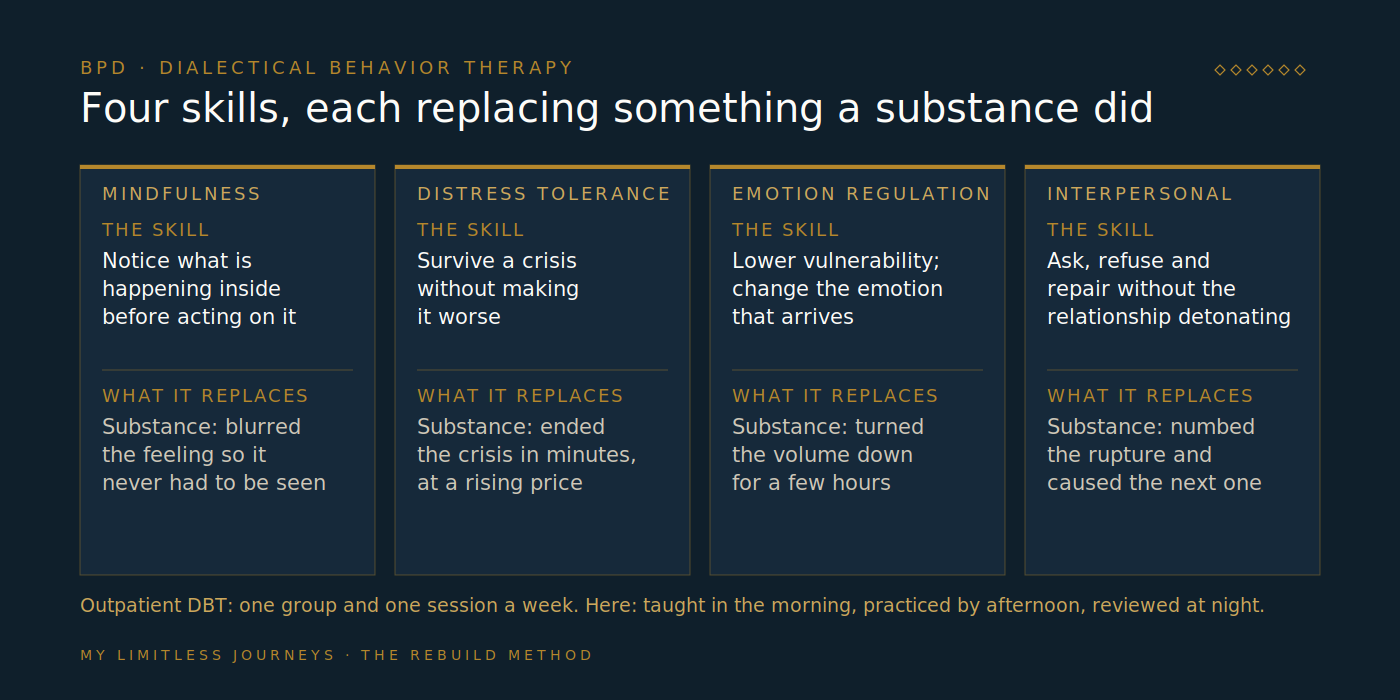
The therapy has four skill modules. Mindfulness: noticing what is happening inside before acting on it. Distress tolerance: surviving a crisis without making it worse, which is exactly what the substance used to do. Emotion regulation: reducing vulnerability to emotional storms and changing the ones that arrive. Interpersonal effectiveness: asking, refusing and repairing without the relationship detonating. Standard outpatient DBT is a weekly group and a weekly individual session. Here, DBT is the spine of every day: skills taught in the morning, practiced in the afternoon, reviewed in the evening, with a diary card that tracks urges, emotions and use. Chain analysis after any lapse traces the sequence from trigger to behavior so the next link can be changed. Trauma work, which most clients with BPD need, begins once distress-tolerance skills are reliable.
BPD through the four domains.
The Rebuild Method frames the work beyond the DBT curriculum.
Body. Emotional vulnerability rises with poor sleep, poor nutrition, and a body that has not moved. DBT calls these the "PLEASE" skills; we deliver them as one-to-one fitness coaching, a regular eating schedule, and sleep protected from the first night.
Mind. DBT skills, chain analysis, and, when ready, trauma processing. Most people with BPD have trauma histories, and EMDR is introduced carefully once there are skills to hold what it surfaces.
Life. Relationships are where BPD does its damage and where recovery is tested. Family sessions teach validation, the single most useful skill for people who love someone with BPD, and set up the structures that will hold after discharge.
Self. Chronic emptiness and an unstable identity are core symptoms, so values and purpose work is not decoration here. Discovering what you care about when not in crisis is, for many clients, the first stable thing they have had to stand on.
What a stay looks like.
Week one is detox, safety planning, and the first distress-tolerance skills. You meet your primary clinician on day one and see them every day thereafter. Weeks two through four are skills acquisition: the DBT modules in sequence, diary cards, chain analysis when something goes wrong, fitness and yoga to lower baseline arousal. Weeks five through eight deepen the work: trauma processing where indicated, family sessions, and the gradual reintroduction of the phone, social media and outside relationships as skills practice. The final stretch plans transfer to PHP or IOP with the same DBT team, and often transitional living, so that the relational stability built in the house is not lost the day you leave it.
Residential or outpatient?
Comprehensive outpatient DBT is effective and, for people without substance dependence whose crises are manageable at home, is the standard of care. Residential treatment is right when detox is needed, when substance use has repeatedly derailed outpatient DBT, when self-harm or suicidal behavior has escalated, or when the home environment is itself the trigger. It is also right for people who have left several therapists in a rupture; one consistent team is designed to hold through ruptures instead of ending at them. Acute suicidality with intent belongs in a hospital first, and we will help arrange that. Our levels-of-care guide explains how we decide.
For families and partners.
Loving someone with BPD and a substance problem is exhausting in a way that is hard to explain. In family sessions we teach validation, the skill of acknowledging the feeling without endorsing the behavior, and we teach limits that hold without punishing. Expect the first weeks of the stay to include phone calls asking you to bring them home; expect us to help you answer them. Our post on navigating a BPD episode and our families hub are good places to start.
- Mental health treatment at MLJ. The hub for every condition we treat.
- Bipolar disorder. The diagnosis most often confused with BPD.
- PTSD and trauma. The history most people with BPD carry.
- Dialectical behavior therapy. The treatment at the center of this page.
- Residential treatment. How the program is structured day to day.
- DBT in substance use recovery. How the skills translate to staying sober.
This guide is educational and is not a substitute for medical advice. If someone is in immediate danger, call 911.