
Food was never the real subject.
Disordered eating in adults is rarely about food and almost always about control, worth and a nervous system trying to manage what it cannot feel. When alcohol or drugs are also involved, the two conditions hold each other up. This page is for adults, and it is written plainly.
Authored by the MLJ Clinical Team. Reviewed under board-certified psychiatric oversight. Last updated September 2026.
Key Takeaways- Eating disorders are adult illnesses as often as adolescent ones, and they occur across every body type, gender and profession.
- Disordered eating and substance use share drivers: emotion regulation, control, perfectionism and trauma. Treating one and ignoring the other rarely holds.
- A medical assessment comes before anything else, because these conditions affect the heart, the electrolytes and the gut, and because withdrawal complicates all three.
- Some presentations need medical stabilization or a specialty eating-disorder program. We say so directly and help you find it rather than admitting anyone we cannot safely treat.
- Where we can treat, we treat both conditions in one plan, with meals as supported clinical practice rather than a test.
Eating disorders in adults.
The cultural image of an eating disorder is a teenage girl, and that image keeps a great many adults from getting help. The reality described by the National Institute of Mental Health is broader: anorexia nervosa, bulimia nervosa, binge-eating disorder and related conditions affect men and women across the lifespan, and many adults have carried a version of the illness quietly since their twenties.
Two beliefs do the most damage. The first is that you have to look a certain way to qualify. You do not; appearance is not diagnostic, and people at every body size develop these disorders. The second is the conviction of not being sick enough, which is itself a symptom, and which we hear from nearly everyone who calls us about this. A useful test is not severity but position: how much of your attention does this take, and what have you stopped doing because of it.
In the adults we treat, the illness usually sits inside a life that looks well managed. It survives because it is disguised as discipline, and because in some professional worlds the disguise is rewarded. For clients whose appearance is part of how they are hired, that pressure is not imagined, and we treat it as a real feature of the environment rather than as a distortion to be argued away.
Why the two travel together.
The overlap is well documented. A systematic review and meta-analysis published in Psychiatry Research found that substance use disorders are substantially more common among people with eating disorders than in the general population, with alcohol the most frequent.
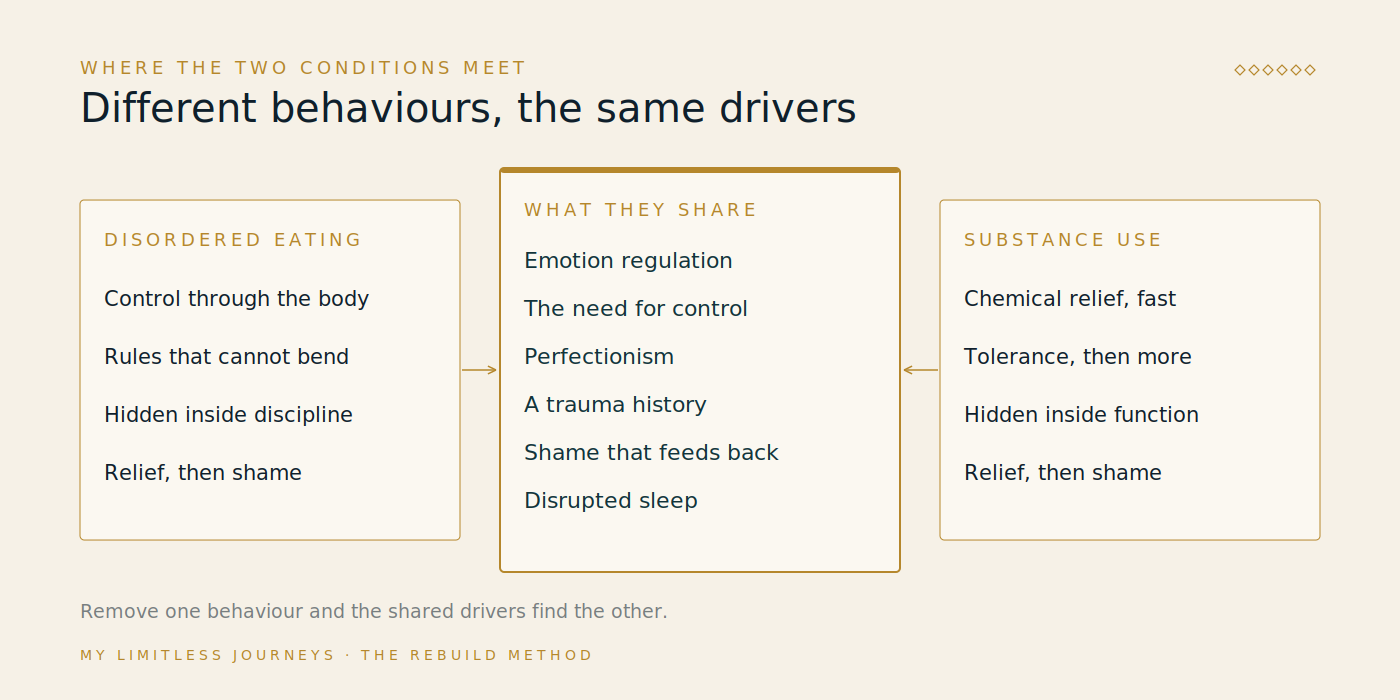
The reason is not mysterious once you look at what both conditions do. Each is a way of regulating feeling through the body. Each offers control at a moment when nothing else is controllable. Each is followed by shame, which increases the distress the behaviour was managing, which makes the behaviour more likely. Perfectionism, early trauma and difficulty naming emotions turn up in the histories of both, and so does chronic sleep disruption.
Clinically, the important consequence is substitution. Treat the drinking alone and the disordered eating frequently intensifies, because the regulating job has to go somewhere. Treat the eating alone and drinking often takes up the slack. This is the same principle described on our co-occurring disorders page, and it is why we do not run these as separate tracks.
The medical assessment comes first.
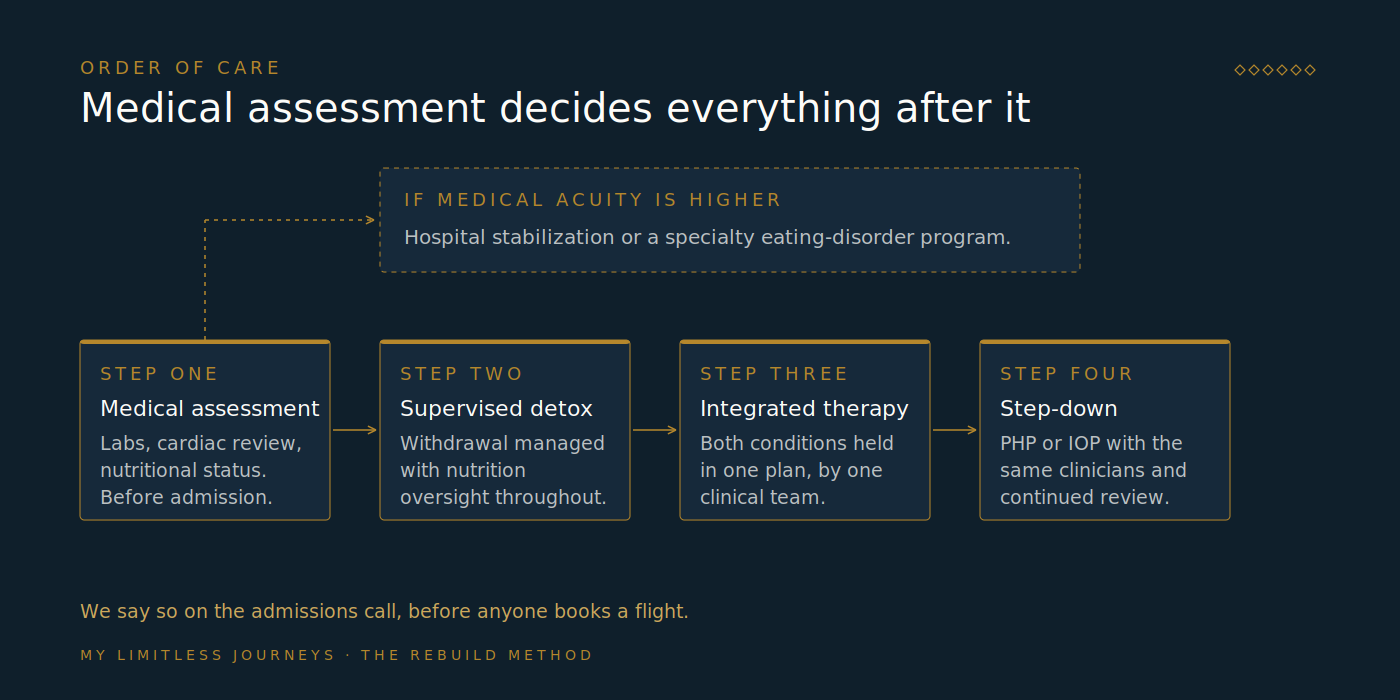
Eating disorders carry genuine medical risk. They can affect cardiac function, electrolyte balance, the gastrointestinal system, bone density and hormonal regulation, and the person carrying that risk often feels fine. Before we admit anyone, a physician reviews the medical picture, and where indicated we ask for laboratory work and a cardiac assessment first.
This is also where we are obliged to be honest about scope. We are a six-bed residential program with medical detox and psychiatric oversight, not a hospital and not a specialty eating-disorder unit. Some presentations require inpatient medical stabilization or a program built specifically for this illness, with the nutritional and medical infrastructure that implies. When that is the case we say so on the admissions call, explain why, and help you find the right placement rather than admitting you and hoping. Turning someone away well is part of the job.
Detox when eating is disordered.
Withdrawal is harder on a body that is nutritionally depleted, and the two problems complicate each other in ways that argue strongly against detoxing at home. Electrolyte disturbance can already be present before withdrawal begins. Alcohol use depletes thiamine and other nutrients, which is why replacement is a standard part of any competent alcohol detox. Appetite changes sharply in the first weeks off alcohol and off stimulants, in opposite directions, and for someone with an eating disorder those changes are frightening rather than neutral.
So nutrition is a medical matter here, not a lifestyle one. Restoring intake after a period of restriction has to be done gradually and under supervision, because doing it quickly carries real physiological risk. Our medical team manages that alongside the withdrawal protocol rather than after it, and a dietitian is involved from the beginning. Our page on medically supervised detox describes the setting, and nutrition in detox and recovery covers the nutritional side for anyone in early sobriety.
What the therapy actually is.
The American Psychiatric Association's practice guideline for eating disorders places structured psychotherapy at the center of treatment, with nutritional rehabilitation and medical monitoring alongside it. In practice that means cognitive behavioral work adapted for eating disorders, which addresses the beliefs about control and worth that keep the pattern running, and dialectical behavior therapy for the emotion regulation that both conditions are substituting for.
Where trauma is present, and it frequently is, trauma-focused therapy is part of the plan once you are stable enough for it. Group work in a six-person house is small enough that these conversations stay honest and are not performed.
Meals matter, and they are handled as clinical practice rather than as a test. They are prepared here, eaten together, and supported by staff, and the point is not compliance but the gradual return of an ordinary relationship to an ordinary part of the day. Nobody is watched in a way designed to humiliate them. For most of our clients, sitting at a table with other people and not thinking about it for an hour is the first evidence that the illness is loosening.
Medication considerations.
Medication plays a supporting role here rather than a leading one. Some conditions in this group respond to specific pharmacotherapy and others do not, and the evidence differs enough between diagnoses that a blanket answer would be misleading. Our psychiatrist works from the diagnosis in front of them and reviews it as the picture clarifies.
Two cautions are worth stating because they come up constantly. Bupropion, a common antidepressant that is also used for smoking cessation and sometimes for attention problems, is contraindicated in people with a current or past eating disorder because of seizure risk. And stimulant medication, whether prescribed for ADHD or misused, interacts with appetite in ways that can entrench the disorder, so prescribing decisions in that overlap are made carefully and never on autopilot. Where electrolytes or cardiac function are affected, medication choices narrow further, which is another reason the medical assessment leads.
Through the four domains.
The Rebuild Method applies here with one adjustment: the Body domain is led by medicine, not by fitness.
Body. Medical monitoring, nutritional restoration under supervision, sleep, and medication management. Exercise is prescribed and limited by clinicians in this population rather than encouraged freely, because for many people it has been part of the illness.
Mind. The cognitive work on control and worth, DBT skills, trauma processing where indicated, and treatment of the depression and anxiety that almost always accompany this.
Life. Structure that includes ordinary meals, and planning for the specific situations that will be difficult afterward: the work dinner, the wrap party, the flight, the household where food is a subject. Family work belongs here too.
Self. Almost every client arrives with worth attached to a body and to self-denial. Values work is where a different measure gets built, slowly, and it is the part of treatment that most protects against relapse.
A stay, and whether we are the right place.
A stay opens with medical review, detox where it is needed, and a nutrition plan built with a dietitian. Therapy begins gently and deepens as the body stabilizes, with family sessions once you want them and step-down to PHP or IOP with the same clinicians.
We are usually the right place when a substance use disorder is the primary problem and disordered eating sits alongside it, when you are medically stable, and when integrated treatment by one team is what has been missing. We are usually not the right place when the eating disorder is medically acute, when nutritional rehabilitation needs hospital-level supervision, or when a specialty program is what the evidence calls for. That conversation happens on the admissions call, before anyone books a flight.
For families and partners.
Two things help more than anything else you might try. Do not make food, weight or appearance the subject of conversation, in either direction; comments intended as reassurance land as measurement. And do not turn mealtimes into surveillance, which shifts the illness from a private struggle into a battle with you. What does help is saying that you have noticed the person seems to be suffering, that you are not going anywhere, and that you would like them to talk to someone. Our families hub and our page on when they refuse treatment cover the rest.
- Mental health treatment at MLJ. The hub for every condition.
- Co-occurring disorders. Both conditions, one plan.
- Anxiety. The condition most often sitting underneath.
- Dialectical behavior therapy. The emotion-regulation work at the center of this.
- Residential treatment. What a stay involves.
- Nutrition in detox and recovery. Why food is medical in early sobriety.
This guide is educational and is not a substitute for medical advice. If someone is in immediate danger, call 911.