
Stability is not flatness. It's freedom.
Bipolar disorder is among the most treatable serious psychiatric conditions and among the most often self-medicated. Stimulants extend the high; alcohol softens the crash; both make the next episode more likely. This page explains how we separate the illness from the substances, keep you safe through detox, and find medication that steadies you without dimming you.
Authored by the MLJ Clinical Team. Reviewed under board-certified psychiatric oversight. Last updated September 2026.
Key Takeaways- Bipolar disorder carries one of the highest rates of co-occurring substance use of any psychiatric condition; large surveys put it near half of people with bipolar I.
- Stimulant intoxication mimics mania and alcohol mimics depression, so a diagnosis made during active use is often wrong in one direction or the other.
- Sleep loss is the most reliable trigger of mania, which makes detox, a period of disrupted sleep, a moment of psychiatric risk to be managed deliberately.
- Mood stabilizers interact with alcohol, dehydration and liver strain in ways that shape which medication is chosen and when it is started.
- A six-bed setting lets us adjust medication against daily observation rather than a monthly snapshot, which is how flatness gets avoided.
Two poles, one nervous system.
Bipolar I disorder is defined by at least one manic episode: a week or more of elevated or irritable mood with increased energy, reduced need for sleep, racing thoughts, pressured speech, grandiosity, and risk-taking severe enough to cause real damage. Bipolar II involves hypomania, a milder version, alternating with major depressive episodes that usually do the most harm. The National Institute of Mental Health estimates that about 2.8 percent of American adults have bipolar disorder in a given year, with a median age of onset around 25.
In the adults we treat, the manic or hypomanic side is frequently the part of the illness that built the career. The three-day writing sprint, the deal closed at four in the morning. Nobody calls that a symptom until it turns: the spending, the affair, the project abandoned, the crash that lasts months. By the time someone calls us, they have often had years of being treated for depression alone, sometimes with antidepressants that made the highs sharper. Misdiagnosis of bipolar II as unipolar depression is common, and a careful history of past elevated periods, from you and, with permission, from someone who has known you for years, is where assessment begins.
Why bipolar disorder and substances travel together.
Large American epidemiological surveys have found lifetime substance use disorders in roughly half or more of people with bipolar I, and the National Institute on Drug Abuse notes the overlap as one of the strongest in the comorbidity literature.
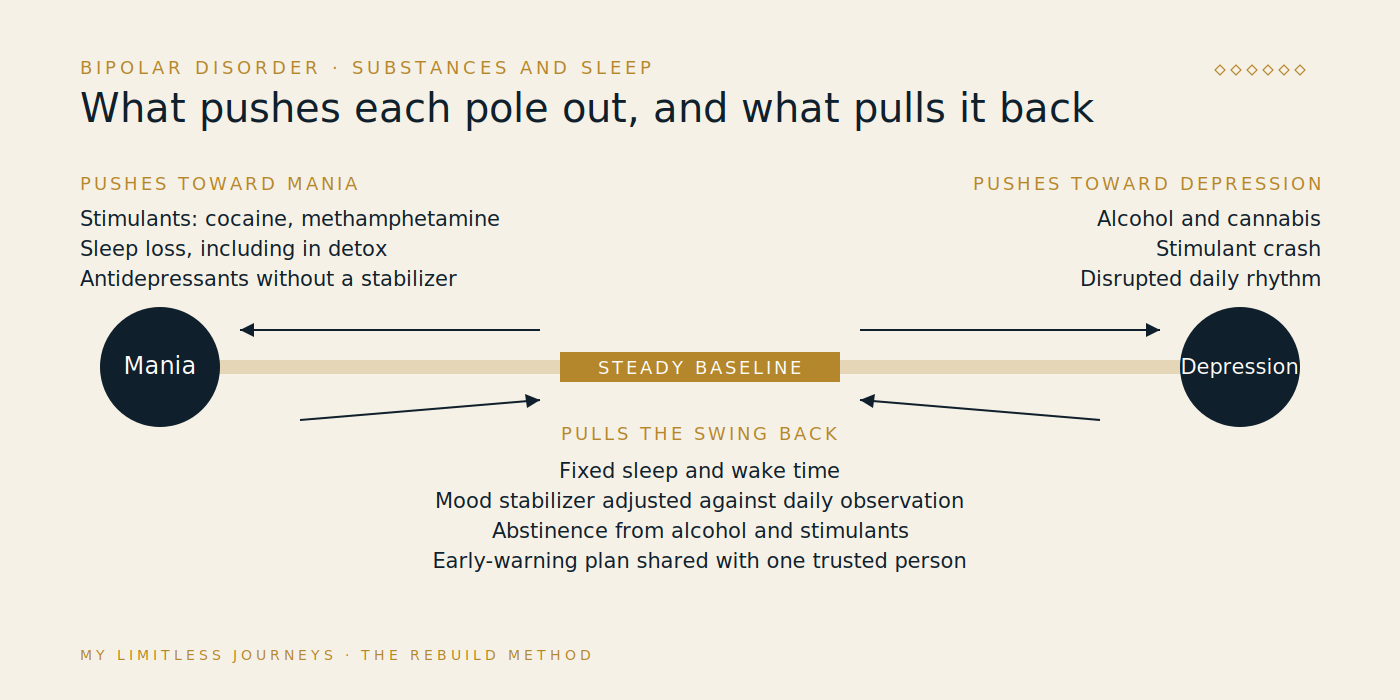
The pattern of use tends to track the pole. In mania and hypomania, judgment thins and appetite for intensity grows, so cocaine, methamphetamine and heavy drinking often appear as part of the episode. Some people use stimulants deliberately to prolong a productive high, or to pull themselves out of a depression that is arriving. In the depressive phase, alcohol and cannabis are used to blunt, to sleep, to get through. Alcohol also shortens sleep and destabilizes mood, which brings the next episode closer, and stimulant crashes are easily mistaken for bipolar depression. Each substance, in other words, imitates one pole and provokes the other. Our co-occurring disorders overview explains why separate treatment fails.
Detox: protecting sleep, protecting the diagnosis.
Two things make detox different when bipolar disorder is present or suspected. The first is sleep. Loss of sleep is the single most reliable precipitant of mania, and withdrawal from almost any substance disrupts sleep for days. We treat sleep as a psychiatric priority from the first night, with the psychiatrist reviewing each morning for early signs of elevation: talking faster, needing less, planning more.
The second is diagnostic humility. A client who arrives after a week on cocaine looks manic, and one who arrives after a month of heavy drinking looks depressed. Alcohol withdrawal is managed under the ASAM guideline with monitored dosing; stimulant withdrawal with rest, nutrition and sleep support, as described on our stimulant withdrawal page. Meanwhile we collect history: past episodes, family history, response to prior medications, and periods of sobriety long enough to show the mood pattern on its own. A working diagnosis is usually clear within two weeks; if you arrive with an established diagnosis and a mood stabilizer that works, we continue it, with blood levels checked because withdrawal changes hydration and kidney function.
Mood stabilizers when substances are involved.
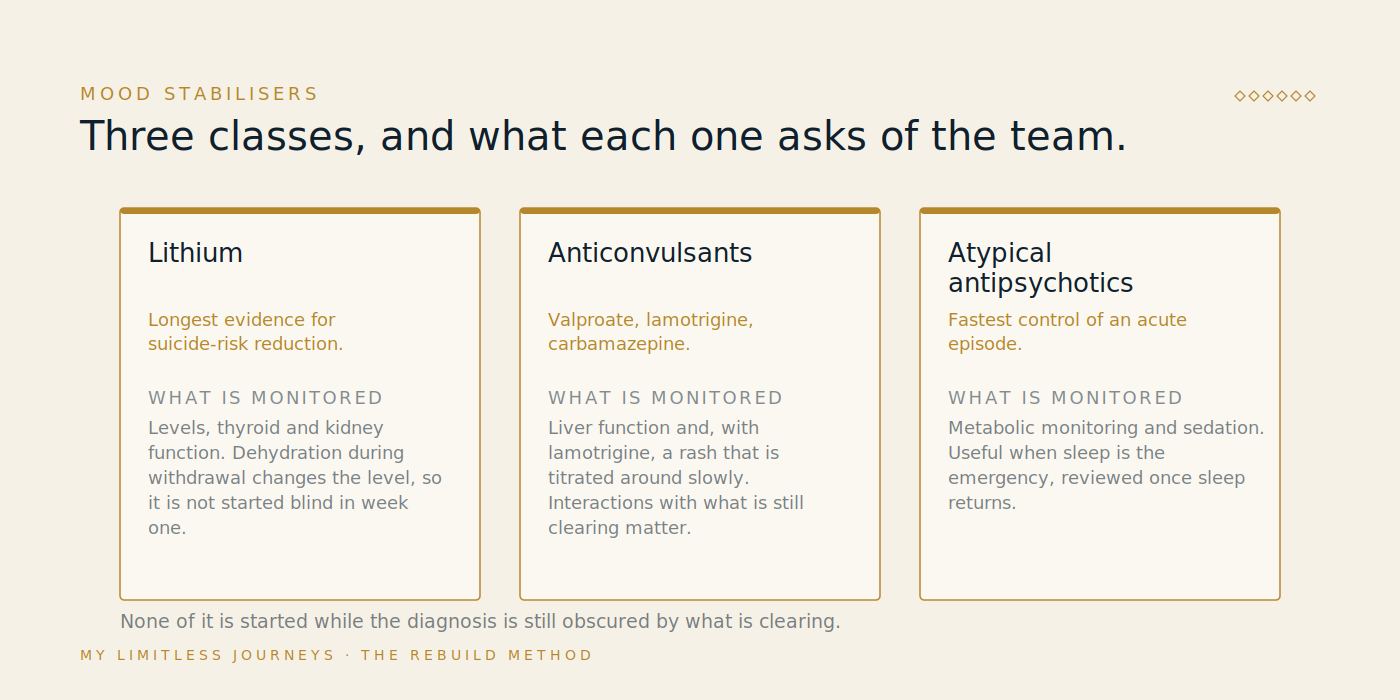
Medication is the backbone of bipolar treatment, and the choice is shaped by what else has been going into the body. The table summarizes what our psychiatrist weighs; it is not a prescribing guide.
| Medication | What it does well | Substance-related considerations |
|---|---|---|
| Lithium | Prevents mania and depression; the only mood stabilizer with strong evidence for reducing suicide risk. | Narrow therapeutic window. Dehydration from alcohol withdrawal, vomiting or heavy sweating can push levels toward toxicity; kidney and thyroid function are checked before and during. |
| Valproate | Strong for acute mania and mixed states; often used when substance use is prominent. | Metabolized by the liver. Heavy drinkers need liver enzymes checked first; sedation stacks with alcohol and benzodiazepines. |
| Lamotrigine | Best evidence for preventing bipolar depression; little weight gain or sedation. | Must be titrated slowly over weeks to avoid a serious rash, so it is started early in the stay rather than at discharge. |
| Atypical antipsychotics | Rapid control of mania; several also treat bipolar depression. | Metabolic effects are monitored; sedation and blood-pressure drops are amplified by alcohol and opioids. |
| Antidepressants | Sometimes added for bipolar depression, always alongside a stabilizer. | Used alone, they can trigger mania or rapid cycling, which is the risk in years of "depression" treatment before diagnosis. |
Where alcohol use disorder is present, naltrexone or acamprosate can be added; neither interferes with mood stabilizers. The "flat" so many clients describe from past medication usually means a dose set once and never revisited. Here the psychiatrist sees you most days and the dose moves with you.
Bipolar disorder through the four domains.
The Rebuild Method is well suited to an illness whose best-known non-drug treatment is rhythm.
Body. A fixed sleep and wake time is not a wellness suggestion for bipolar disorder; it is a treatment with its own evidence base. Interpersonal and social rhythm therapy, developed specifically for this illness, rests on the finding that regular daily routines protect against episodes. Fitness is timed for the morning to anchor the day, caffeine is limited, and medication is monitored with blood work.
Mind. Psychoeducation, learning your own early warning signs well enough to act on them, is the most underrated part of bipolar treatment. CBT addresses the thinking that accompanies each pole, including the seductive belief during hypomania that this time it is just clarity. Trauma and anxiety, common alongside bipolar disorder, are treated once mood is stable.
Life. Careers built on sprints have to be rebuilt around sustainability. We work on how to deliver without the all-nighter, how to structure travel and production schedules so that sleep survives them, and how to give one trusted person permission to say "you are speeding up." Family therapy is where that permission gets negotiated.
Self. Many people with bipolar disorder grieve the highs and fear that stability means losing who they are. Values work addresses that directly. The aim is a self that is recognizable across both poles and does not need either of them to feel alive.
What a stay looks like.
The first week is detox, sleep, lab work and daily psychiatric review. Mood and sleep hours are charted from day one, because the two move together. By the end of week two there is a working diagnosis and, usually, a medication plan under way. Weeks three through six are stabilization and learning: dose adjustments against what the team sees each day, psychoeducation, CBT, rhythm-building, one-to-one fitness, and the start of family sessions. Lamotrigine, if chosen, is being titrated through this period. The final weeks concentrate on transfer: the relapse-signature document you and your clinician write together, the outpatient psychiatry plan, and a step down to PHP or IOP with the same team so that no change in medication or mood is lost between providers.
Residential, outpatient, or hospital?
Acute mania with psychosis, or any state in which someone cannot keep themselves safe, belongs in a hospital, and if that is what we hear on the phone we will say so and help you get there. Our residential program is right for people who are medically stable enough for detox outside a hospital, whose mood is elevated or depressed but not psychotic, and whose substance use has made outpatient stabilization impossible. It also suits the person managed for years on a plan that never quite worked, who needs close observation to get it right. Stable bipolar disorder without active substance use is well served by an outpatient psychiatrist and therapist, and we say that too. Our guide to levels of care for co-occurring disorders covers the decision in more detail.
For families.
You have probably learned to read the weather before your person does. That skill is valuable, and in family sessions we turn it into an agreement: what the early signs are, what you are allowed to say, and what happens next. Sleep is the canary; a partner who notices two short nights in a row often knows more than a monthly appointment can. We also address the blame that follows manic episodes, and how to rebuild trust without policing. Our families hub is the place to begin.
- Mental health treatment at MLJ. The hub for every condition we treat.
- Depression. The diagnosis many people carry before bipolar disorder is recognized.
- Borderline personality disorder. Often confused with bipolar disorder; the differences matter.
- Cocaine addiction. The stimulant most often woven into manic episodes.
- Residential treatment. How the 30–90 day program is structured.
- Sleep in early recovery. Why sleep is treated as medicine here.
This guide is educational and is not a substitute for medical advice. If someone is in immediate danger, call 911.