

What should parents notice when a college student comes home for Thanksgiving?
Parents should notice patterns rather than single moments: how a college student sleeps, what they drink at family events and afterward, how their mood holds across the long weekend, and whether money or grades come up evasively. One heavy night is common. A pattern of drinking alongside persistent low mood deserves a calm, private conversation before they head back.
Why is the first visit home a useful moment?
Because it is the first time you see the new routine up close. The NIAAA’s guidance for parents describes the opening weeks of college as a period of heightened risk for harmful and underage drinking, driven by social pressure, unstructured time, easy access to alcohol, uneven enforcement and limited contact with parents. By late November that stretch is over, and whatever habits formed in it have had time to settle.
For many families in Calabasas, Hidden Hills, Agoura Hills and Westlake Village, the Wednesday before Thanksgiving is the first time since August that a son or daughter has slept under the same roof. Some drive down the 101 from a UC campus; others fly in. Either way, the long weekend gives you five days, not a phone call, and five days show patterns that a weekly check-in cannot.
Drinking usually did not begin at college. In the CDC’s 2025 survey of high school students, 30.9% of twelfth graders reported drinking in the past 30 days. College tends to remove the structure around a habit that already existed, which is why the change you notice may be one of scale rather than kind.
What signs are worth paying attention to?
No single sign means much on its own. Together, and across several days, these are the ones clinicians ask families about:
- 1Drinking that continues after the family event ends, alone or with old friends, or a quiet top-up before dinner.
- 2Sleep with an odd shape: up most of the night, unreachable until afternoon, or exhausted in a way rest does not touch.
- 3A mood that does not lift across the visit, especially flatness, irritability or comments about not seeing the point.
- 4Vague answers about classes, a withdrawn course, or a sudden reluctance to talk about grades.
- 5Money that does not reconcile: repeated requests, a drained account, or reasons that shift on retelling.
- 6A changed social world: old friends dropped entirely, or a new group that is never described.
Is it drinking, sadness, or both?
Often both, and the order matters less than noticing them together. A companion report in the same CDC release on October 15 looked at unmet need for mental health care. In 2025, 33.3% of U.S. high school students reported persistent feelings of sadness or hopelessness, including 43.4% of girls and 23.9% of boys. Among students who felt that way, 29.6% had received counseling or therapy, 28.8% said they needed it and did not get it, and 41.5% said they did not need it. Among boys with persistent sadness, more than half, 52.9%, reported no perceived need.
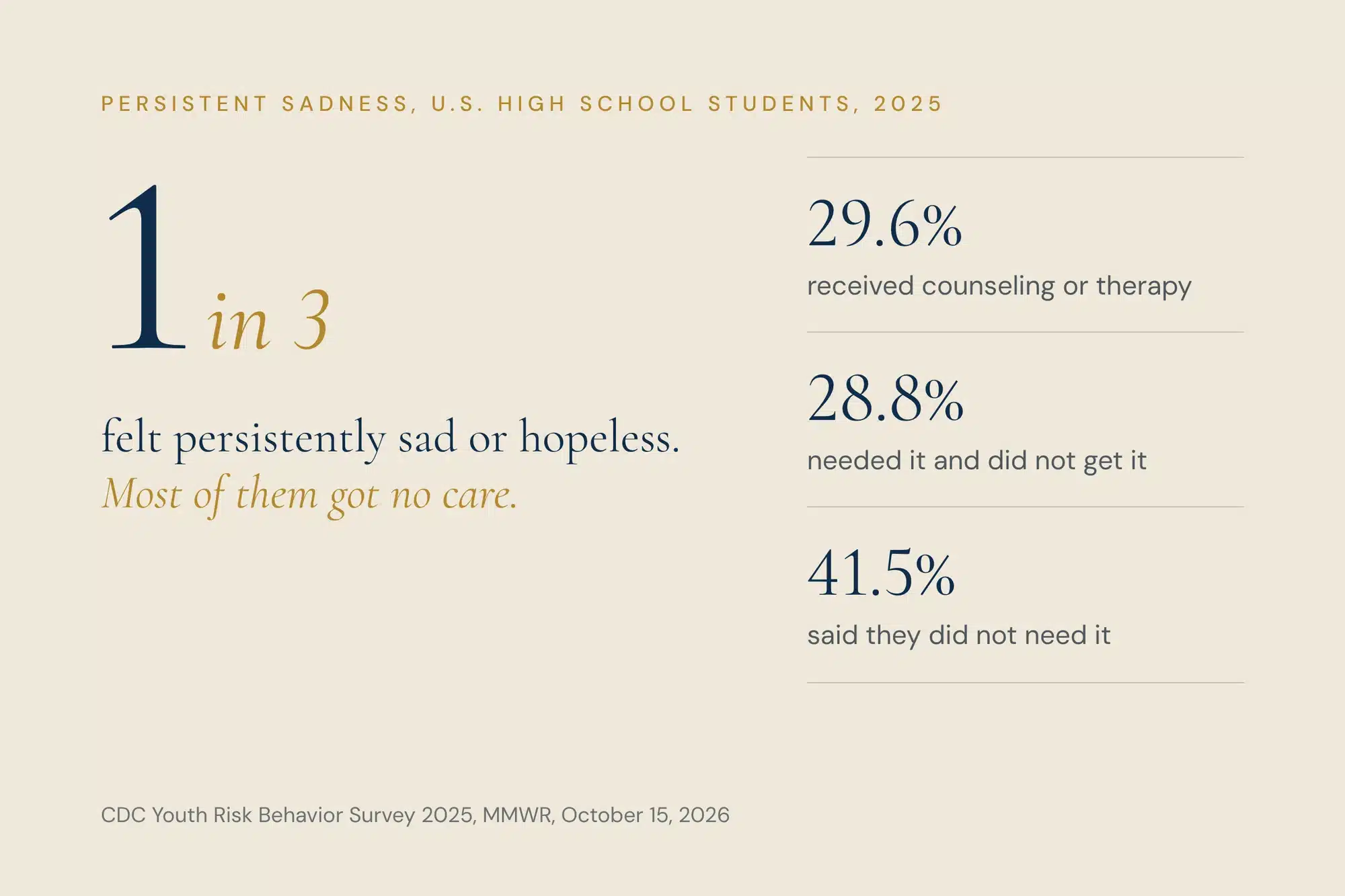
That last figure is the one to hold in mind at Thanksgiving. A young man who drinks more than he did in June and says he is fine may be telling you exactly how he sees it. Low mood in young adults often looks like irritability or withdrawal rather than tears, and alcohol can make it feel manageable for an evening and heavier the next morning. Our clinicians treat depression alongside substance use for that reason: treating one and ignoring the other rarely holds.
How do you start the conversation over a long weekend?
Privately, specifically, and not at the table. Pick a quiet moment when nobody has been drinking. Say what you have noticed, not what you have concluded: “You seemed really low on Thursday night, and I noticed you went out again after dinner. How has this semester actually been?” Then listen longer than feels comfortable.
“Thanksgiving Day is rarely the right day for the real conversation. The Friday after usually is. Nobody is performing for relatives, and a walk or a drive gives you both something to look at besides each other.”
Brett Cronon, Counselor, My Limitless Journeys
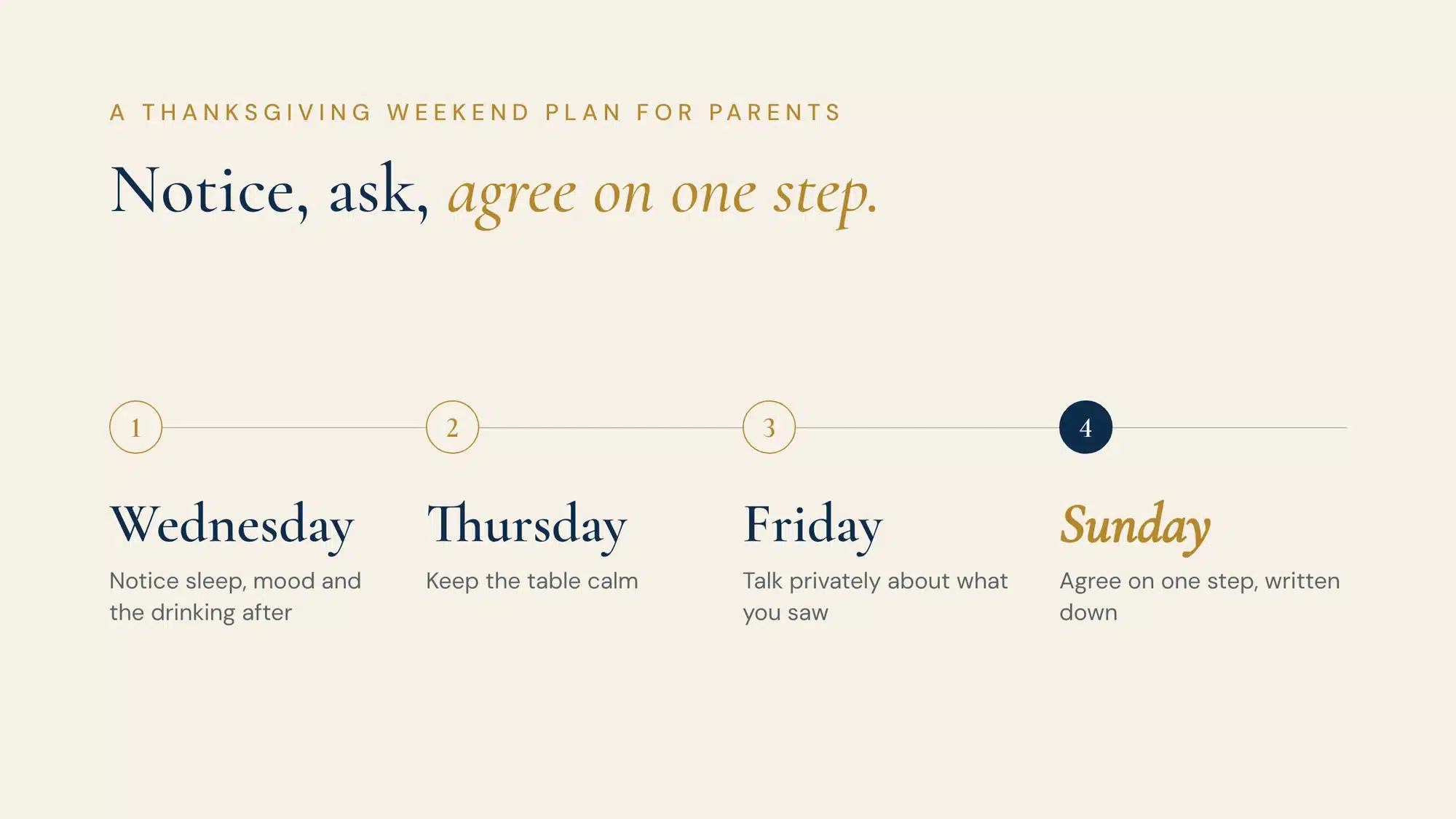
The NIAAA’s advice to parents is consistent with what we see: keep talking regularly, encourage your student to tell you about daily life and to ask for help, and learn what their campus offers. Before Sunday, aim for one agreed next step, such as an appointment with campus counseling, a call with a clinician over winter break, or a check-in date you both write down.
What does help look like if they go back in a few days?
It depends on what is going on, and an assessment is how you find out. For some students the right step is campus counseling and a clear plan to cut back. For others, a few weeks of intensive outpatient therapy over winter break, while living at home, gives enough structure to reset before spring term. When drinking is daily, when stopping brings shakiness or sweating, or when low mood has turned into hopelessness, a higher level of care may be needed, and that decision belongs with a clinician.
For families looking at rehab serving Calabasas families, care happens at our six-bed licensed residence in Encino, about fifteen to twenty minutes east on the 101; there is no facility in Calabasas itself. The same clinical team covers detox, residential care, partial hospitalization and intensive outpatient work, and the Calabasas addiction treatment page sets out how that continuum works for young adults and their parents.
“Families often feel there is no time to act during a short break. Usually there is time for an assessment and an honest plan, even if the plan is to start care over winter break rather than this week.”
Casey Flores, RADT, Retreat Manager, My Limitless Journeys
When is it an emergency?
When drinking has become an overdose. The NIAAA lists the critical signs as mental confusion or stupor, difficulty staying conscious or being unable to wake, vomiting, seizures, slow breathing (fewer than eight breaths a minute), irregular breathing (ten seconds or more between breaths), slow heart rate, clammy skin, dulled responses such as no gag reflex, and very low body temperature with bluish skin or paleness. Call 911 right away; do not wait for every sign. Do not leave the person alone, and do not rely on cold showers or coffee. If they are lying down, roll them onto their side.
If what worries you is not a single night but a sense that your son or daughter is struggling to keep going, call or text 988 to reach the Suicide and Crisis Lifeline at any hour. And if you want to talk through what you saw over the weekend with a clinician, our Calabasas rehab overview explains how a first call works.
Frequently asked questions
Is it normal for a college freshman to drink more than in high school?
Many do, and one heavy weekend is not a diagnosis. What matters is pattern: drinking that continues after events, that comes with low mood, missed classes or money problems, or that the student cannot cut back when they try. Those are reasons for a calm conversation and, if needed, an assessment.
Should I bring it up at Thanksgiving dinner?
No. A family meal with an audience tends to produce defensiveness and a story that hardens. Choose a private moment the next day, when nobody has been drinking, and lead with what you noticed and how you feel rather than a label.
Can a college student get treatment over winter break?
Often, yes. Depending on the assessment, options range from outpatient therapy to intensive outpatient care several days a week while living at home, up to residential care when that is clinically needed. Winter break gives several weeks without classes, which makes planning easier.
My student is over 18. Can I find out what campus counseling knows?
Only with their permission. Adult students control their own health information, so counselors generally cannot share details with parents without consent. Ask your son or daughter directly, and if they agree, they can sign a release that lets the clinician speak with you.
If the visit home left you uneasy, you can talk it through with our team before you say anything to your son or daughter. The call is confidential, and it commits no one to anything.
This article is general information, not a diagnosis or a substitute for an assessment by a clinician. If someone is in immediate danger, call 911. In a mental health or substance use crisis, call or text 988.
Sources
- National Institute on Alcohol Abuse and Alcoholism, “Fall Semester: A Time for Parents To Discuss the Risks of College Drinking” (updated December 2025). niaaa.nih.gov
- Pampati, S., et al. “Urban-Rural and Demographic Differences in Substance Use Among High School Students, Youth Risk Behavior Survey, United States, 2025.” MMWR Supplements 75(1):54 to 66, Centers for Disease Control and Prevention, October 15, 2026. cdc.gov
- Kiplagat, S. J., et al. “Unmet Need for Mental Health Services Among High School Students Experiencing Persistent Feelings of Sadness or Hopelessness, Youth Risk Behavior Survey, United States, 2025.” MMWR Supplements 75(1):35 to 43, Centers for Disease Control and Prevention, October 15, 2026. cdc.gov
- National Institute on Alcohol Abuse and Alcoholism, “Understanding the Dangers of Alcohol Overdose” (updated December 2025). niaaa.nih.gov
Every article on this site is written by our editorial team and reviewed by a licensed clinician. Read how we write and review content.
Keep reading: Addiction treatment serving Calabasas · Calabasas addiction treatment · Holiday drinking when you have been cutting back · Young adult addiction treatment after 18