
Why are overdose deaths rising among older adults in Los Angeles County?
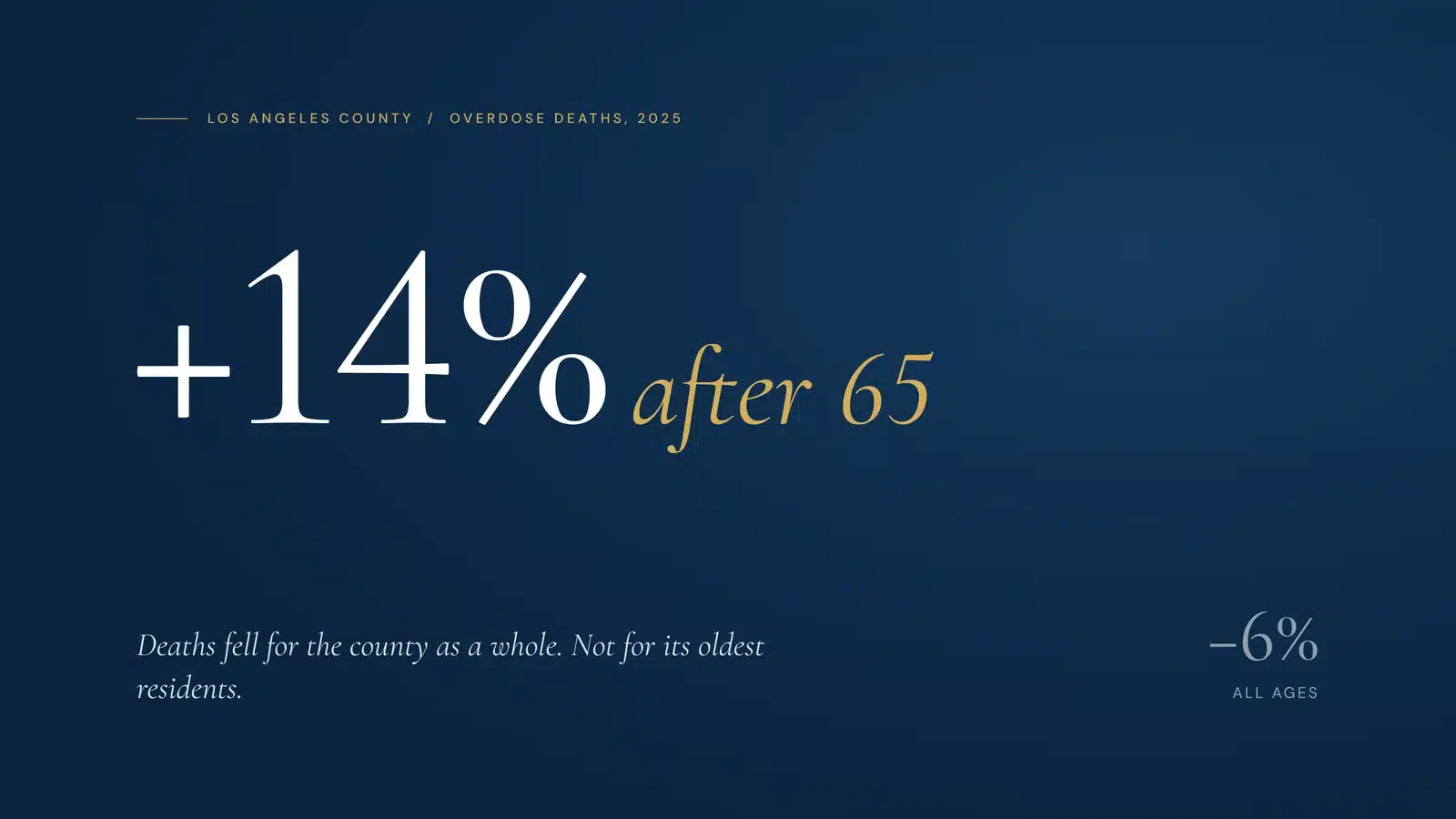
In 2025, overdose deaths among Los Angeles County residents 65 and older rose 14 percent while deaths countywide fell 6 percent. Older bodies process drugs more slowly, many older adults take several prescriptions that can interact, and addiction later in life is easily mistaken for ordinary aging, so it is often found late.
What did the 2025 county numbers show?
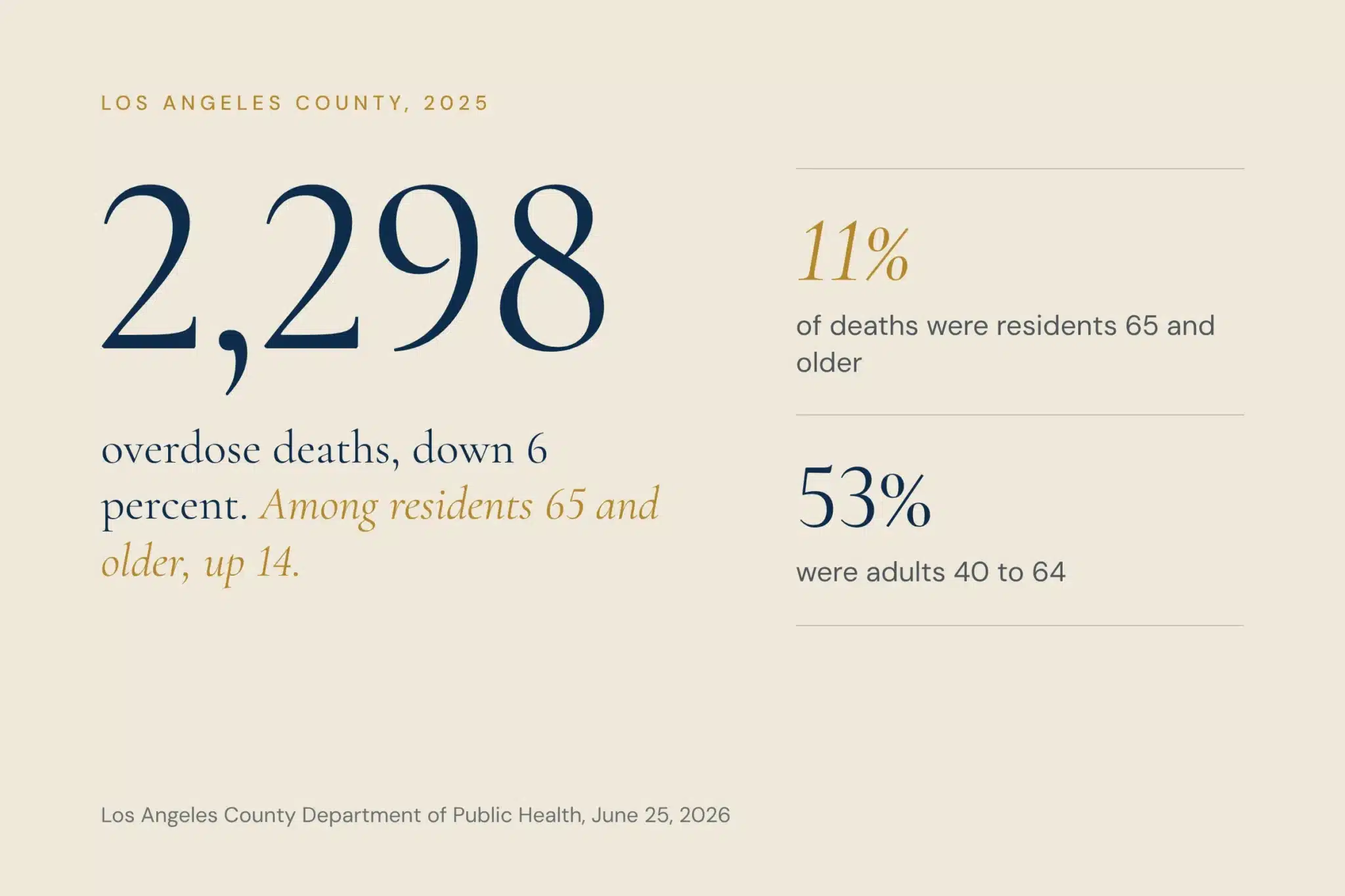
The headline was good news. The Los Angeles County Department of Public Health reported in June that 2,298 people died of accidental drug overdoses and poisonings in 2025, a 6 percent drop from 2024 and the third decline in a row. Deaths are now nearly 30 percent below the 2022 peak of 3,220. Fentanyl deaths fell 10 percent last year and methamphetamine deaths fell 7 percent.
One line in the same report ran the other way. Overdose deaths among residents 65 and older rose 14 percent, and that age group now accounts for 11 percent of all overdose deaths in the county. Adults 40 to 64 remain the largest group, at 53 percent of deaths, and men account for 77 percent.
The county release does not break the numbers out by region, so there is no separate figure for the San Fernando Valley. What it does show is a pattern families everywhere in the county should take seriously: the people least likely to be asked about drug use are now the ones whose risk is rising.
Why does the risk change after 65?
The National Institute on Drug Abuse sets out the reasons in its guide to substance use in older adults. None of them requires a dramatic story. Most of them build quietly over years.
- 1The body changes. Older adults typically metabolize substances more slowly, and the brain can be more sensitive to them. A dose that was manageable at 50 can be too much at 75.
- 2The medicine cabinet fills up. In one study of 3,000 adults aged 57 to 85, more than 80 percent took at least one prescription every day, which put at least 1 in 25 of them at risk of a major drug interaction.
- 3Mistakes look like misuse, and misuse looks like mistakes. Forgotten doses, doubled doses and old prescriptions taken for new pain are common, and they can turn dangerous when opioids, sedatives or alcohol are involved.
- 4The signs get misread. NIDA notes that providers may confuse substance use symptoms with other chronic conditions or with ordinary aging, so the problem is often found late.

Prescription opioids are part of this picture. NIDA estimates that between 4 and 9 percent of adults 65 and older use prescription opioids for pain, and it notes that opioid prescribing to older adults during routine office visits rose ninefold between 1995 and 2010. An older adult can become physically dependent on a medication taken exactly as directed, and that dependence deserves the same careful handling as any other.
What are the warning signs in an older parent?
Look for change rather than any single event. One fall is an accident. A pattern is information.
- 1Falls, bruises or near misses that do not have a clear explanation.
- 2New forgetfulness, confusion or slurred speech that comes and goes with the time of day.
- 3Prescriptions that run out early, more than one doctor prescribing similar drugs, or pills kept in unlabeled containers.
- 4Drinking alongside sleep aids, anxiety medication or pain medication.
- 5Pulling back from friends, church, the grandchildren or the routines that used to anchor the week.
Substance use can also make memory problems and mood disorders worse, which is why a careful assessment matters before anyone settles on a diagnosis.
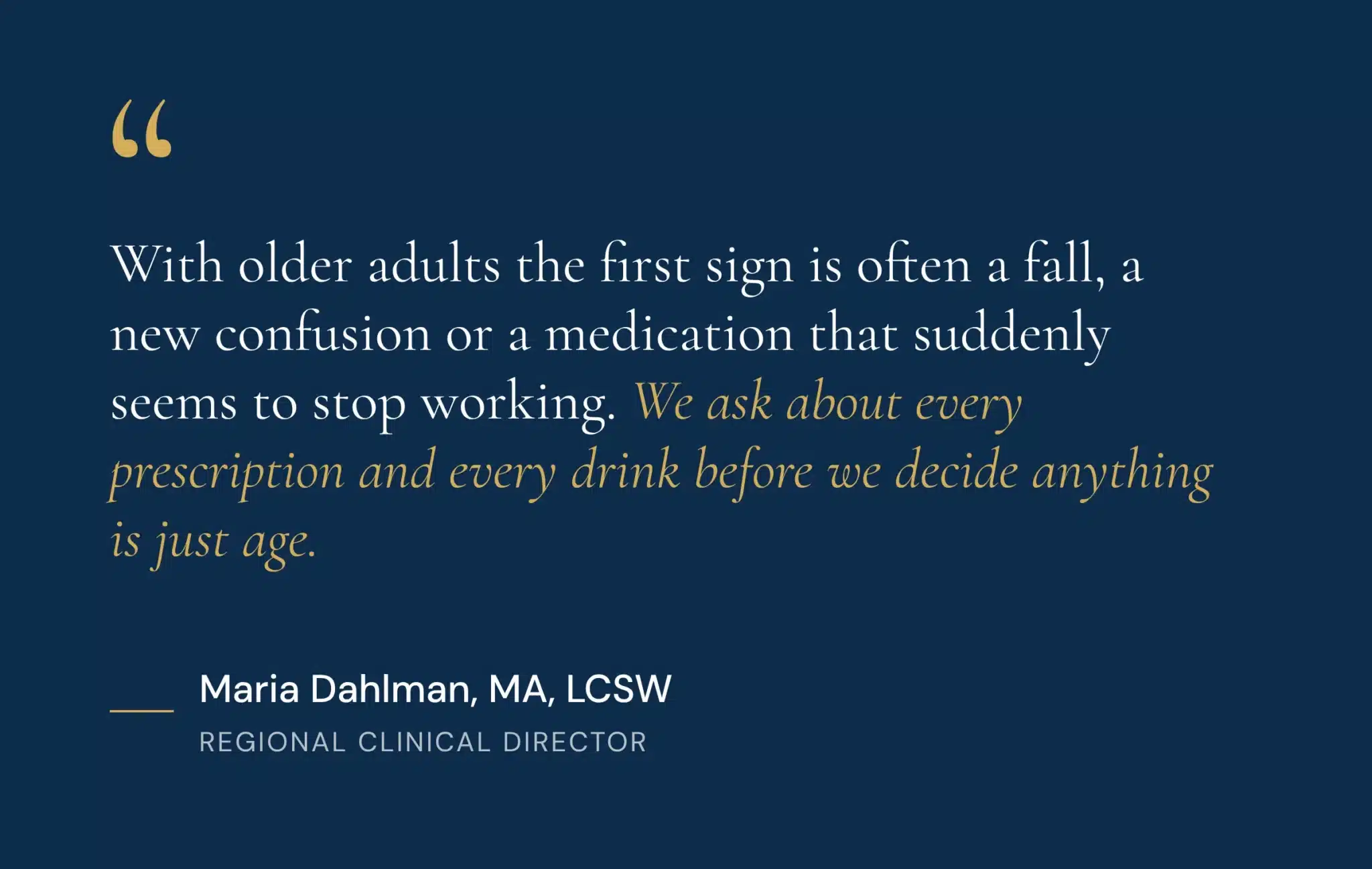
“With older adults the first sign is often a fall, a new confusion or a medication that suddenly seems to stop working. We ask about every prescription and every drink before we decide anything is just age.”
Maria Dahlman, MA, LCSW, Regional Clinical Director, Emend Healthcare
Is it different when the drug was prescribed?
It changes the conversation, not the risk. Many older adults who are in trouble never bought anything on the street. They take an opioid after surgery, a benzodiazepine for sleep or anxiety, and a glass or two of wine at dinner, and the combination slowly becomes the problem.
Two points matter most. First, no one should stop a benzodiazepine or a long-term opioid suddenly without medical advice; our guide to benzodiazepine tapering explains why a slow, supervised reduction is the safe way off. Second, prescription drug dependence is treatable, and our overview of prescription drug misuse treatment describes what that care involves. If counterfeit pills or illicit opioids are part of the picture, keep naloxone in the home and make sure everyone knows where it is.
Does addiction treatment work for older adults?
Yes. NIDA reports that many behavioral therapies and medications work for older adults with substance use disorders, that older patients do better with longer periods of care, and that medications for addiction are still underused in this age group. Nearly 1 million adults 65 and older had a substance use disorder in 2018, so a parent who needs help is far from alone.
For an older adult, treatment usually starts with medically supervised detox and a full review of every medication, followed by therapy that respects how much life the person has already built. Families looking at drug rehab in the San Fernando Valley often want care close enough that adult children can be part of the plan, and for an aging parent that closeness can matter even more.
“Older clients in detox get checked on more often, not less. We pay close attention to sleep, balance and how clearly someone is thinking, because withdrawal can look different at seventy than it does at thirty.”
Brianna Ayles, RADT, Behavioral Health Technician, My Limitless Journeys
How do you start the conversation with a parent?
Start with safety and with facts you have seen yourself. “You fell twice this month and you seemed confused on Sunday” lands differently than “I think you have a problem.” Offer to go with them to their next medical appointment and to bring every bottle in the house, prescription and over the counter, so one clinician can see the whole list.
Expect resistance, especially from a parent who has always been the one taking care of everyone else. Our guidance on how to talk to a loved one about getting help and on what to do when they refuse treatment applies at any age.
Where can Valley families start?
If you are unsure whether what you are seeing is addiction, start with the person’s own physician and a complete medication review. Los Angeles County’s substance use helpline, listed in the same Public Health release, is 800-854-7771.
My Limitless Journeys is a six-bed residence in Encino, licensed by DHCS (license 191135CP) and accredited by The Joint Commission, with detox, residential care and step-down programs under one clinical team. For drug rehab for San Fernando Valley families, admissions will tell you honestly whether our setting fits your parent’s medical needs, and if it does not, what kind of program would. The San Fernando Valley overview explains how families across the Valley use the same house.
Frequently asked questions
Is it safe for an older adult to go through detox?
It can be, with medical supervision. Age, other health conditions and the substances involved all change how withdrawal unfolds, and withdrawal from alcohol or sedatives can be dangerous at any age. An older adult should never detox alone at home; a medical team should set the pace and watch sleep, blood pressure, balance and thinking closely.
How can you tell the difference between dementia and substance use?
Often you cannot at first, and neither can a single office visit. Substance use can cause confusion and memory problems or make existing ones worse. A clinician usually needs a complete medication list, an honest account of drinking and, sometimes, a period of safe abstinence before the picture becomes clear.
Is it too late to treat addiction at 70 or 80?
No. NIDA reports that older adults can respond well to treatment, that many therapies and medications work for them, and that longer periods of care tend to bring better results.
What if my parent only takes what the doctor prescribes?
Physical dependence can develop even when every dose is taken as directed, and combinations of prescriptions and alcohol can be risky. Ask the prescriber for a full medication review, do not stop anything suddenly, and raise any falls or confusion at the same appointment.
Worried about a parent and not sure what you are seeing? Talk it through with our admissions team during business hours. We will listen first and answer plainly.
This article is general information, not a diagnosis or a substitute for an assessment by a clinician. If someone is in immediate danger, call 911. In a mental health or substance use crisis, call or text 988.
Sources
- Los Angeles County Department of Public Health, “Drug-Related Overdose Deaths in LA County Continue to Fall,” June 25, 2026. lacounty.gov
- National Institute on Drug Abuse, Substance Use in Older Adults DrugFacts, updated March 6, 2026. nida.nih.gov
Every article on this site is written by our editorial team and reviewed by a licensed clinician. Read how we write and review content.
Keep reading: Drug rehab in the San Fernando Valley · Benzodiazepine tapering · When a loved one refuses treatment · Polysubstance detox