
An honest page about IOP and the 405.
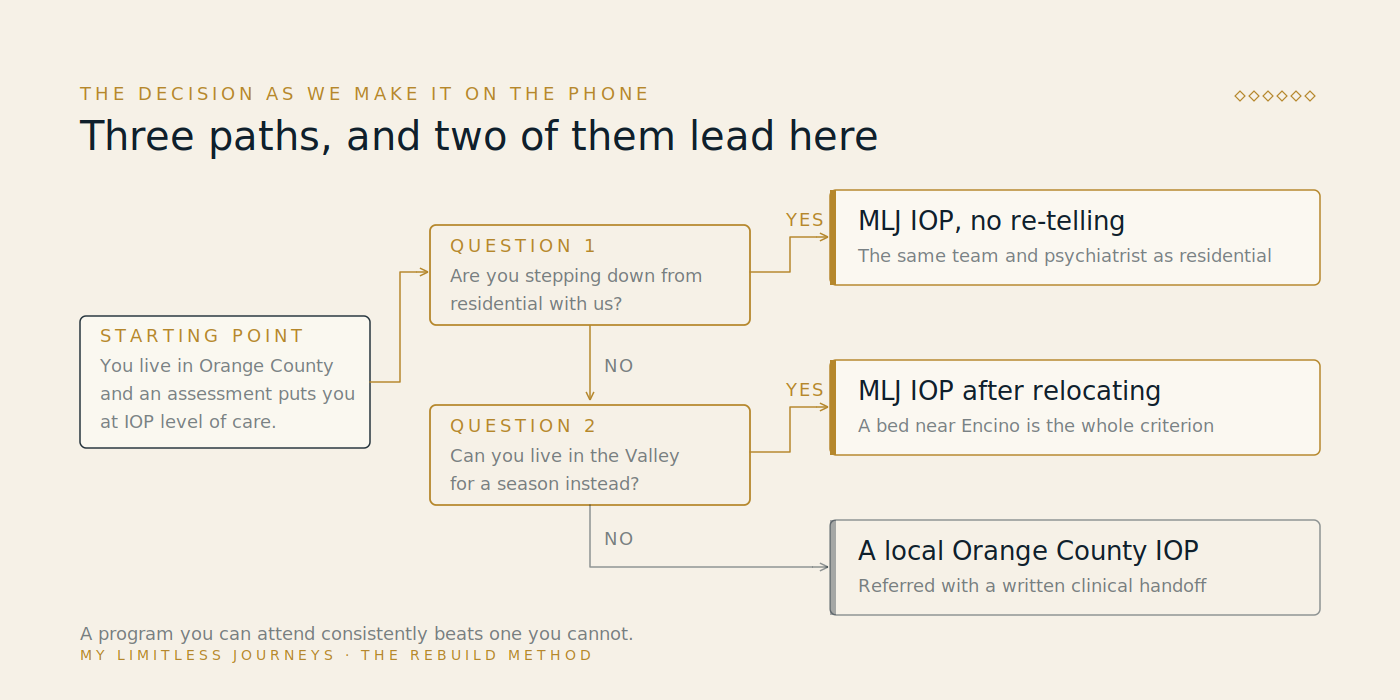
Our intensive outpatient program runs in Encino, which is sixty to ninety minutes from most of Orange County, and often longer at the hours IOP meets. This page is for two kinds of people: Orange County residents finishing residential treatment with us who are stepping down while living in our transitional housing, and people relocating to the Valley for a season. If you are living at home in Orange County and need an IOP, we will tell you plainly that a local program is the better choice, and help you find one.
Authored by the MLJ Clinical Team. Reviewed under board-certified psychiatric oversight. Last updated September 2026.
Key Takeaways- MLJ's IOP meets in Encino; there is no Orange County site, and a daily commute from Newport, Irvine, or Mission Viejo for a three-hour session is not something we recommend or design around.
- The program fits Orange County clients in two situations: stepping down from our residential program while living in MLJ transitional housing in the Valley, or temporarily relocating north for the duration.
- For someone living at home in Orange County who needs IOP-level care, a local program is the clinically better answer, and we will make that referral with a written handoff.
- Where our IOP does fit, the advantage is continuity: the same team that ran your detox and residential care, the same psychiatrist, and no re-telling of your history to strangers.
- IOP is covered under most behavioral-health benefits; we work with Aetna, Anthem, Cigna, Kaiser Southern California, and UnitedHealthcare, and accept private pay.
What IOP is, and why distance breaks it.
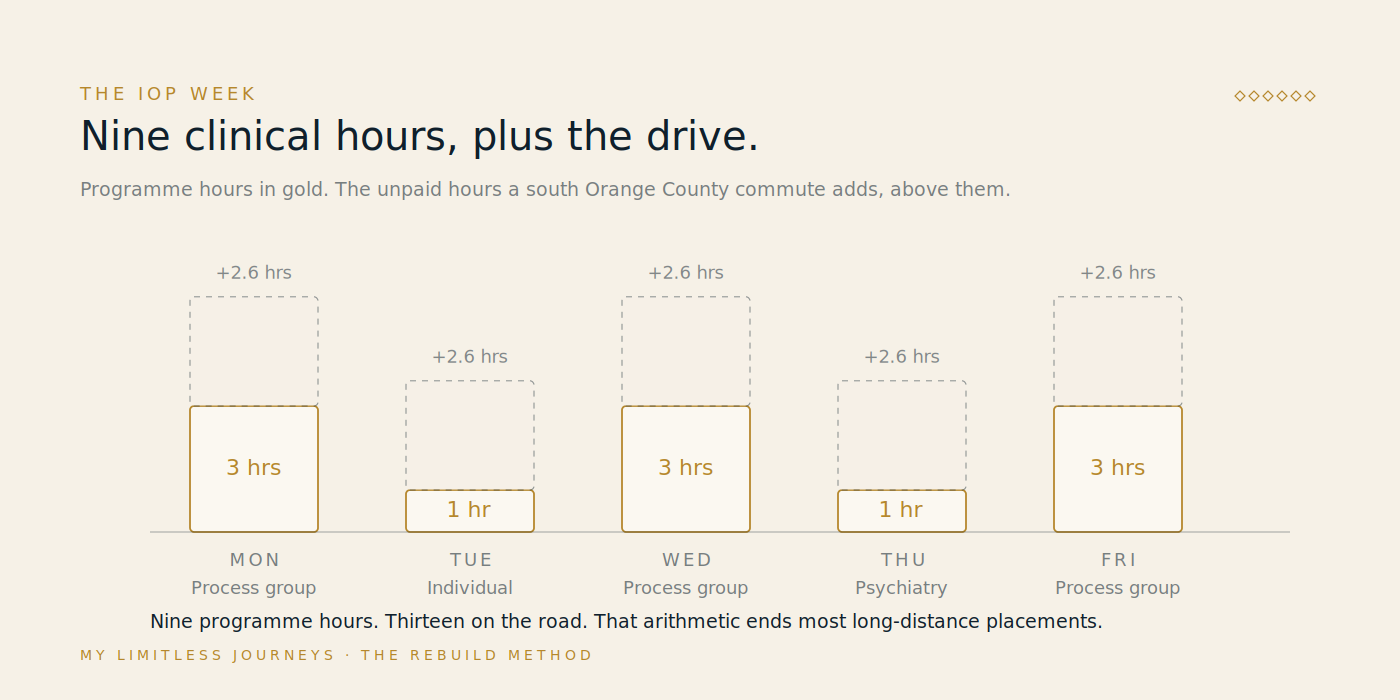
Intensive outpatient programming is roughly nine to fifteen hours of clinical care a week, usually delivered in three-hour blocks across three to five days. Its design premise is that you live your life and come to treatment, rather than the reverse: you work, you sleep at home, you attend group and individual sessions in the morning or evening, and you practice what you learned between sessions in the real world. The American Society of Addiction Medicine's levels-of-care framework places IOP below partial hospitalization and above standard outpatient precisely because it assumes a stable living situation nearby.
Now put sixty miles and the Sepulveda Pass between the living situation and the program. A three-hour evening session in Encino, for someone who lives in Irvine, means leaving work early, ninety minutes north in rush hour, three hours of group and individual work, and ninety minutes home in the dark. Four times a week. The clinical hours become a minority of the time spent, the fatigue undoes the benefit, and attendance collapses by week three. We have watched it happen and we no longer pretend otherwise. An IOP you cannot attend consistently is not an IOP.
The previous version of this page described an IOP "built around the 405," with sessions clustered into fewer, longer days to make the drive workable. Clustering helps at the margin. It does not change the arithmetic for someone whose bed is in Orange County. So this page is rewritten around the two situations in which our IOP genuinely serves Orange County residents, and the one in which it does not.
Who our IOP is actually for.
The first group is the largest: Orange County clients stepping down from residential treatment with us. You have spent thirty to ninety days at the Encino residence. You are not ready to go home to Laguna or Anaheim yet, and your team agrees. You move into MLJ transitional living, a structured, staffed residence in the Valley a few minutes from the house, and you attend PHP and then IOP with the same clinicians who ran your detox. The drive to programming is minutes, not hours. The continuity that makes step-down work, a team who already knows your history and your triggers, is intact. Our page comparing transitional living and sober living describes what that residence is and is not.
The second group is smaller: people who relocate to the Valley temporarily. Some Orange County residents have reasons to spend a season in Los Angeles anyway. Work that has shifted to the Burbank or Studio City lots. A family member's home in Sherman Oaks or Tarzana. A deliberate decision to be away from the county's social scene for a few months while doing outpatient work. For these clients our IOP functions as it was designed to, and they may or may not have done residential with us first; a direct admission to IOP is possible after assessment if the level of care is right. Our guide to IOP versus PHP covers how that assessment is made.
What both groups share is a bed within a short drive of Encino. That is the whole criterion. If it describes you, the rest of this page is about what you get. If it does not, the next section is for you.
When a local Orange County IOP is the better choice.
If you are living at home in Orange County, working there, and need IOP-level care, you should attend an IOP in Orange County. We say this on our own page because it is true, and because the alternative is watching someone fail at a program they could never have attended consistently. Orange County has a large number of licensed IOPs, some excellent, and the right one for you is one you can reach in twenty minutes after work.
This applies to two groups of people in particular. The first are those calling us cold, without a prior stay, who have been assessed at IOP level. If you do not need detox or residential, you do not need to drive to the Valley for outpatient care; you need a good program near your home, and we will help you evaluate candidates using the same questions in our guide on how to choose a rehab. The second are our own residential alumni for whom transitional living does not fit: children at home, a job that cannot be done remotely, a spouse who needs you back. For them, we refer to a local IOP with a written clinical handoff, a call between clinicians, releases signed, and our alumni program continuing in parallel. The referral is a plan, not a dismissal.
The discretion concern that brings Orange County professionals north for residential treatment is real, and it applies to IOP too. But a three-hour group in Costa Mesa attended consistently is better for your recovery than a three-hour group in Encino attended twice. If privacy in a local IOP is a serious worry, tell us; the questions on our privacy hub apply to any program, and we will help you ask them.
What the program contains when it fits.
For clients in transitional living or relocated to the Valley, IOP at MLJ is three-hour blocks, typically three to four days a week, with the balance of the week increasingly spent in real life. Groups never exceed six. Individual therapy continues weekly with the therapist you have had since residential. Psychiatric follow-up is scheduled into the same days so that a medication adjustment does not require a separate trip. Family sessions continue, by video or in person on the weekends when your family drives up from Orange County.
The clinical content shifts from the Body and Mind domains toward Life and Self. Relapse-prevention planning gets specific: which situations you have already faced during day trips home, which went well, which did not, and why. The relapse-prevention program is woven through IOP rather than bolted on. Return-to-work planning moves from theory to logistics: the first email to the firm, the first week's calendar, the client dinner in Newport in week two. Our guide to working during treatment describes what is realistic at this level of care.
And there is the escalation path. If IOP proves too little, the residence is minutes away and the team is the same; moving back up to PHP or residential is a conversation, not a re-admission to a new program. That safety net is what an Orange County client in our transitional housing has that a commuter never could.
Working from transitional living.
Most Orange County professionals in our IOP are working again, at least partly, and IOP is the level of care designed for it. A laptop and a quiet room in transitional living, programming in the morning or late afternoon, and work in the hours between. For people whose employers are in Irvine or Newport, remote work during this stretch is common, and the Life-domain planning during residential will have covered how the return was framed: "unavailable for personal reasons" for the residential weeks, then a phased return that IOP supports. Our For Professionals hub and the page on what to tell your team cover the disclosure decisions.
Day trips to Orange County during IOP are not just permitted; they are part of the program. A Friday in the office, a Saturday at home with the family, a return Sunday night to structure, and a Monday session that debriefs all of it. Each trip is a rehearsal with a safety net. By the end of IOP, the trips have grown longer and the debriefs shorter, and the move home has been practiced rather than leapt into.
The step from IOP to Orange County.
IOP ends when the week is mostly real life and the team agrees you are ready. What you carry home is a local therapist or psychiatrist who has already spoken with us, a relapse-prevention plan built from actual rehearsals rather than hypotheticals, a list of meetings near your home you have already attended, and your alumni contact at MLJ. The alumni program does not care that you live sixty miles away; the phone is the same distance from Laguna as from Sherman Oaks, and alumni from Orange County make the drive north for gatherings more often than you would expect. The After Treatment hub covers what the first year at home usually holds.
- Orange County hub. Which levels of care travel well and which do not.
- Orange County PHP. The step before IOP, also from transitional living.
- Orange County residential treatment. The level of care where distance helps.
- Intensive outpatient program. The program page.
- Transitional living. Where Orange County clients live during step-down.
- Recovery support groups in Orange County. The community waiting at home.
This guide is educational and is not a substitute for medical advice. If someone is in immediate danger, call 911.