
What is a sober living relapse policy?
A sober living relapse policy is the written rule a recovery home follows when a resident drinks or uses. California’s AB 1556, signed in September 2026, requires state-funded recovery housing to keep a written return-to-use policy, train staff and residents in overdose response, and keep naloxone on site. Families can ask any home for the same.
What does California’s new law change?
On September 29, CalMatters reported that Governor Gavin Newsom had signed Assembly Bill 1556, by Assemblymember Matt Haney of San Francisco. California funds homeless housing under a Housing First model, and the bill clarifies that sober housing providers can qualify for those state funds if they follow certain rules. It was Haney’s third attempt, and it came a year after Newsom vetoed a broader measure that would have created a new state regulatory system for sober housing.
The rules are the useful part. According to the bill analysis, a recovery housing program that wants state funding must provide relapse support, train staff and residents in emergency preparedness and overdose response, keep overdose reversal medication available and readily accessible to staff and residents on site, and adopt and maintain a written return-to-use policy. CalMatters adds that residents who relapse must be offered the option of moving into low-barrier housing, and that providers may evict residents who decline. The bill is now Chapter 779, Statutes of 2026.
Does the law apply to a private sober living home?
Usually not. AB 1556 is about which recovery housing can receive state homelessness money. Most sober living homes that families pay for privately after treatment receive no such funding, so the law does not reach them.
Nor does the state license them. The California Department of Health Care Services says plainly that it does not license, certify or investigate complaints against sober living or transitional living homes. The exception is a home that provides licensable treatment services, such as group or individual sessions, which needs a DHCS license; a complaint about that can be filed with DHCS. For everything else, quality is whatever the operator decides it is.
That is why the new law is worth reading even if it never touches your family. It is the first time California has written down, in statute, what a responsible answer to relapse in recovery housing should include. It makes a good checklist.
Why does the relapse plan matter so much after residential treatment?
Because the body has changed. The NYC Health Department’s guidance on tolerance explains that tolerance decreases when someone stops or takes a break from using, and it names people discharged from a hospital or a drug treatment program among those at increased risk of overdose. After thirty to ninety days of residential care, the amount someone used to take is no longer the amount their body can handle.
That is the clinical reason we plan the step down carefully rather than ending treatment on a single morning. In residential treatment in Encino, the last weeks are spent on where the person will live, who will notice if things slip, and what happens next if they do.

“Families often hear relapse policy and think punishment. A good policy is closer to a fire plan: who notices, who gets called, and where the person goes next.”
Karen Lakritz, AMFT, Associate Marriage and Family Therapist, My Limitless Journeys
What should a good relapse policy say?
SAMHSA’s Best Practices for Recovery Housing describes recovery homes as safe, healthy, family-like substance free living environments, and calls recovery housing a recovery support service rather than treatment. It recommends that homes clearly define in their policies how they will address a resident’s return to use, and that every policy be given to the resident in writing and signed. Put that together with AB 1556 and a sound policy answers a handful of plain questions.
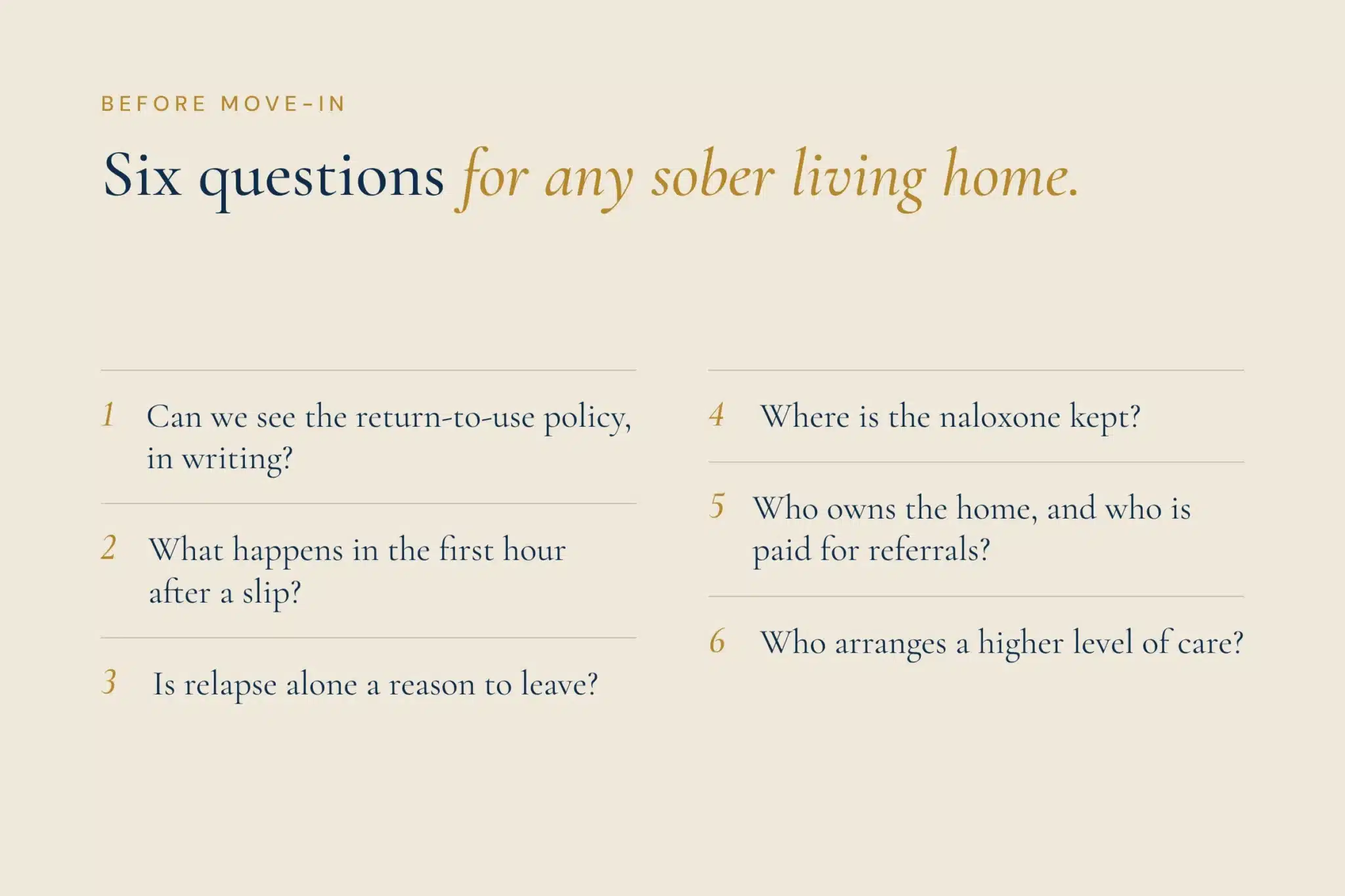
- 1May we see your return-to-use policy in writing, and will my family member sign it before moving in?
- 2What happens in the first hour if someone uses: who checks on them, who is called, and is a family contact notified with consent?
- 3Is relapse alone a reason to ask someone to leave, or is there a step to another level of support first?
- 4Where is naloxone kept, and have staff and residents been trained to use it?
- 5Who owns the home, and does anyone receive payment for referring residents to treatment programs?
- 6If a higher level of care is needed, who arranges it, and how quickly?
The fifth question matters for a separate reason. Recruiting through sober living has been part of several California fraud cases, and our guide to patient brokering explains what to watch for.
“House rules only help if they are written down, signed and the same for everyone. Residents should know where the naloxone is on the first night, and so should their families.”
Casey Flores, RADT, Retreat Manager, My Limitless Journeys
Is sober living the right next step at all?
Not always. Some people go home with outpatient care. Some need more structure than a sober living house offers, at least for a while. Our transitional living program sits between the two, and the differences are laid out in transitional living versus sober living. The right answer depends on what the person is going back to, which is a clinical question as much as a practical one.
“The relapse conversation belongs in a family session before move-in day, not in the driveway after something has gone wrong. When everyone already knows the plan, a slip is a problem to solve instead of a crisis.”
Karen Lakritz, AMFT, Associate Marriage and Family Therapist, My Limitless Journeys
How we plan the step down in Encino
Our residential program runs thirty to ninety days in a six-bed home in the hills above Ventura Boulevard, with partial hospitalization, intensive outpatient and transitional living at the same address. Because the team does not change when the level of care does, the person who helped write the relapse plan is still there when it is used. Families who want to see how residential care fits the rest of the continuum can start with our six-bed residential treatment in Encino or the overview of our Encino residence.
If a return to use has already happened, the most urgent concern is safety. Keep naloxone nearby, call 911 if someone is unresponsive or not breathing normally, and read what to do in the first 24 hours after a relapse. The free, confidential SAMHSA National Helpline, 1-800-662-4357, can refer to care in any state, at any hour.
Frequently asked questions
Can a sober living home evict someone for relapsing?
Usually, yes, if the house rules say so, because most private sober living homes are not licensed and set their own policies. Under AB 1556, recovery housing that takes state homelessness funds must have a written return-to-use policy and offer support, which is a reasonable standard to ask any home to meet.
Are sober living homes licensed in California?
Generally not. DHCS does not license, certify or investigate complaints against sober living or transitional living homes. A home that provides treatment services such as group or individual sessions needs a DHCS license, and complaints about that can go to DHCS.
When should we choose a sober living home?
Ideally during residential treatment, a few weeks before discharge, so the clinical team can weigh in and the family can visit, read the policies and ask questions. Choosing in a hurry on discharge day makes it harder to compare homes or to notice warning signs.
Does AB 1556 require every sober living home to carry naloxone?
No. The requirement applies to recovery housing that wants state homelessness funding. Many private homes keep naloxone anyway, and any family can ask where it is stored, whether it has expired, and whether staff and residents have been trained to use it before move-in day.
Plan the months after residential care before they arrive. Ask us how step down, transitional living and the relapse plan work at our Encino residence.
Begin a conversation · (866) 209-4246 during business hours · Verify your benefits
This article is general information, not a diagnosis or a substitute for an assessment by a clinician. If someone is in immediate danger, call 911. In a mental health or substance use crisis, call or text 988.
Sources
- Kendall, M. “New California law frees up funds for sober homeless housing.” CalMatters, September 29, 2026. calmatters.org
- AB 1556 (Haney), recovery housing, Chapter 779, Statutes of 2026. Bill status and analysis, CalMatters Digital Democracy. calmatters.digitaldemocracy.org
- California Department of Health Care Services, Licensing and Certification Complaints (sober living and transitional living homes). dhcs.ca.gov
- SAMHSA, Best Practices for Recovery Housing (PEP23-10-00-002), September 2023. library.samhsa.gov
- NYC Health Department, Drug Tolerance and Risk of Overdose. nyc.gov
- SAMHSA National Helpline. samhsa.gov
Every article on this site is written by our editorial team and reviewed by a licensed clinician. Read how we write and review content.
Keep reading: Residential treatment in Encino · Transitional living vs. sober living · Going home vs. transitional living after rehab · Relapse: the first 24 hours