
Addiction treatment Orange County won't hear about.
The full continuum, detox through alumni, delivered by one clinical team at a six-bed residence in Encino, roughly an hour north of Orange County. This page walks the whole staircase from an OC address: which steps happen at the house, which happen in our transitional housing nearby, and which should happen at home.
Authored by the MLJ Clinical Team. Reviewed under board-certified psychiatric oversight. Last updated September 2026.
Key Takeaways- MLJ's continuum for Orange County clients is medically supervised detox, residential (30–90 days), PHP, IOP, transitional living, and alumni care, all under one team in the San Fernando Valley; there is no OC facility.
- The first two stages happen inside the Encino residence; PHP and IOP happen while living in our nearby transitional housing; alumni care follows you home to Orange County.
- Length of the whole arc is set by clinical assessment, not by a brochure: most clients spend between two and five months across all levels before living fully at home again.
- Co-occurring anxiety, depression, trauma, and ADHD are treated in parallel from the first week, because the substance is usually the symptom, not the whole diagnosis.
- We verify Aetna, Anthem, Cigna, Kaiser Southern California, and UnitedHealthcare benefits before admission; same-week admission is often possible.
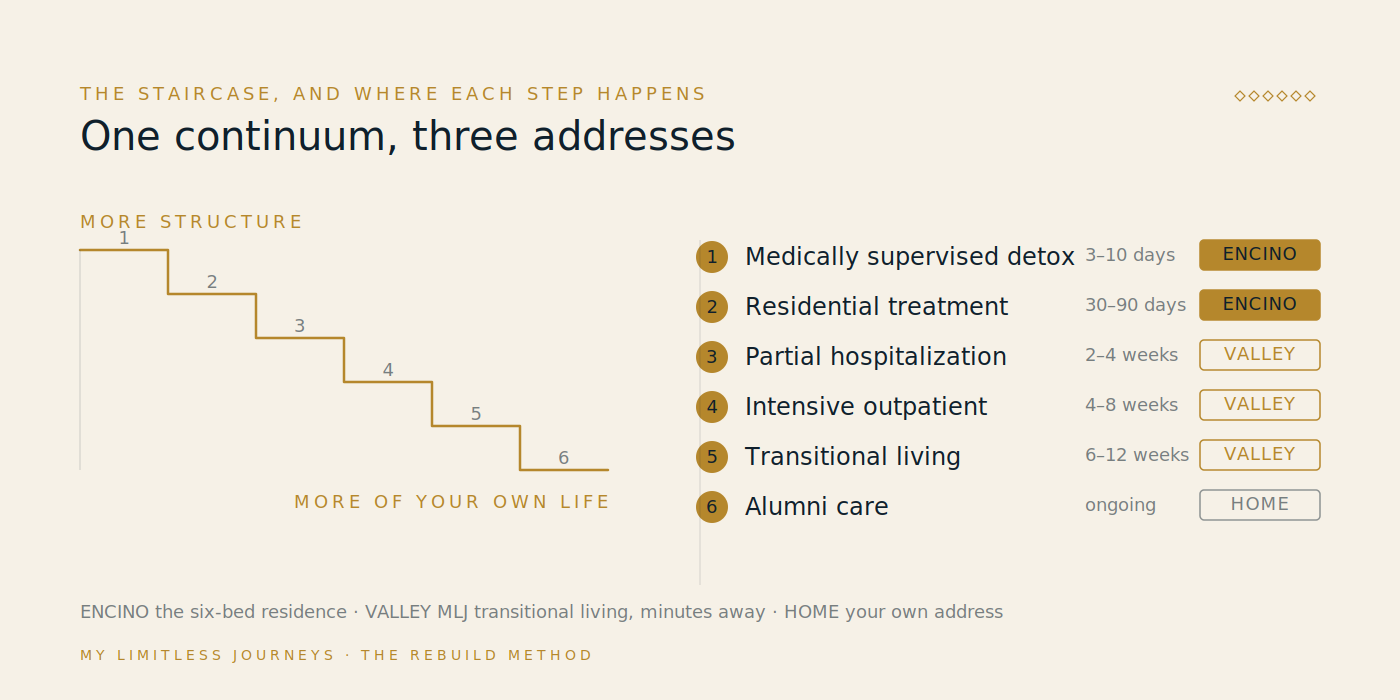
The staircase, and where each step happens.
"Addiction treatment" is a phrase that covers everything from a three-day detox to a year of weekly therapy. When someone from Newport Beach or Anaheim calls us, the first thing we do is unpack it into stages, because the geography question changes at each one. Here is the honest version.
Detox and residential treatment happen at the residence in Encino. You live there. Partial hospitalization and intensive outpatient are day programs; when Orange County clients step down into them, they live in our transitional housing in the Valley, a short drive from the house, and attend programming with the same team. Alumni care and relapse prevention are wherever you are, which for you means Orange County. The programs overview describes each level generically; this page describes them from an OC driveway.
The reason we lay it out this way is that the most common failure in addiction treatment is not a bad program. It is a gap between programs: a detox that discharges on Friday to a residential program with no bed until Tuesday, or a residential discharge to an IOP across town that never quite starts. The Substance Abuse and Mental Health Services Administration has been describing continuity of care as a core principle of effective treatment for two decades. In practice, continuity is a logistics problem, and having every level inside one organization is how we solve it.
Weeks one and two: detox into residential.
Most Orange County clients arrive needing medical detox, whether or not they think so on the phone. Alcohol, benzodiazepines, opioids, and fentanyl each have withdrawal courses that range from miserable to dangerous, and stimulant crashes carry their own psychiatric risk. Detox at MLJ is medically supervised inside a private bedroom, with nursing coverage, substance-specific protocols, and a board-certified psychiatrist directing medication. The Orange County detox page covers the protocols and, importantly, how to travel here safely.
What matters for this page is what happens when detox ends. Nothing, visibly. You do not pack. You do not meet a new intake coordinator. The bedroom you detoxed in is the bedroom you live in for residential treatment, and the therapist who checked on you during the worst night is the therapist you sit with on day eight. The transition from detox to residential is a shift in what the days contain, not a change of address. For someone who has done the detox-then-transfer routine before, this alone is often the reason they choose to drive north.
Contact with home during this stretch is limited, and we tell families that before admission so it is not a shock. It is not punishment. Someone four days off alcohol who takes a phone call about a client dispute in Irvine is not in a state to process it, and their nervous system needs the quiet. Family clinicians are in touch with your spouse or parents from day one so that the silence from your end does not feel like a void.
The residential middle.
Residential treatment is where the distance from Orange County earns its keep. For thirty to ninety days, depending on assessment, you live in a six-bed house with a daily structure: individual therapy several times a week, small groups that never exceed the number of beds, psychiatric follow-up, fitness and nutrition treated as clinical work, family sessions, and the slower reconstruction of sleep and appetite that no one talks about in brochures. We describe this level in detail on the Orange County residential treatment page, so here we will say only what is specific to the continuum.
The residential phase is where the discharge plan gets built, starting in week one. For an Orange County client that plan has a geographic spine: which local psychiatrist or therapist will take over, which meetings near Irvine or Laguna are a fit, what the first week back at a firm in Newport Center actually looks like hour by hour, and whether going straight home is wise at all. The Life domain of The Rebuild Method is where this work lives, and it is done with the same clinicians who will still be your team in step-down.
Family involvement during residential is scheduled with the 405 in mind. A Saturday trip north can hold a family therapy session, a shared meal, and a walk, rather than a fifty-minute session bracketed by three hours of freeway. Secure video handles the weeks in between.
Stepping down without going home yet.
This is the stage where an Orange County address changes everything, and where we will disappoint anyone hoping to commute. Partial hospitalization is five to six hours a day, five or six days a week. Intensive outpatient is roughly three hours a day, three to five days a week. Neither is compatible with a daily round trip from Mission Viejo or Huntington Beach, and we will not pretend otherwise.
What we offer instead is transitional living: a structured, staffed residence in the Valley near the house where clients live while attending PHP and then IOP with the same team. It is a bridge between a six-bed house with round-the-clock support and a home in Orange County with none. Clients in transitional living begin working remotely, take day trips home, rehearse the situations that worried them in residential, and come back to structure every night. Our guide comparing transitional living and sober living explains how this differs from a generic sober house.
When transitional living does not fit, because of children at home, a job that cannot be done remotely, or a family that needs you back, the right answer is a day program near your home, and we will make that referral with a written handoff rather than pretend our IOP is a fit. The Orange County PHP and Orange County IOP pages go into when each is appropriate.
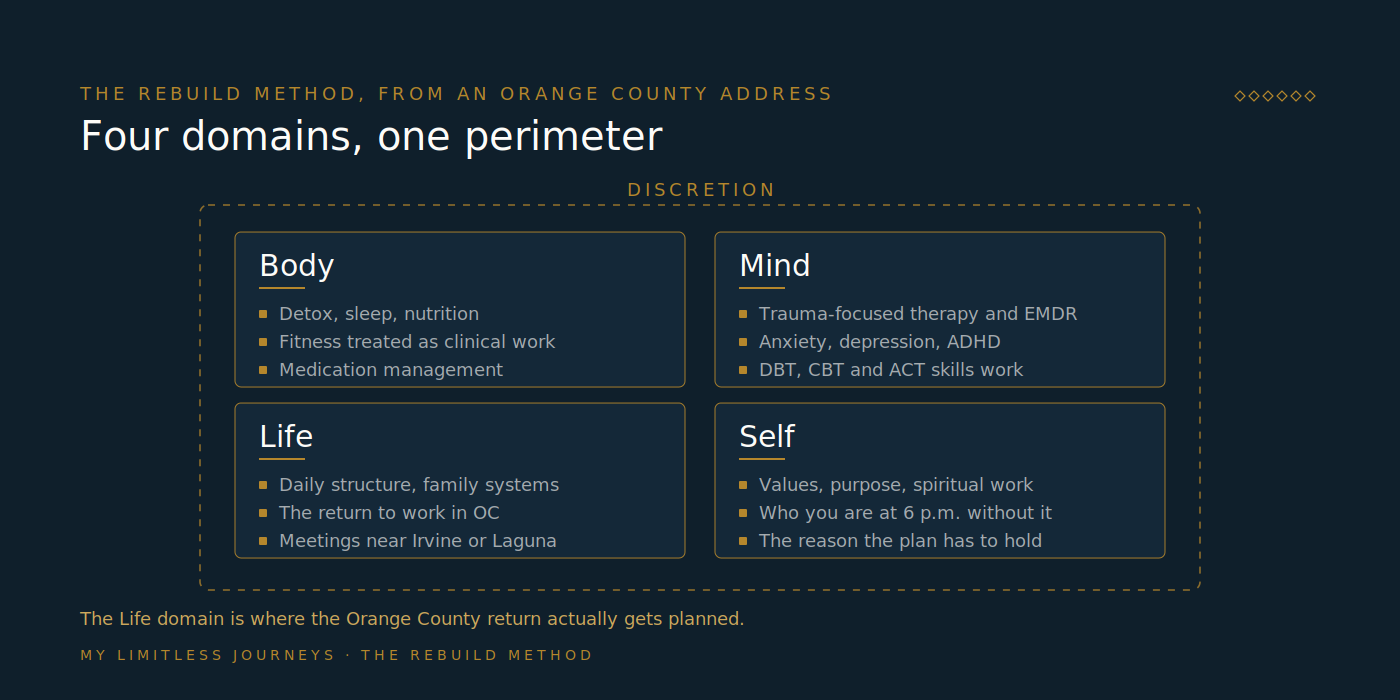
What we are actually treating.
Very few people who arrive from Orange County have a substance problem and nothing else. The founder who drinks a bottle of wine a night has an anxiety disorder that was managed with wine for fifteen years. The surgeon on fentanyl patches has chronic pain and a depression she has never named. The twenty-six-year-old in Costa Mesa with a stimulant problem has untreated ADHD and a father who is also in this file. Treating the substance and sending the rest home is why so many people have been to treatment twice.
The Rebuild Method holds four domains at once. Body: detox, sleep, fitness as clinical work, nutrition, medication management. Mind: trauma-focused therapy, co-occurring conditions, and the cognitive work of DBT, CBT, EMDR, and ACT. Life: daily structure, family systems, and return-to-work planning. Self: values, purpose, and the question of who you are when the substance is not doing the talking. A psychiatric assessment happens early in the stay so that the co-occurring picture is understood before the therapeutic work is designed around it. Our page on co-occurring disorder treatment explains how those diagnoses are made and treated together.
Around all four sits a perimeter we call discretion. Staff are trained to treat your identity, your work, and your reputation as sensitive by default, without you having to ask. That perimeter is easier to maintain in a house of six than in a campus of sixty, and it is why Orange County clients whose names appear on buildings and letterheads end up in the Valley.
Going home to Orange County.
Eventually the staircase ends at your own front door, and the sixty miles that protected you become sixty miles between you and your team. We plan for that from the first week. Your discharge packet names a local therapist or psychiatrist who has already spoken with us, with releases signed; a relapse-prevention plan built around your actual triggers, not generic ones; a list of meetings and recovery communities near your home, drawn from the same research behind our guide to recovery support groups in Orange County; and a schedule for alumni contact that starts on day one at home, not "when you need it."
The alumni program is phone, video, and periodic in-person gatherings. Alumni who live in Orange County are not second-class; a good number of them make the drive north for gatherings precisely because the drive itself has become part of the ritual. If something goes wrong, the first twenty-four hours after a relapse page describes how alumni re-engage without shame and without starting over.
How long the whole thing takes.
People want a number, and the honest answer is a range with reasons. Detox is three to ten days depending on the substance. Residential is thirty to ninety. PHP in transitional living is often two to four weeks; IOP another four to eight. Put together, most Orange County clients are away from their own home for somewhere between two and five months, with the last stretch spent increasingly at home during the week and in the Valley for programming. That is longer than the twenty-eight days many people expect, and it is longer for a reason: the research NIDA summarizes in its principles of effective treatment is consistent that adequate duration matters more than any single modality.
What that range does not include is any pressure to fill it. Length of stay is set by clinical assessment and revisited weekly, with you in the room. If you are ready for step-down at day thirty-five, you step down at day thirty-five. Our guide to 30, 60, and 90-day programs explains how those decisions are made.
- Orange County hub. Why leaving the county is the point.
- Orange County detox. The first step, and arriving safely.
- Orange County residential treatment. The middle of the staircase.
- Transitional living. The bridge between the house and home.
- Levels of care explained. The generic version of this staircase.
- Building a continuing-care plan. What the last step contains.
This guide is educational and is not a substitute for medical advice. If someone is in immediate danger, call 911.