
PHP for Orange County clients, without the commute.
Partial hospitalization is five to six hours of clinical care a day, most days of the week. Nobody should be doing that from Newport Beach or Anaheim to Encino and back. Our PHP serves Orange County clients who have finished residential treatment with us and are living in MLJ transitional housing in the Valley during step-down. This page explains what that bridge is, what the days hold, and why we will not pretend a daily drive is an option.
Authored by the MLJ Clinical Team. Reviewed under board-certified psychiatric oversight. Last updated September 2026.
Key Takeaways- PHP at MLJ runs in Encino; there is no Orange County site, and a daily round trip of two to three hours for a six-hour program is not a plan we will write for anyone.
- Orange County clients in our PHP live in MLJ transitional living, a structured residence in the Valley minutes from the house, and attend programming with the team that ran their residential stay.
- PHP is the bridge between round-the-clock residential care and a life at home: full clinical days, evenings and weekends increasingly spent in real life, including day trips to Orange County.
- Typical length is two to four weeks, followed by IOP from the same residence; the step home is rehearsed, not leapt.
- PHP is a covered level of care under most behavioral-health benefits; we work with Aetna, Anthem, Cigna, Kaiser Southern California, and UnitedHealthcare, and accept private pay.
What PHP is, and what it is not.
Partial hospitalization sits one step below residential treatment in the levels-of-care framework the American Society of Addiction Medicine maintains. The clinical intensity is nearly the same as residential, five to six hours of programming a day, five or six days a week, with individual therapy, group work, psychiatric follow-up, and medical monitoring where needed. What changes is the nights. In residential you sleep at the program. In PHP you sleep somewhere else, and that "somewhere else" is the entire question for an Orange County client.
The name misleads people. PHP has nothing to do with a hospital. It is a day program, and its purpose is to hold clinical intensity steady while you begin to reclaim evenings, weekends, and pieces of your ordinary life. It is the level of care where the question shifts from "can I stay sober inside a protected house" to "can I stay sober with a laptop, a phone, and a Saturday." Our guide to IOP versus PHP explains how the two outpatient levels differ; this page is about what PHP looks like when your home is sixty miles from the program.
The commute we will not design.
Here is the arithmetic. Programming runs roughly 9 a.m. to 3 p.m. From Irvine or Newport Beach, arriving at 9 on a weekday means leaving before 7 to sit in the 405's worst hour through the Sepulveda Pass. Leaving Encino at 3 means an hour and a half to two hours south, again in traffic. That is a twelve-hour day for six hours of treatment, five days a week, for someone in their first month of sobriety. Nobody sustains it. The fatigue becomes a relapse risk in itself, the missed days accumulate, and the client concludes that treatment does not work for them when what did not work was the freeway.
We have seen enough of this in the industry to have made a rule of it: we do not admit Orange County clients to PHP as commuters. There is no clustering of sessions that fixes six hours a day. The earlier version of our Orange County outpatient pages leaned on "fewer, fuller days"; that was a reasonable idea for IOP at the margin and never one for PHP. If you are living at home in Orange County and need PHP-level care, the right program is a local one, and we will help you find and evaluate it using the questions in our guide to how to choose a rehab.
Transitional living as the bridge.
So how does an Orange County client do PHP with us at all? By living in the Valley for a few weeks. MLJ transitional living is a structured, staffed residence a short drive from the house. It is not a sober-living house in the loose sense; it is part of the clinical continuum, with expectations, accountability, and the same team you have had since detox. Residents attend PHP by day, return to a supervised home by night, and begin to reclaim the pieces of ordinary life in a setting where the safety net is minutes away. The transitional living program page describes the residence itself, and our comparison of transitional living versus sober living explains why the distinction matters.
For an Orange County client this arrangement solves the geography problem twice. It puts your bed near the program, so PHP works as designed. And it keeps you out of Orange County for a few more weeks, which for many people is exactly the right amount of additional distance: no longer inside the protected house, not yet inside the old life, in the middle where the rehearsals happen.
Continuity is the other thing it buys. The therapist who ran your residential sessions runs your PHP sessions. The psychiatrist who adjusted your medication in week two is the psychiatrist who adjusts it in week six. There is no intake, no new chart, no telling the story again to strangers. Our page on the one-to-one clinical ratio explains why that continuity is only possible in a program this small.
A PHP day from the Valley.
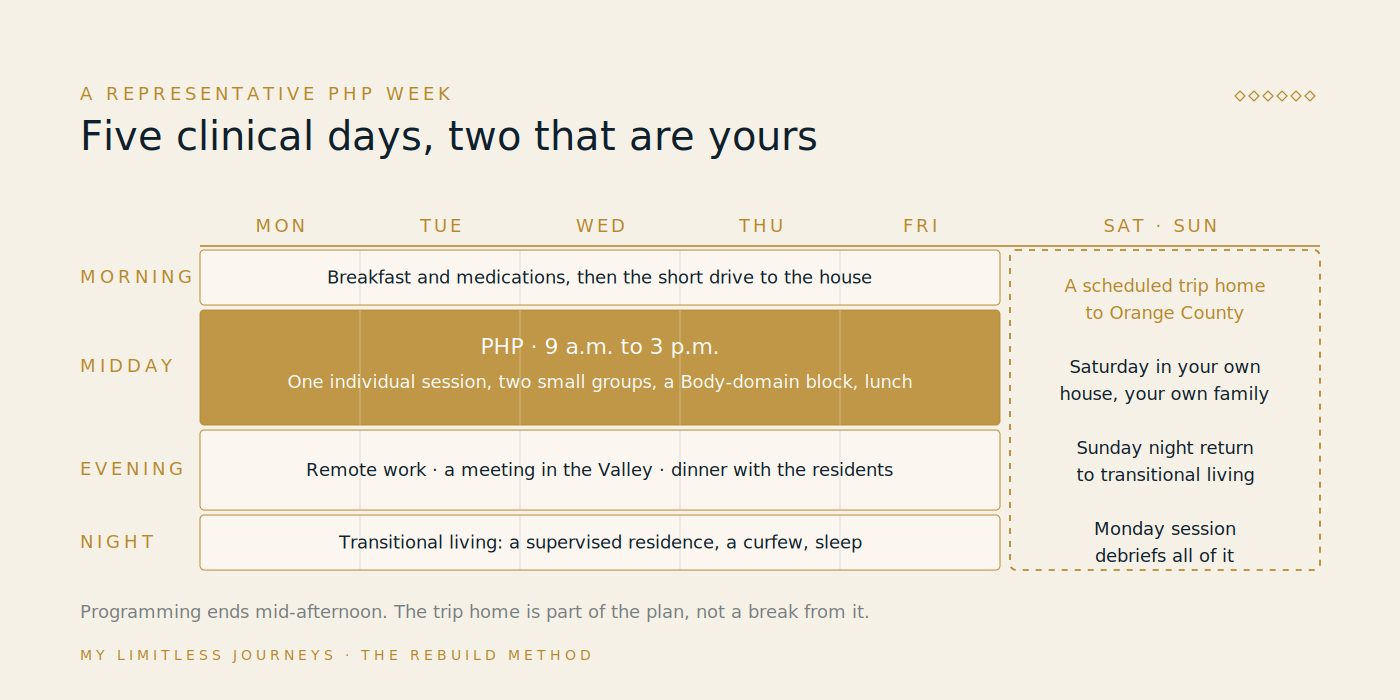
Morning begins in transitional living: breakfast, medications if prescribed, the short drive to the residence. The clinical day holds an individual session or a psychiatric check, two or three small groups that never exceed six people, and a block in the Body domain, whether that is a structured workout, a nutrition session, or the sleep work that is still under way for most people a month into sobriety. Lunch is at the house. The afternoon often holds the Life-domain work: return-to-work planning, family sessions by video with a spouse in Orange County, the logistics of the first weeks home. Programming ends mid-afternoon.
The evening is yours in a way it was not during residential. Remote work for those whose employers in Irvine or Anaheim have agreed to a phased return, and our guide to working during treatment is honest that PHP is where this begins rather than where it flourishes. A recovery meeting in the Valley. Dinner with the other residents. A phone that is yours again, within the boundaries set by clinical stage. Then a supervised residence, a curfew, and sleep.
The whole point of the shape is that it is a real day with treatment in it, rather than treatment with a real day around the edges. That is the distinction between residential and PHP, and it is the one that makes PHP the right rehearsal for going home.

Day trips to Orange County as clinical work.
During residential, the sixty miles between Encino and Orange County kept you away from the county. During PHP, they become a distance you cross on purpose, and then cross back. Weekend trips home are scheduled into the plan: a Saturday in your own house with your own family, a Sunday-night return to transitional living, a Monday session that goes through all of it. What did you feel driving past the exit you used to take. Who texted. What happened at dinner when someone opened wine. What you did with the hour alone in the afternoon.
These are not tests you can fail. They are the material the therapy works with, and they are far more useful than hypotheticals. A relapse-prevention plan built in a residential living room is a good draft; one revised after three actual Saturdays in Laguna is a plan. The relapse-prevention program at MLJ is built around exactly this iterative cycle, and PHP from transitional living is where an Orange County client gets to run it with a safety net.
The trips also change the family's role. A spouse who has been driving north for visits now hosts a visit home, and the family session on Monday includes what that felt like for them. The household is practicing, too. Our page on the family's role in recovery covers how that work continues after residential.
Who steps down through PHP, and who does not.
Most Orange County clients who complete residential with us step down through PHP in transitional living, because most people are not ready to go from round-the-clock support to an empty house in one day. The ones for whom it fits especially well are people whose home environment is not yet stable, whose using network is dense and local, whose work can be done remotely for a few more weeks, or who simply know themselves well enough to want the bridge.
It does not fit everyone. A parent of young children who has already been away for six weeks. A physician whose practice cannot run without her. A client whose spouse and home are the strongest part of their support and whose risk is lower away from them. For these people, a direct return to Orange County with a local PHP or IOP, a local clinician, and our alumni program is the better plan, and we make that referral with a written handoff and a clinician-to-clinician call. Our guide to going home versus transitional living lays out the decision as we actually make it. Nobody is pushed into transitional living to fill a bed; the residence is small, the decision is clinical, and it is made with you during residential, not at the door.
From PHP to IOP to home.
PHP typically lasts two to four weeks. When the weekends home are going well and the clinical days feel like more structure than you need, the step to IOP is a change in the schedule, not a change in team or address: three-hour blocks instead of six, more of the week in real life, longer trips to Orange County. The Orange County IOP page describes that stage, including our honesty about when a local program is the better fit. After IOP comes home, with a local clinician already in place, meetings near your house you have already attended, and an alumni contact whose number works the same in Dana Point as in Encino. The whole descent, from six beds to your own bed, is designed so that no single step is bigger than the one before it.
- Orange County hub. Which levels of care travel well from OC.
- Orange County residential treatment. The stage before PHP.
- Orange County IOP. The stage after.
- Partial hospitalization program. The program page.
- Transitional living. Where you live during step-down.
- Building a continuing-care plan. What the descent is aiming at.
This guide is educational and is not a substitute for medical advice. If someone is in immediate danger, call 911.