

Can you go to rehab when people know your name?
Yes. Being known changes the logistics of treatment, not the need for it. Federal rules restrict how addiction treatment records are shared, a small program outside your county keeps you out of local waiting rooms, and what you say afterward, and to whom, can stay your decision rather than the town’s.
What happened in Anaheim this fall
On October 2, 2026, Voice of OC reported that the mayor of Anaheim had shared, in her own words and on her own timing, that she entered residential treatment for alcohol in 2025, drank again in 2026, and recommitted to recovery. She wrote that her “recovery is not a straight line.”
We are not writing about her, or about anything else in that news cycle. We are writing about the part many people in this county will recognize from the inside: how to get treatment when your name is known, and how to keep the story yours.
Why being known keeps people from treatment
Orange County produces a particular kind of hesitation. The people who call us from Newport Beach, Irvine or Laguna are rarely worried that treatment will fail. They are worried about being seen getting it: by a client in a waiting room, a patient at the pharmacy, a fellow board member whose cousin works at the program down the street. For an elected official, a physician, an attorney or a founder, reputation is part of the job, and the fear of exposure can keep a treatable problem in place for years.
That fear is rational, which is why reassurance rarely moves it. What moves it is a plan that answers three practical questions: who has access to the record, who is likely to see you, and who you will tell. The rest of this article takes them in that order.
What the law protects, and what it does not
Most addiction treatment programs are covered by a federal rule written for exactly this worry. 42 CFR Part 2, the confidentiality regulation for substance use disorder patient records, imposes restrictions on how those records are used and disclosed, and its stated purpose is that people in treatment should not end up more exposed than people who never sought it. In practice, a covered program generally needs your written consent before it confirms to an employer, a reporter or a relative that you are a patient. Our plain guide to 42 CFR Part 2 explains the exceptions, and the privacy in treatment hub covers the rest.
What the law cannot do is stop someone from recognizing you. Records stay private; faces do not. A program of forty clients in a business park you pass every day carries a different kind of exposure than a home with six beds in another county, and that difference comes from geography and headcount rather than regulation. We wrote about how six beds changes anonymity because the arithmetic matters more than any promise on a website.
Who actually needs to know, and when
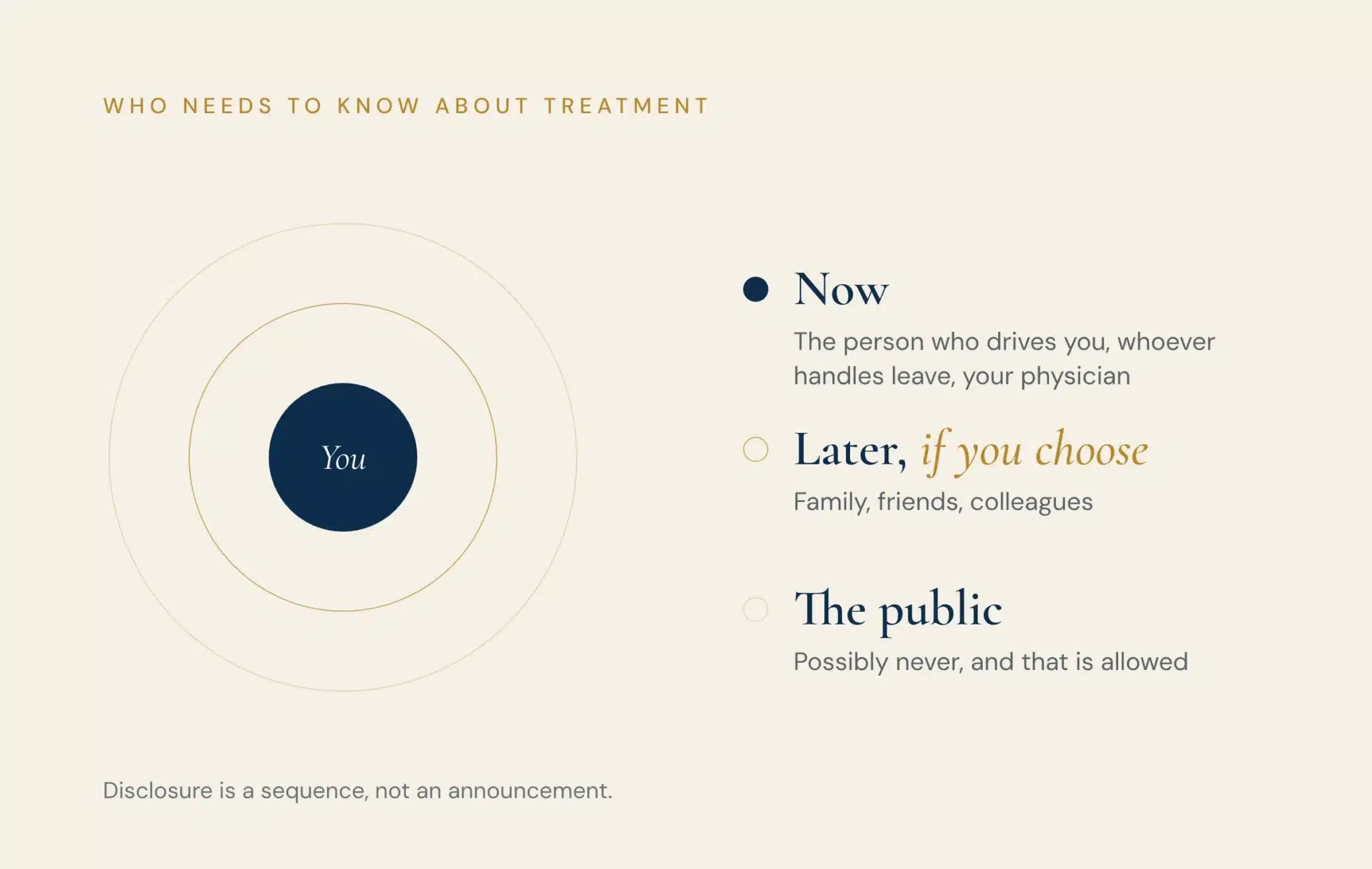
For most adults, the honest answer before admission is a short list.
- 1Now: the person who will drive you or sit with you on admission day, usually a partner, parent or close friend.
- 2Now, with limits: whoever handles leave at work. They need a medical reason and dates, not a diagnosis. Our guide on whether an employer can find out walks through it, and what to tell your team covers the colleagues who will notice you are gone.
- 3Now, for safety: your physician or psychiatrist, especially if you take medications that interact with withdrawal.
- 4Later, if you choose: extended family, friends and colleagues. This group can wait until you are steady enough to choose the words.
- 5Possibly never: the public. Some people decide to speak openly, as the Anaheim mayor did. Many never do. Neither choice says anything about the quality of a person’s recovery.
Notice what is missing from the first three lines: the explanation. Early in treatment you owe nobody a narrative. “I am taking medical leave for a health condition, and I will be back on the twelfth” is a complete sentence.
“The people who call us from Orange County are rarely asking whether treatment works. They are asking who will see them. We answer that first, plainly, because a person who feels exposed will not stay long enough for the treatment to matter.”
Garrett Braukman, Executive Director, SoCal West Region, Emend Healthcare
Why distance helps when you are recognizable
Leaving the county for treatment is a common choice for people with public roles, and it is the logic behind our alcohol rehab for Orange County professionals at a six-bed residence in Encino, about an hour north of most of the county. Distance does two things for someone who is known. It takes the fact of treatment out of the local ecosystem while you are least able to manage it, and it removes the calendar alcohol organized: the client dinners, the fundraisers, the Saturday at the harbor.
Alcohol in particular needs medical care at the start. Withdrawal after heavy daily drinking can bring seizures, which is why medically supervised detox comes first, in the same house and with the same team. A residential program of thirty to ninety days follows, with groups that never exceed six. For families comparing options, our Orange County hub lays out the drive city by city and explains which levels of care travel well.
Relapse, in public or in private
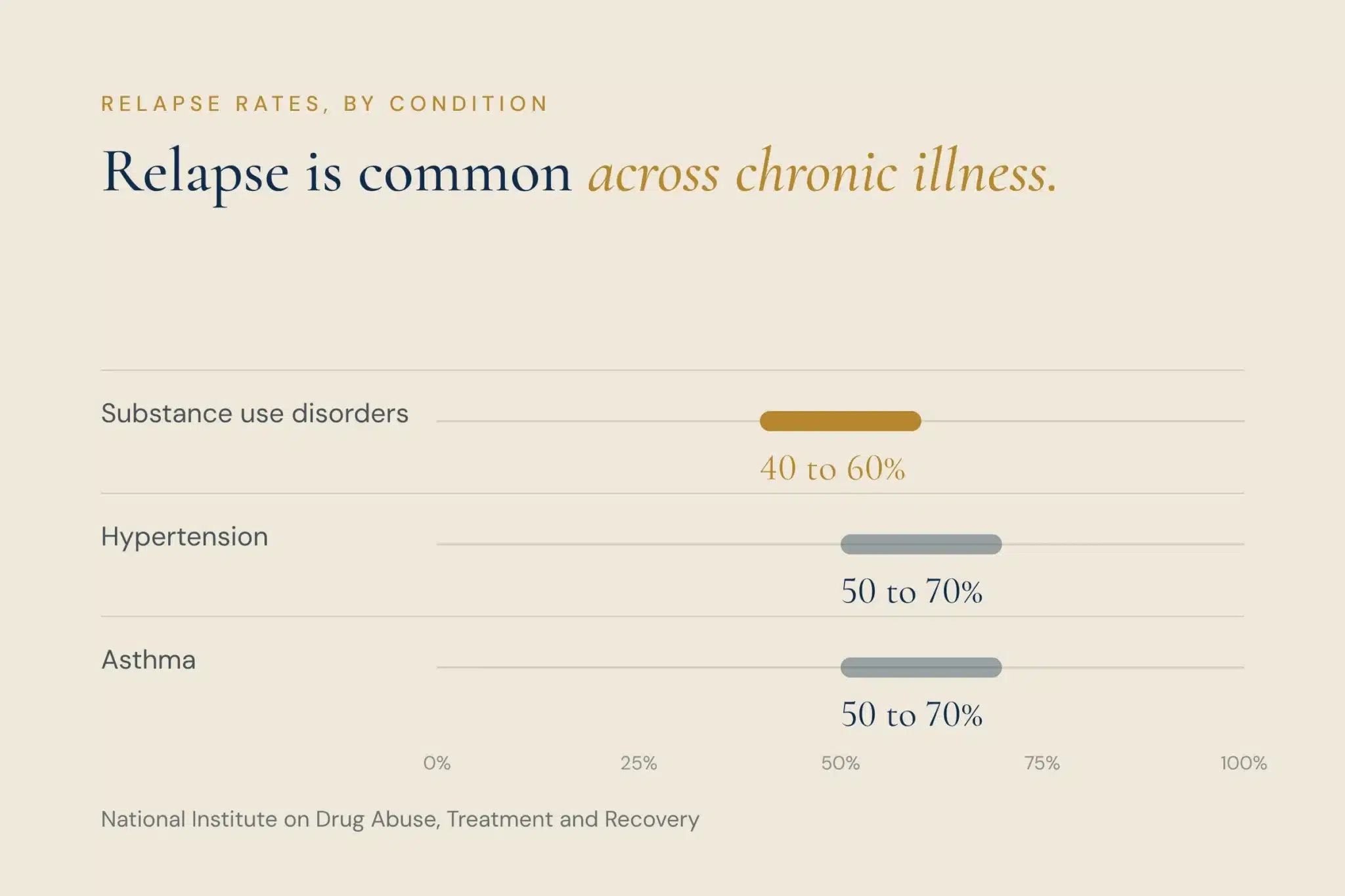
The part of that disclosure that may matter most to other families was the plainest: a return to drinking after treatment, named honestly, and a decision to start again. That pattern is common. NIDA’s overview of treatment and recovery puts relapse rates for substance use disorders at 40 to 60 percent, in the same range as hypertension and asthma at 50 to 70 percent, and answers its own question directly: relapse “doesn’t mean treatment has failed.” It means the plan needs to be resumed, adjusted or changed.
NIAAA’s guide to alcohol treatment says the same thing in fewer words: “Setbacks are common among people who overcome alcohol problems.” It also notes that three medications are approved for alcohol use disorder in the United States, naltrexone, acamprosate and disulfiram, and that all of them are nonaddictive. For someone whose drinking happens at events they cannot easily skip, a medication conversation with a psychiatrist belongs in a serious plan.
What changes for a person in the public eye is not the relapse. It is the audience. The work, then, is to build the plan for a setback before it happens: who you call within the first day, which events you skip for a season, and who speaks for you if anyone asks. Our guide to the first 24 hours after a relapse is written for that day, and it is one reason our alcohol rehab for Orange County families treats the return home as part of treatment from the first week.
“Families carry the secret too. Part of our work with a spouse or parent is deciding together what they will say at the school pickup or the office, so nobody is improvising under pressure and nobody is asked to lie.”
Karen Lakritz, AMFT, Associate Marriage and Family Therapist, My Limitless Journeys
If you decide to tell the story yourself
Some people find that speaking openly takes the power out of the secret. If that is where you land, a few principles help.
- 1Wait until you are steady. Early recovery is a poor time to manage a public reaction, and many people choose a date months after discharge.
- 2Tell the people closest to you first, in person, before anything is posted.
- 3Decide in advance what you will not discuss: the details of treatment, other people’s roles, medications.
- 4Say it in your own words and in one place. A single statement is easier to stand behind than a series of interviews.
- 5Line up support for the week after, when the reaction arrives.
None of this is required. Privacy is a legitimate choice, and so is candor. What matters is that the choice stays with you, and good treatment protects your ability to make it later. If you are not ready to call a program, SAMHSA’s free, confidential National Helpline, 1-800-662-4357, offers treatment referrals around the clock.
Frequently asked questions
Will anyone find out if I go to rehab?
Not from the program, as a rule. Federal confidentiality rules for addiction treatment records generally require your written consent before a covered program discloses that you are a patient. The larger risk is being recognized in person, which is why a small program outside your county can matter for people who are known locally.
Do I have to tell my employer why I am taking leave?
Usually not the diagnosis. Leave processes generally need a provider’s certification of a health condition and your dates, not the details. Ask HR or your benefits administrator about the specific policy, and keep the explanation to colleagues short.
Should I talk publicly about my recovery?
Only if and when you want to. Some people find openness helpful; many keep treatment private for good. If you do speak, wait until you are stable, tell the people closest to you first, and decide in advance what stays private.
Does a relapse mean rehab did not work?
No. NIDA reports relapse rates of 40 to 60 percent for substance use disorders, similar to other chronic illnesses, and says a return to use means treatment should be resumed or adjusted, not that it failed. A plan for the first day after a setback is part of good care.
Questions about privacy deserve straight answers before anything else. Who will know, where you would stay and what it costs, answered plainly and in confidence, during business hours.
This article is general information, not a diagnosis or a substitute for an assessment by a clinician. If someone is in immediate danger, call 911. In a mental health or substance use crisis, call or text 988.
Sources
- Elattar, H. “Anaheim Mayor Admits Drinking Problem & Going to Rehab.” Voice of OC, October 2, 2026. voiceofoc.org
- 42 CFR Part 2, Confidentiality of Substance Use Disorder Patient Records. Electronic Code of Federal Regulations, current as of October 22, 2026. ecfr.gov
- National Institute on Drug Abuse, “Treatment and Recovery,” Drugs, Brains, and Behavior: The Science of Addiction. nida.nih.gov
- National Institute on Alcohol Abuse and Alcoholism, “Treatment for Alcohol Problems: Finding and Getting Help,” updated February 2025. niaaa.nih.gov
- SAMHSA National Helpline. samhsa.gov
Every article on this site is written by our editorial team and reviewed by a licensed clinician. Read how we write and review content.
Keep reading: Alcohol rehab for Orange County professionals · How six beds changes anonymity · What to tell your team before treatment · Residential treatment for Orange County adults · Treatment for physicians and attorneys