
Treatment that fits an Irvine calendar.
Our residence is in Encino, about sixty miles north of Irvine on the 405. This page is written for the person who is not asking whether they need help; they are asking what it does to the job. Benefits, leave, coverage, timing, and the return to work, answered before you commit to anything.
Authored by the MLJ Clinical Team. Reviewed under board-certified psychiatric oversight. Last updated September 2026.
Key Takeaways- My Limitless Journeys has no Irvine location; every level of care runs from a six-bed residence in Encino, roughly an hour north on the 405 outside of rush hour.
- Your behavioral-health benefit does not stop at the county line. We work with Aetna, Anthem, Cigna, Kaiser Southern California, and UnitedHealthcare, and we verify your specific plan before you travel.
- Under federal law your employer's leave administrator receives certification of a serious health condition, not a diagnosis, and health plans do not report individual claims to employers.
- An employee assistance program is a real resource and also an employer-sponsored one; know what it shares before you use it as your front door.
- Return-to-work planning is a clinical task that starts at intake, not a conversation you have on your last morning.
The Irvine pattern: performance, then maintenance.
Irvine is built out of employers: the office parks off Jamboree and Von Karman, the medical and biotech campuses near the university, the software and device companies clustered around the Spectrum. The people who call us from those addresses tend to share a profile. High conscientiousness. A long history of being the reliable one. A performance culture where nobody asks how you are sleeping as long as the work ships.
That profile produces a specific kind of substance use. It rarely begins as escape. It begins as management: something to end the day at nine when the day started at six, something to sleep before a Monday, something to take the edge off a quarter that will not close. Tolerance is quiet and gradual. The performance stays intact long past the point where the biology has changed, which is precisely what makes it hard to see and easy to defend. Our guide to the signs of high-functioning alcoholism describes the shape of it, and the post on high-functioning anxiety covers what usually sits underneath.
Two things follow clinically. First, the underlying condition matters more than the substance: anxiety, insomnia, attention problems, depression, or unprocessed trauma are usually the engine, and treating only the drink or the pill leaves the engine running. Dual-diagnosis care is the default here rather than an add-on, which is what co-occurring treatment means in practice. Second, the thing you are most afraid of losing, the job, is a clinical variable, not a distraction from treatment.
Benefits first: what your plan actually covers.
Most Irvine clients are covered through an employer group plan, and most of those plans cover residential and outpatient treatment for substance use disorders. Federal parity law requires that behavioral-health benefits not be applied more restrictively than medical and surgical benefits on the same plan. That does not mean everything is covered automatically; it means the rules cannot be quietly worse.
The practical questions are narrower than people expect. Is the residence in network or out of network on your specific plan. What is left on your deductible and your out-of-pocket maximum this year. Does the plan require prior authorization, and at what level of care. Whether a single-case agreement is possible if we are out of network. We answer all four before you commit, using either the insurance verification form or a phone call that takes about fifteen minutes; what happens after you submit verification explains the sequence.
Two timing details save real money. If you have already met a deductible this year, starting before January 1 is usually cheaper than waiting; if you have not, and the clinical situation is stable enough to wait a few weeks, the reverse can be true. And crossing from Orange County to Los Angeles County changes nothing about a benefit. The Paying for Treatment hub covers both, and single-case agreements covers the out-of-network path. Private pay is accepted, and some Irvine clients choose it for reasons we set out plainly on the Newport Beach page.
Leave, the ADA, and who learns what.
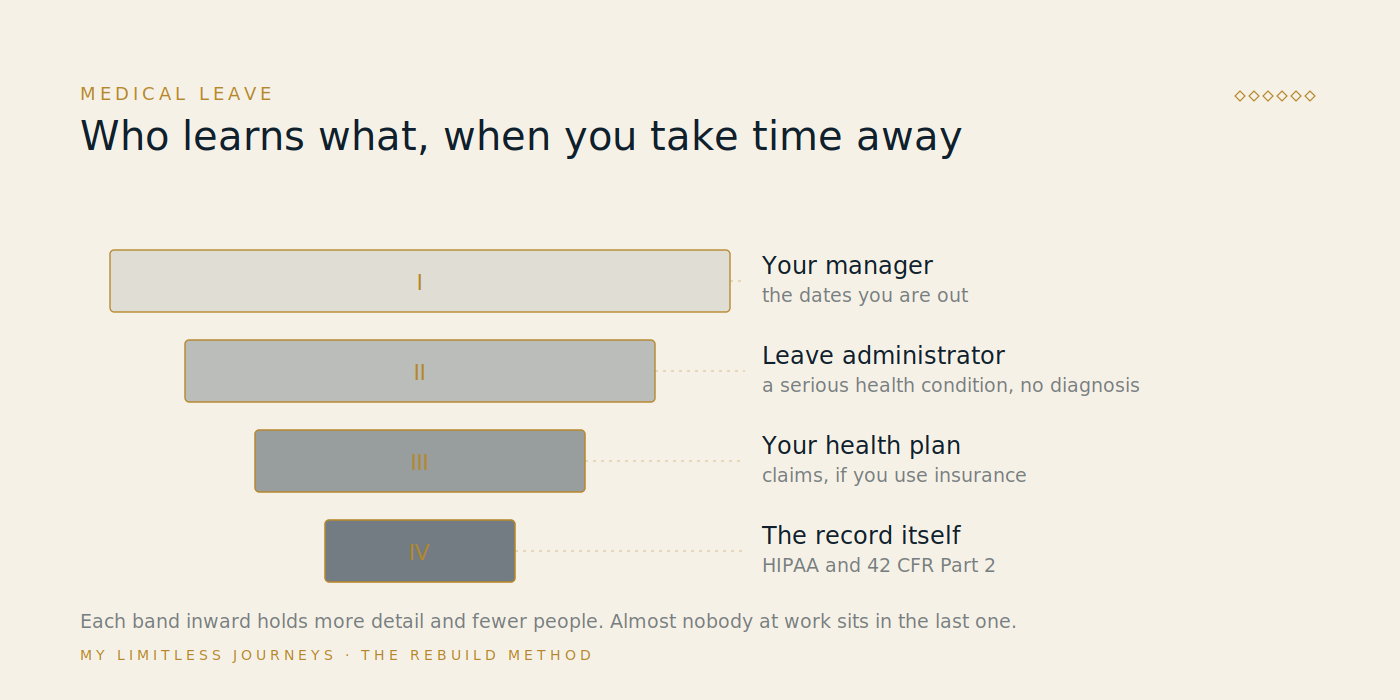
The fear behind most delayed admissions in Irvine is not the treatment. It is the org chart. So here is the structure, plainly. If you work for an employer covered by the federal Family and Medical Leave Act and you meet the eligibility tests, you may take job-protected unpaid leave for a serious health condition. The certification your employer receives states that a serious health condition exists and gives dates; it does not have to name a diagnosis or a facility. The Department of Labor is the primary source, and California's own family and medical leave protections run alongside it.
Separately, the Americans with Disabilities Act protects employees with substance use disorders who are not currently using illegal drugs, and it protects people who are in or have completed treatment; the EEOC is the source for how that works. Your health plan holds claims data, and your employer as an employer does not receive individual claims; where an employer sponsors a self-funded plan, HIPAA still walls plan information off from employment decisions. The treatment record itself carries an additional layer of protection under 42 CFR Part 2. Our page on whether your employer can find out takes this apart claim by claim.
What remains is a communication decision rather than a legal one: what you say, to whom, and when. Most people need one sentence for a manager, a different sentence for a team, and nothing at all for a client. What to tell your team gives you the actual wording. If you hold a professional license, a clinical credential, or a security-sensitive role, the calculus changes and is covered under licensed professionals.
A word about your EAP.
Large Irvine employers usually offer an employee assistance program, and it can be a genuinely useful front door: assessments, short-term counseling, sometimes help coordinating leave. Use it if it fits. Just know two things first. An EAP is purchased and administered on behalf of your employer, and while individual clinical detail is confidential, aggregate utilization reporting flows back to the company. And EAP referral lists are networks, which means the recommendation you receive reflects contracted relationships as well as clinical fit.
You are allowed to call a treatment program directly, without going through anyone at work, and to have your benefits verified without your employer being contacted. Nothing about that is evasive; it is how the system is designed to work. If you want a neutral read on how to compare programs before you call anyone, how to choose a rehab is written for exactly that.
The 405, and why we do not want you commuting.
From most Irvine addresses the route is the 405 north the entire way, over the Sepulveda Pass, then a short run west on the 101. About sixty miles, sixty-five to eighty minutes on a Saturday morning or late evening, and considerably worse on a weekday afternoon. You make that drive twice: once in, once out.
That is a feature at the residential level and a problem at the day-program level, and we would rather say so than sell you something that will not hold. Partial hospitalization runs most of a day, most days of the week. Intensive outpatient runs about three hours a day, several days a week. Nobody should be driving the 405 for three hours of clinical work and then driving it home in the dark. Orange County clients who step down through our PHP or IOP do it while living in transitional housing in the Valley. When that does not fit your life, a day program near Irvine is the correct answer and we will help you find one.
If you are not sure which level you need at all, do not guess. How the right level of care is determined explains the assessment, and the ASAM criteria explains the framework clinicians actually use to make the call.
Thirty, sixty, ninety days against a work year.
People arrive having already decided how long they can be gone, usually based on a product cycle or a fiscal quarter. That number is worth stating out loud on the admissions call, because it is a real constraint and because it is often wrong in both directions. Some people need less time away than they feared. Some are negotiating with a disease using a calendar, which does not work.
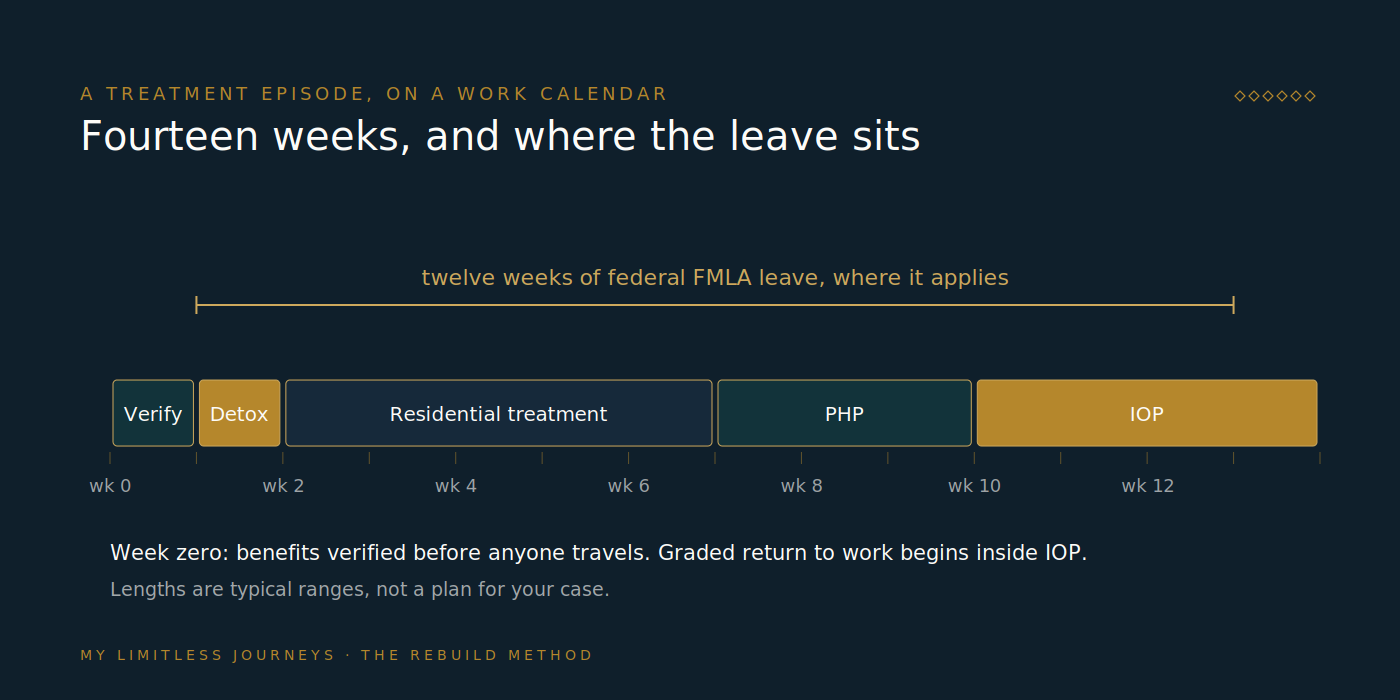
| Stage | Typical length | Where you are | Work contact |
|---|---|---|---|
| Detox | Several days to two weeks | The residence | None |
| Residential | 30 to 90 days | The residence | Limited, by clinical agreement |
| PHP | 2 to 4 weeks | Transitional living | Planning begins |
| IOP | 6 to 12 weeks | Transitional living or home | Graded return |
Those are typical ranges, not a promise about your case. Thirty, sixty, and ninety-day programs explains what actually changes with length, and working during treatment covers what limited contact does and does not include.
The first ninety days back.
Returning to an Irvine job is its own clinical phase, and it is the one people under-plan. The old cues are all still there: the same commute, the same 4 p.m. slump, the same standing dinner with the same accounts. The first week back tends to go well on adrenaline. Weeks three through eight are where the risk lives, once the novelty is gone and the workload is fully restored.
So the plan is written before you leave: which meetings you keep, who your therapist is near home, how sleep is protected when a deadline moves, what the first sign of drift looks like and who you have agreed to tell. The first ninety days back at work is the detailed version, and the alumni program is what keeps the plan attached to a person rather than a document.
- Orange County hub. The whole picture, including which levels of care travel well.
- Newport Beach. The same drive, framed around discretion and private pay.
- Orange County residential treatment. The level where the distance works for you.
- For professionals. Treatment designed around work, reputation, and licensure.
- Intensive outpatient program. What step-down actually contains.
- Does insurance cover addiction treatment?. The plain-language version.
This guide is educational and is not a substitute for medical advice. If someone is in immediate danger, call 911.