
Newport is a small town wearing a large one.
We treat Newport Beach clients at a six-bed residence in Encino, about sixty miles and an hour north. For people whose name, boat slip, firm, or face is known along this stretch of coast, the distance is not a drawback. It is most of the point. This page is the discretion-first, private-pay conversation, written plainly.
Authored by the MLJ Clinical Team. Reviewed under board-certified psychiatric oversight. Last updated September 2026.
Key Takeaways- There is no My Limitless Journeys facility in Newport Beach; treatment happens at a private six-bed home on an Encino hillside, roughly 60 miles north via the 55 and the 405.
- Newport's density of programs and sober-living houses is an asset for people who want a local recovery community and a liability for people whose work depends on not being recognized.
- Six beds is not a luxury detail. It is the variable that decides how many strangers ever learn you were in treatment.
- Private pay is a legitimate option and we accept it, but it does not erase a medical record and it is not the only way to protect confidentiality.
- The harbor, the club, the standing Friday, the wine list at the boat show: those are rehearsed in treatment, not avoided forever.
Why a coastal city behaves like a village.
Newport Beach is not small. It only functions that way. The same few hundred people run the firms, sit on the boards, sponsor the regattas, and eat at the same eight restaurants on the peninsula and in Corona del Mar. Balboa Island is a footbridge wide. Newport Coast is a set of gated loops where neighbors know which cars belong. After a decade here, the number of people between you and any given stranger is one or two, not six.
That density is wonderful for a life and dangerous for a decision. The most common reason Newport clients give for having waited two years is not denial and not money. It is arithmetic: they ran the odds of walking into a local program's morning group and seeing a client, a competitor, a patient, or the parent of a kid on their daughter's team, and the odds were not low enough. So they kept managing it alone. Delay is the cost of a small town, and it gets measured in liver enzymes and in a marriage that quietly stops trying.
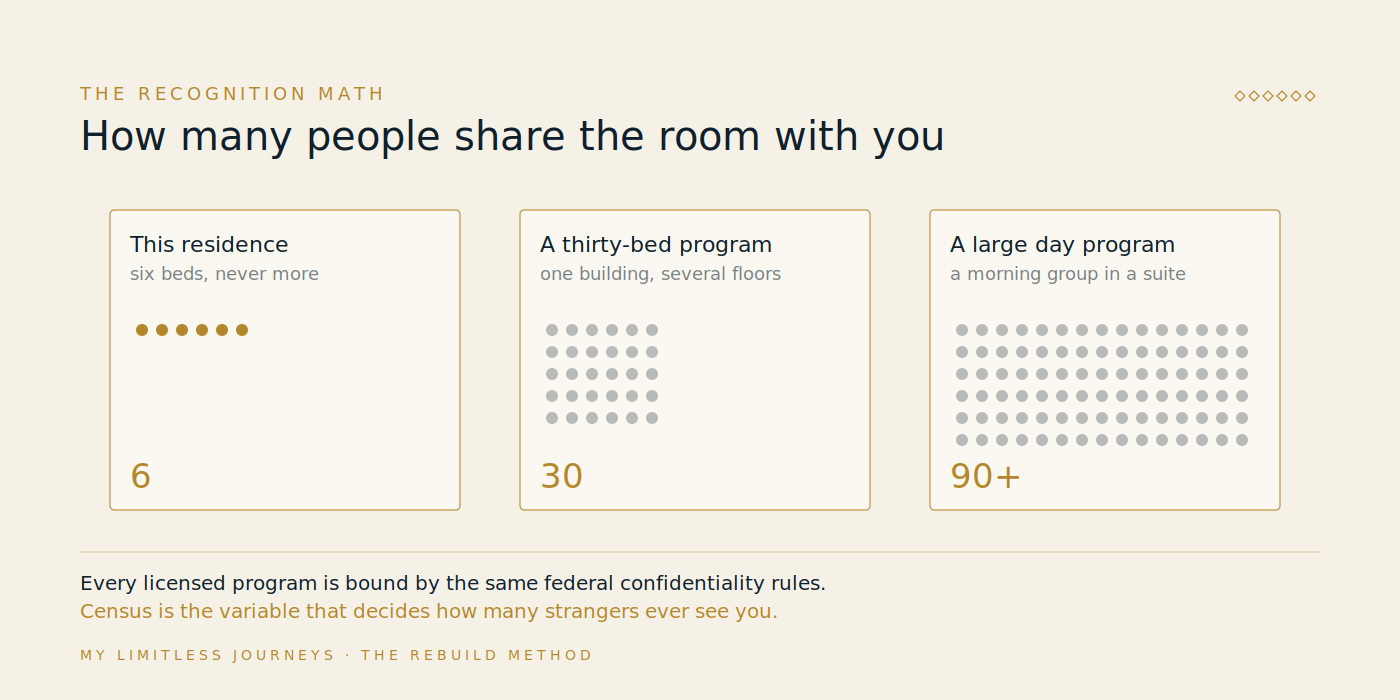
We built around that specific arithmetic. Our residence holds six people. There is no sign, no lobby, no logo on a van, and no parking lot that a neighbor drives past. The address is shared at admissions and not before. Our guide to how six beds changes anonymity walks through why census, not policy, is the number that actually protects you.
The Newport recovery scene, honestly assessed.
Newport Beach and neighboring Costa Mesa sit inside one of the most concentrated treatment corridors in the United States. There are excellent clinicians here. There are meetings every hour of the day, a large and genuinely warm alumni culture, and sober-living houses on ordinary residential streets. For many people that ecosystem is exactly right, and we say so without hedging: if what you need is a strong local recovery community and you have no particular exposure to protect, staying in Orange County is a reasonable and sometimes better choice.
The problem is that a dense scene is also a well-connected one. Alumni networks overlap with business networks, and referral relationships move information around by design. None of that is improper, and all of it is a risk profile if you are the managing partner of a firm on Newport Center Drive, a physician with local privileges, a broker whose listings depend on being the steady one, or a founder about to raise.
There is a second, purely clinical reason to leave. The cues that hold a pattern in place are local: the slip, the club bar at five, the friend who always has more, the drive home along Jamboree that ends the same way. Environmental cues are among the most reliable drivers of relapse, as the National Institute on Drug Abuse describes. Sixty miles does not delete a cue. It puts a freeway between you and it during the weeks when your judgment is least trustworthy.
The recognition math of six beds.
Every program says it protects confidentiality, and most mean it. Federal law is strict here: 42 CFR Part 2 governs substance use disorder records and is tighter than HIPAA alone. But a regulation binds the program. It does not bind the twelve people in the circle with you, the forty in a morning group, or whoever is signing in at reception when you walk out.
Six beds changes the denominator. Over a thirty-day stay you will meet, at most, a small handful of other residents, all of whom are living under the same conditions and the same expectations. There is no waiting room. There is no shift change in a hallway full of people. Staff are trained to treat identity, employer, and reputation as protected by default, which is what the perimeter of Discretion in The Rebuild Method actually means in practice.
The same census does something clinical that is easy to miss. True 1:1 clinical ratios mean the clinician running your trauma work in week three already sat with you at 3 a.m. in week one. Nothing gets retold to a new team, which is the argument of our page on the one-to-one clinical ratio.
beds, never more
signs, lobbies, or logo vans
miles from the harbor
The drive from Newport, Corona del Mar, and Balboa.
From most Newport addresses the route is the 55 north to the 405 north, over the Sepulveda Pass, then a few minutes west on the 101. From Corona del Mar and Newport Coast, many people prefer the 73 north to the 405 to avoid the Costa Mesa surface streets. From Balboa Island and the peninsula, add ten to fifteen minutes just to get off the sand. Call it about sixty miles and sixty-five to eighty minutes on a Saturday morning or after eight at night. Weekday afternoons on the 405 through the Westside can add an hour on their own, so we schedule admissions early or late on purpose.
You should not be the one driving. If you have been drinking heavily or using opioids or benzodiazepines daily, the last dose and the timing of departure are clinical decisions we make with you on the admissions call, not logistics you sort out alone. A nurse is expecting the car when it arrives. The Orange County detox page covers arrival day in detail, and the admissions call guide describes what that first conversation actually asks you.
One practical note: pack for a week, not a day. Most Newport clients arrive for detox and continue straight into residential treatment without going home in between, because going home in between is where admissions quietly fall apart.
Private pay, insurance, and what each one leaves behind.
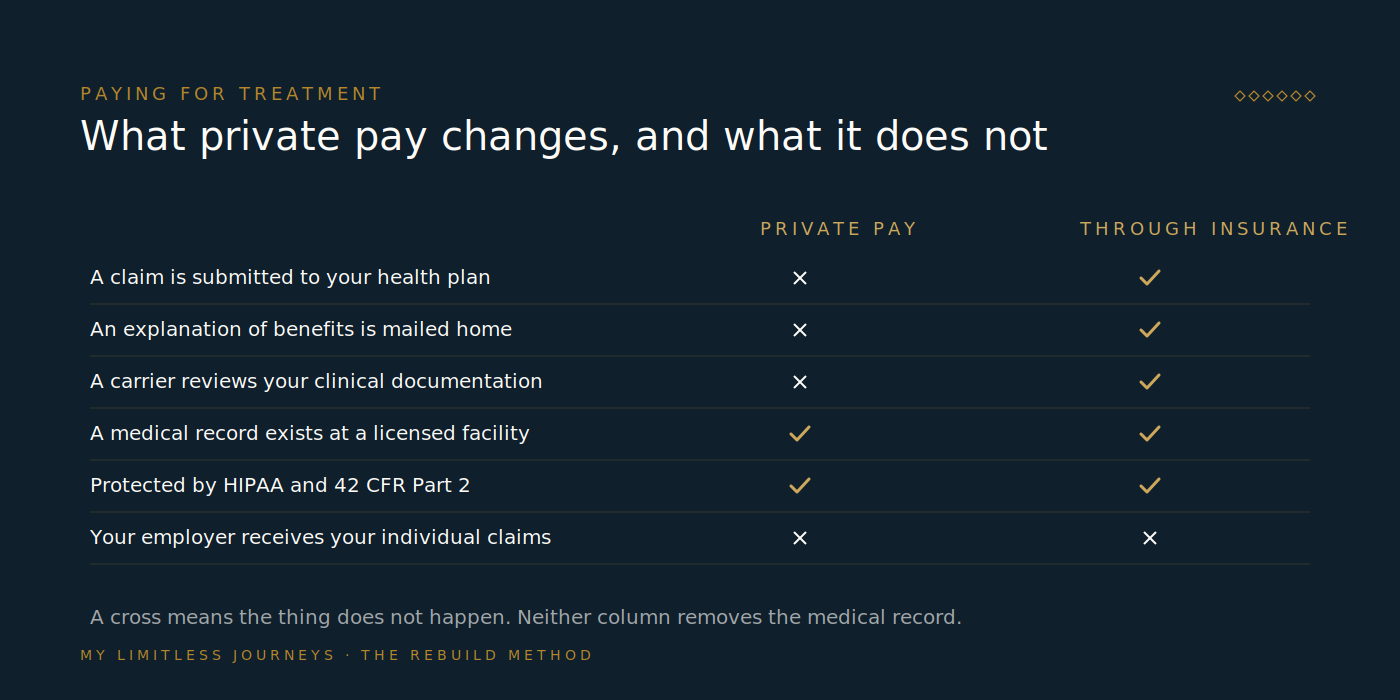
A meaningful share of our Newport admissions are private pay, and the reason is almost never affordability for its own sake. It is the belief that paying directly leaves no trail. That belief is half right, and the half that is wrong causes real disappointment, so here is the honest version.
Paying privately means no claim goes to your health plan, so no explanation of benefits arrives at a house where someone else opens the mail, and no utilization reviewer receives clinical documentation about your stay. That is a real difference, and for some people it is decisive. What it does not do is erase a medical record. Your chart exists at any licensed facility, protected either way by HIPAA and 42 CFR Part 2. Nor does it change what an employer can learn, since employers do not receive individual claims data in the first place. Our page on insurance versus private pay privacy lays out both columns side by side, and private pay covers the mechanics.
Crossing from Orange County into Los Angeles County changes nothing about a behavioral-health benefit, and we work with Aetna, Anthem, Cigna, Kaiser Southern California, and UnitedHealthcare. If your plan is out of network, a single-case agreement is sometimes possible, and we will tell you before you commit rather than after; see in-network, out-of-network, and single-case agreements. Benefits get verified before anyone drives north, through the insurance check or on the phone in about fifteen minutes.
Coming back to the harbor.
Nobody stays in Encino. The point of the sixty miles is to build something that survives the drive home, and Newport is a demanding place to test it: the boat show, the club, the closing dinner, the summer that runs from Memorial Day to October with a drink in every frame. Avoidance is not a plan for a life like that.
So the last third of a stay is rehearsal. Specific rooms, specific people, specific sentences. What you say when a client orders the second bottle. Which invitations you decline for ninety days, and which you keep because declining would raise more questions than attending. That work sits in the Life domain and continues through relapse prevention.
Discharge planning starts in week one and ends with something written: a therapist or psychiatrist near you, a meeting schedule you have actually looked at, a relapse-prevention plan, an alumni contact. Newport's density becomes an asset here, and the Orange County support-group guide is where to start mapping it. For some clients the step home runs through transitional living first.
Family, across an hour of freeway.
The first question a Newport spouse asks is how often they can come. In the detox window the answer is rarely, and the reason is clinical rather than logistical. After that, family sessions are clustered so a Saturday trip north holds a clinical session, a meal at the table, and unstructured time in one visit, instead of asking someone to make a round trip on the 405 for fifty minutes on a Tuesday. Secure video fills the gaps.
Distance also does something for the household that proximity cannot. A partner who has spent two years listening for the garage door at midnight gets to sleep. Parents stop being the surveillance system. That is not abandonment; it is the beginning of the family's own recovery, and it is why family work starts in the first week rather than at discharge. If your person has not agreed to any of this yet, start with when they refuse treatment.
- Orange County hub. The full picture of what leaving the county buys and costs.
- Irvine. The same drive, framed around employer plans and return-to-work.
- South Orange County. Laguna, Dana Point, San Clemente, and small-town visibility.
- The Encino residence. The hillside, the boulevard, and the house itself.
- Residential treatment. The level of care the drive is built for.
- Signs of a high-functioning alcoholic. If you are still deciding whether this is you.
This guide is educational and is not a substitute for medical advice. If someone is in immediate danger, call 911.