
In a town this size, leaving is the privacy.
Laguna Beach, Dana Point, San Clemente, San Juan Capistrano, Mission Viejo. Places where the pharmacist knows your name and the same forty people are at every school event. Our residence is in Encino, up the 5 and over the hill, and this page is about what that distance is actually for.
Authored by the MLJ Clinical Team. Reviewed under board-certified psychiatric oversight. Last updated September 2026.
Key Takeaways- We have no south county facility. Treatment happens at a six-bed private residence in Encino, roughly 70 to 90 miles north depending on whether you start in Mission Viejo or San Clemente.
- "Everyone will know" is not paranoia in a beach town of a few tens of thousands of people. It is a fair reading of how visibility works, and it is a solvable problem.
- What actually leaks is rarely a records breach. It is a car in a parking lot, a shared pharmacy, a group of thirty, and a neighbor who works at the clinic.
- You do not owe anyone a diagnosis. Most people need one sentence for work, a different one for extended family, and nothing for the neighborhood.
- Family weekends are planned around the drive: one Saturday trip holds a clinical session, a meal, and unstructured time, rather than a round trip for fifty minutes.
What "small town" means here.
South Orange County is a string of towns that behave like towns. Laguna has one canyon road in and a downtown you can walk in ten minutes. San Clemente has a pier, a main street, and a set of neighborhoods where the same families have been for thirty years. Dana Point is a harbor with a village around it. San Juan Capistrano still runs on the depot, the mission, and a handful of restaurants. Mission Viejo is larger and more suburban but organized around the same institutions: the lake, the club, the schools, the parishes.
That means the surveillance is not institutional. It is ambient and affectionate. Someone notices your car at the urgent care. Someone's sister works the front desk at the medical group. The parents on the sideline talk. Nobody is being malicious, and the effect on a person trying to get help is the same as if they were: you calculate the cost of being seen, and you decide to handle it yourself for another quarter.
We are not going to tell you the fear is irrational. We are going to tell you it has a shape, that the shape can be measured, and that a six-bed house sixty-something miles away with no sign on it is a straightforward answer to most of it. The bigger question, which we take seriously, is whether leaving is avoidance. It is not, when the leaving is finite and the plan includes coming back. Our page on how six beds changes anonymity explains the mechanics.
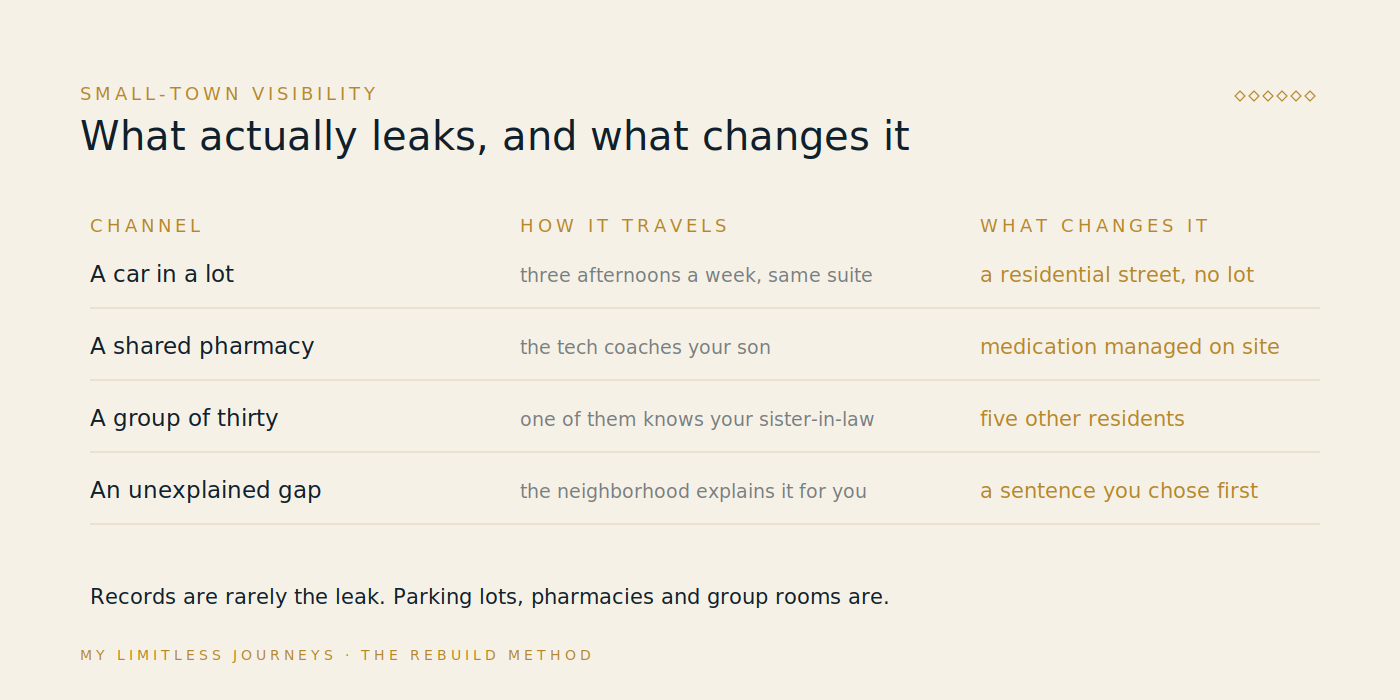
What actually leaks, and how.
People imagine the risk as a records breach. That is almost never what happens. Treatment records are protected by HIPAA and, for substance use disorder records specifically, by the tighter federal rule at 42 CFR Part 2, which restricts disclosure even to law enforcement without a court order in most circumstances.
What leaks is physical and social. A car parked three afternoons a week outside a suite in a familiar business park. A prescription filled at the pharmacy where the tech coaches your son. A group room with thirty people in it, one of whom knows your sister-in-law. An absence that nobody explained, which the neighborhood then explains for you, usually less kindly than the truth. Each of those has a different remedy, and only one of them is about paperwork.
Our answers are unglamorous. Six residents, so there is no group large enough to contain your social circle. No signage, no lobby, no marked vehicle. A hillside street in Encino where an unfamiliar car means nothing to anyone. Staff trained to treat identity, employer, and family name as protected by default. The address released at admissions and not before. That is the whole trick; there is no clever policy that substitutes for it.
The I-5 drive, town by town.
From south county the trip is longer than the rest of Orange County's and worth planning honestly. The usual route is the 5 north to the 405 north, over the Sepulveda Pass, then west a few minutes on the 101. From Laguna Beach many families take Laguna Canyon Road to the 405 directly and skip the 5 entirely. The 73 toll road is a reasonable alternative from Dana Point and San Juan Capistrano when the 5 through Irvine is stacked.
| From | Usual route | Distance | Off-peak |
|---|---|---|---|
| Laguna Beach | Canyon Rd, 405 north, 101 north | About 70 miles | 75–90 minutes |
| Mission Viejo | 5 north, 405 north, 101 north | About 75 miles | 80–100 minutes |
| Dana Point | 5 or 73 north, 405 north, 101 north | About 80 miles | 85–105 minutes |
| San Juan Capistrano | 5 north, 405 north, 101 north | About 80 miles | 85–105 minutes |
| San Clemente | 5 north, 405 north, 101 north | About 90 miles | 95–115 minutes |
Nobody in withdrawal drives themselves. On the admissions call we set the timing of the last drink or dose against the length of that drive, which is a clinical decision and not a scheduling one; the Orange County detox page covers arrival in detail. It is also why we discourage south county residents from commuting to a day program in Encino. Distance is an asset when you live at the residence and a liability when you are driving the 5 twice a day, which is why the IOP page tells most of you to use a local program.
What you tell people.
This is the question that keeps people up, so let us be concrete. You are not obligated to disclose a diagnosis to an employer, a neighbor, a coach, a parish, or an in-law. A medical leave is a medical leave. Most adults need three sentences total: one for a manager, one for close family, and one that covers the school and the neighborhood without inviting follow-up. "I'm dealing with a health issue and I'll be offline for a few weeks" is complete, true, and does not require a sequel.
Where it gets harder is with the people who will notice the absence at close range: a business partner, a co-parent, a board you sit on. Those conversations are worth rehearsing in session rather than improvising in a parking lot, and we do rehearse them. Treatment without telling anyone covers what is actually possible, and what to tell your team gives you wording. If it is your spouse doing the telling while you are away, family confidentiality explains what they can and cannot be told about your care.
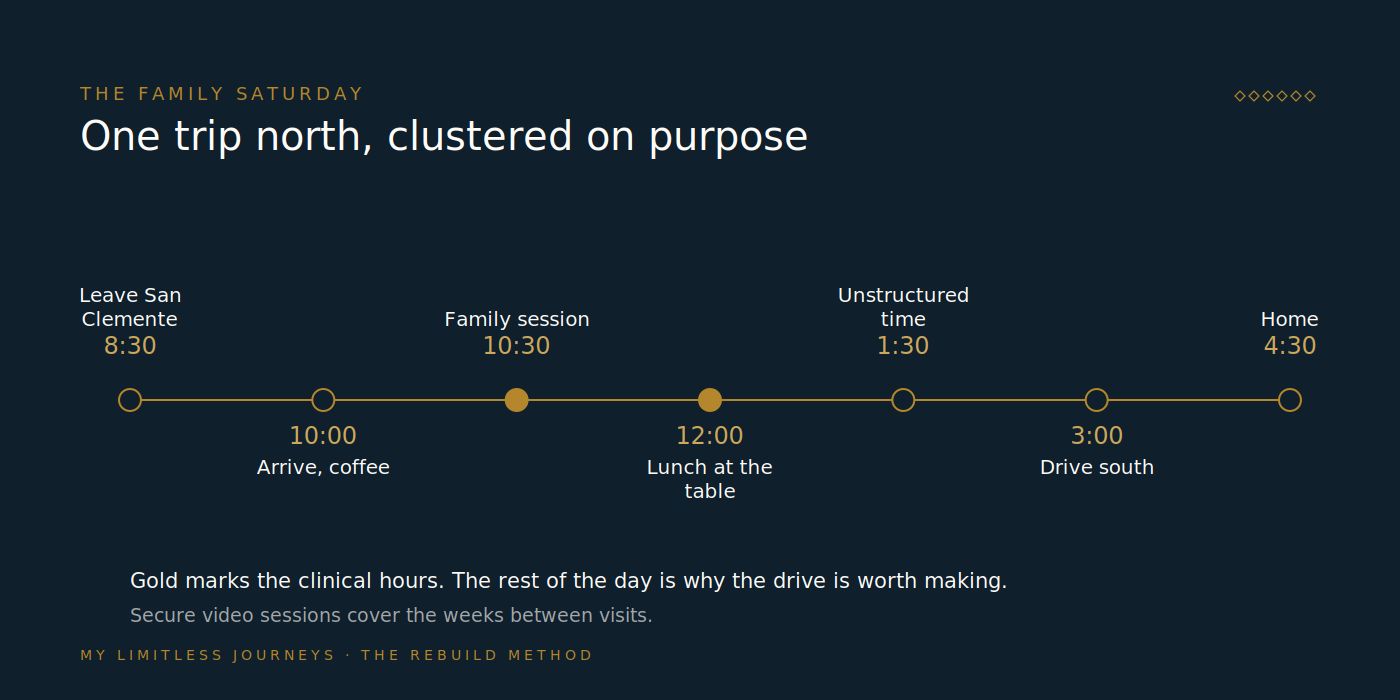
The family Saturday.
An eighty-mile drive changes how family work has to be scheduled, so we schedule it differently. During the detox window, contact is limited for clinical reasons and we explain that to families in advance rather than at the gate. After that, visits are clustered: a family therapy session, a meal at the table with the household, and unstructured time, in one trip, rather than a ninety-minute drive each way for a fifty-minute appointment.
Between visits, family work continues by secure video, and it starts earlier than most people expect. Spouses and parents usually need their own preparation before the first joint session, because the conversations that need to happen are not the ones the household has been having. Family support describes the format and family therapy at MLJ describes the arc.
There is a quieter benefit to the distance that families rarely anticipate. For the first time in a long while, nobody at home is listening for a car in the driveway at two in the morning. That sleep is not a luxury; it is the beginning of the family's own recovery, and it is much harder to get when the person is twelve minutes away.
Young adults and the house you go back to.
A meaningful share of south county calls come from parents of adults in their twenties who are still living at home. The pattern is recognizable: college did not finish or did not stick, the job is intermittent, the sleep schedule inverted, and the family has organized itself around managing the person. Distance matters differently in that case. Treatment sixty miles away interrupts the daily supply of rescue that keeps the arrangement stable.
It also raises the question of what home looks like afterward, which is why transitional living in the Valley is often the honest next step rather than a bedroom in the same hallway. Failure to launch covers the clinical version of this, and when they refuse treatment is for the stage before anyone has agreed to anything.
Coming home to a town that noticed.
You will come back. The point of the drive north was never permanent relocation, and a plan that only works in Encino is not a plan. So the last stretch of a stay is spent rehearsing the specific rooms you are returning to: the harbor bar at sunset, the block party, the beers after the paddle-out, the in-law who pours before asking. Concrete situations, concrete sentences, practiced out loud.
Discharge planning starts in week one and ends with something written: a therapist near you, meetings you have actually looked at, a relapse-prevention plan, and an alumni contact who answers. South county has more recovery infrastructure than most people notice until they need it; the Orange County support-group guide is a place to start. And if the first months back are shaky, that is information, not failure; the first twenty-four hours after a relapse exists for exactly that call.
- Orange County hub. The whole picture, and which levels of care travel well.
- Newport Beach. The discretion and private-pay version of this conversation.
- Irvine. The same drive, framed around benefits and return-to-work.
- The Encino residence. Where you would actually be living.
- For families. The hub for the people making this call on someone else's behalf.
- How to talk to a loved one about getting help. Before the first argument.
This guide is educational and is not a substitute for medical advice. If someone is in immediate danger, call 911.