
Stalled at the threshold is not stuck forever.
A capable young adult who cannot start school, hold a job or leave the house is not lazy. Underneath the pattern there is almost always something treatable, and often something being used to make the days pass. This page is about what that something usually turns out to be.
Authored by the MLJ Clinical Team. Reviewed under board-certified psychiatric oversight. Last updated September 2026.
Key Takeaways- Failure to launch is a description, not a diagnosis. It names a pattern and says nothing about the cause, which is what treatment has to find.
- Underneath it we usually find social anxiety, depression, ADHD, autism, a learning difference, trauma, or a cannabis or alcohol problem, often in combination.
- Young adults have the highest rates of both mental illness and substance use disorder of any adult age group, and among the lowest rates of sustained treatment.
- An inverted sleep schedule is the single highest-yield thing to fix first. Almost nothing else in the plan works until the days and nights are the right way round.
- We treat adults. An adult cannot be admitted against their will, and family work is often where the process genuinely begins.
A description, not a diagnosis.
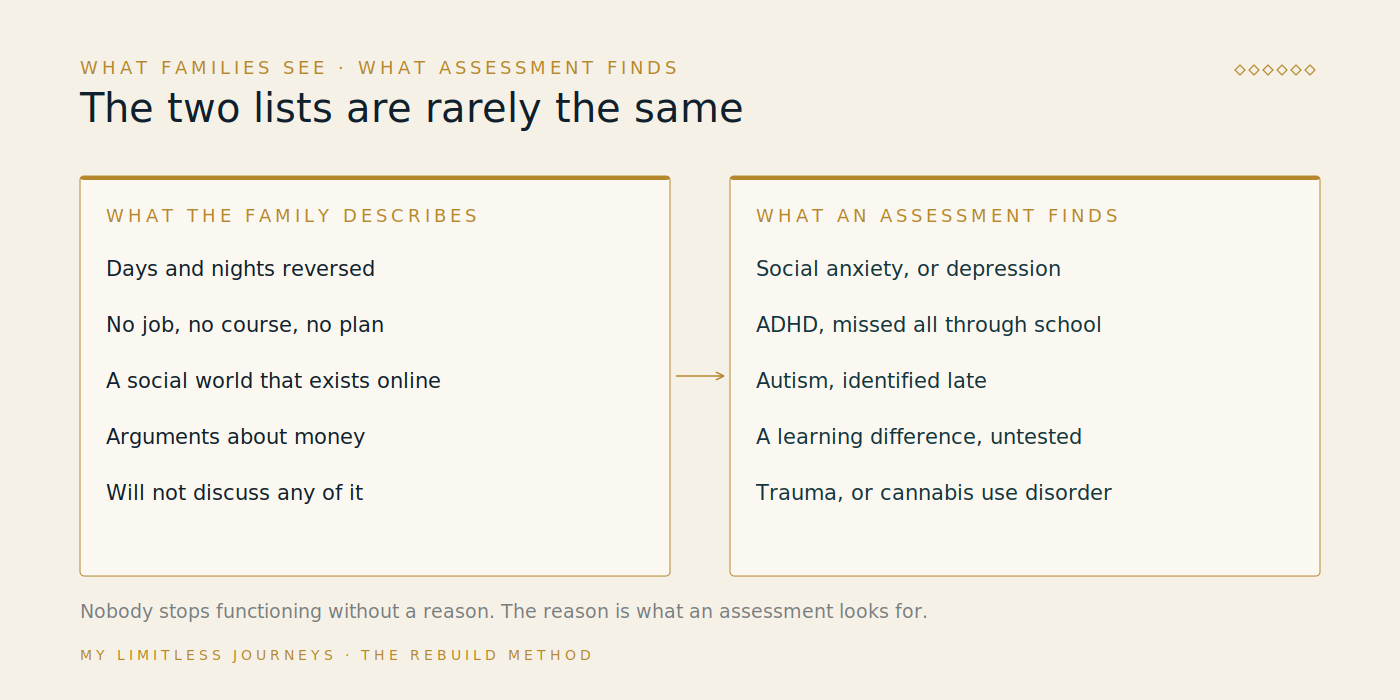
Failure to launch appears in no diagnostic manual. It is a phrase families use to describe a young adult who has not moved into independent life: not studying, not working, days inverted, friendships conducted through a headset, and a growing refusal to discuss any of it. It is a useful shorthand and a dangerous label, because it describes a behaviour and implies a character.
The transition into adult life has become longer and less scripted than it was a generation ago, and some slowness is ordinary rather than clinical. What is not ordinary is the shape we see in the people who reach us: a young adult who was doing fine, then stopped, and whose world has been contracting steadily since. That contraction is the signal. It usually began with something specific, a failed semester, a breakup, a humiliation, an assault, a diagnosis nobody chased down, and then avoidance did the rest, because avoidance is enormously effective in the short term and quietly ruinous over a year.
By the time a parent calls us, the gap between what is expected and what feels possible has grown so wide that not starting is the only move that feels survivable. Nobody in that position is choosing comfort. They are usually deeply ashamed and have no idea how to say so.
What is usually underneath.
In practice the list is short and repeats. Social anxiety, which makes every application and every interview an ordeal and every day of postponement a relief. Depression, which removes the energy required to begin. ADHD, undiagnosed through a school career that was carried by intelligence until the structure disappeared. Autism, often identified late in verbal young adults, where the barrier is not motivation but the unwritten social rules of employment. A learning difference nobody tested for. Trauma. And, very often, cannabis, alcohol or stimulants doing the work of making an empty day tolerable.
The epidemiology backs up what the phone calls suggest. SAMHSA's national survey found that adults aged eighteen to twenty-five have the highest rates of any adult age group for both mental illness, at about a third of that population, and substance use disorder, at more than a quarter, while their engagement with sustained treatment remains among the lowest. This is a group that is unwell more often and treated less often than any other.
Two or three of these conditions usually travel together, and that combination is exactly why single-issue treatment tends not to hold. Our page on co-occurring disorders explains why they are treated in one plan.
Cannabis, screens and motivation.
Cannabis deserves its own paragraph because it is the substance most often present and the one families most often dismiss. It is legal in California, it is not the drug most parents fear, and it has become far more potent than the version they may have encountered. The National Institute on Drug Abuse is clear that regular use can lead to a substance use disorder and that heavy use is associated with poorer educational and occupational outcomes.
We try to be careful about causation. Whether cannabis produces apathy, or whether apathetic and anxious young people use more cannabis, is genuinely debated, and both are probably true. What is not debated is that daily use disrupts sleep architecture, blunts anxiety in a way that removes any pressure to face the thing being avoided, and makes early morning function harder. That combination is exactly what a stalled life runs on. Gaming works similarly, offering structure, status and social contact in a form that asks nothing of the outside world.
None of this is a moral argument. It is an observation that the day has been arranged so that nothing has to be attempted, and that the arrangement has to change before anything else can. Our page on cannabis use disorder covers the treatment side.
What withdrawal looks like here.
Most young adults in this position are not physically dependent in the way an older client with a long alcohol history is, and detox is correspondingly shorter. Cannabis withdrawal is nonetheless real and recognized: irritability, anxiety, poor sleep, vivid dreams, appetite changes and low mood, typically hardest in the first week and settling over two to three. It is not medically dangerous, but it is the reason most attempts to stop at home fail on night four.
Where alcohol, benzodiazepines or opioids are involved the medical protocol takes over, and our medically supervised detox handles that in the same house. What matters clinically in this group is that the first two weeks are flat, unrewarding and easy to misread as evidence that nothing will change. We tell families this in advance, because the temptation to intervene during that fortnight is enormous and usually unhelpful.
Getting the assessment right.
This is where most previous attempts have gone wrong. A young adult who has been smoking daily and sleeping until four will present as depressed, unmotivated and inattentive regardless of what is actually true, and a diagnosis made in that state tends to be a description of the last six months rather than of the person.
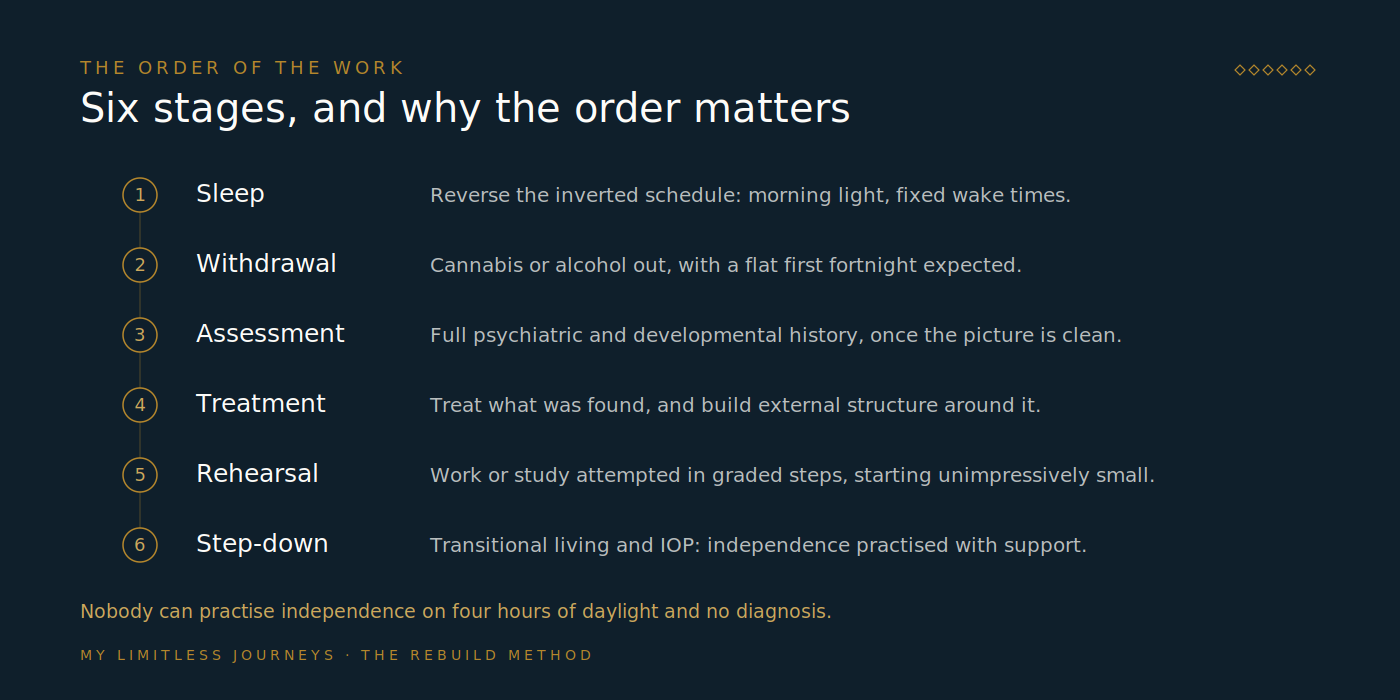
So the sequence is fixed. Sleep first, substances out, and only then a full psychiatric assessment with a developmental history that reaches back to primary school. We look specifically for ADHD, autism, learning differences and social anxiety, because these are the four most commonly missed in bright young adults and the four most likely to explain a stall that makes no sense to anyone in the family. Where a client agrees, we ask parents for their account of childhood, which frequently supplies the detail that reframes everything.
Through the four domains.
The Rebuild Method is well matched to this problem, because the work is at least as much environmental as psychiatric.
Body. The circadian repair is the first and highest-yield intervention: morning light, fixed wake times, food at regular hours, training in the afternoon. Mood, attention and anxiety all improve measurably once the days are the right way round, and no other part of the plan is reliable before that.
Mind. Treatment of whatever the assessment found, using CBT for the avoidance and the catastrophic predictions about work and study, DBT skills where emotion regulation is the barrier, and trauma work where it is indicated.
Life. The launch itself, practised rather than discussed. Daily structure with real responsibilities, life skills from cooking to appointments to money, and graded steps back toward employment or study, starting well below what anyone considers impressive.
Self. Years of being the family disappointment leaves a mark. Values work asks what this person actually wants, separately from what has been expected, which is often the first time anyone has asked.
A stay, and what comes after.
Residential care is the right level when substance use needs to stop under supervision, when the assessment cannot be done at home, or when years of outpatient appointments have not shifted anything. It is where sleep gets repaired and the diagnosis gets made.
But for this population the step-down matters more than the stay. Going straight from a structured house back to the childhood bedroom undoes most of the gain, which is why transitional living alongside IOP is usually the recommendation: independence practised with support, a job or a class attempted while someone is still there to debrief it. Our comparison of transitional living and sober living explains the difference.
For parents.
You are usually the one making the call, and you are usually exhausted, guilty and out of ideas. A few things are worth knowing. Your adult child cannot be admitted without their consent, so the first work is often with you rather than with them, learning how to raise it, what to stop funding, and how to hold a boundary without ending the relationship. Accommodation is the trap here as it is elsewhere: the meals delivered to the door, the phone bill, the rescued deadline. Every one of them is an act of love, and together they make the stall sustainable. Our families hub and our page on when they refuse treatment go through this properly, and family sessions continue throughout the stay.
- Mental health treatment at MLJ. The hub for every condition.
- Anxiety. The condition most often behind the avoidance.
- ADHD. Frequently missed in bright young adults.
- Transitional living. Where the launch is actually practised.
- When they refuse treatment. What parents can do first.
- Burnout or substance use?. Telling the difference in a young adult.
This guide is educational and is not a substitute for medical advice. If someone is in immediate danger, call 911.